Brags
and Blunders of Lester Donald Earnest at https://web.stanford.edu/~learnest/
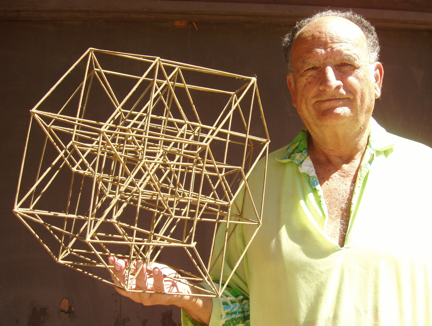
Les in 2004 with his 3D Drawing of a 6D Hyper-Cube, also
called a Super-Hyper-Tesseract
Bad Boy with Good Luck.
At age 88 I am widely viewed as an arrogant badass, with some justification,
perhaps because of my combative style that reportedly began at an early age. I
also like to expose corruption wherever I find it, which qualifies me as a
whistle-blower or troublemaker, depending on your viewpoint. I even expose my
own corruption, such as my having helped create the biggest fraud of the 20th
Century (the SAGE air defense system) and the biggest so far in the 21st
Century – the field of AI (artificial intelligence), now being exploited by
dozens of universities and hundreds of corporations even though AI is a
fantasy. I also worked for a decade as a pirate, stealing money from taxpayers
and giving it to Wall Streeters.
To make things worse, I now immodestly claim to be the most successful innovator in world history. You may reasonably
be suspicious of that claim, since you probably never heard of me. The reason I
have not been talked about much is that I did my inventing quietly in an
oddball way: open-source, taking no patents and making detailed documentation
freely available to anyone who wanted it. Other people have developed
commercial versions of my inventions that have brought in hundreds of billions
in profits, but they naturally did not give me a nickel.
I accidentally played a unique role in creating the Internet and am
still working on making it better. I also invented a lot of other technologies
that have been in use around the world for up to five decades. Some of my
inventions have not yet matured, such as self-driving vehicles, the development
of which I initiated in 1966. It was then picked up by others and only now is
coming into practical use.
I came to Stanford University in 1965 and created SAIL (Stanford
Artificial Intelligence Laboratory), which became a research success that spun
off many companies. The four most valuable publicly traded corporations in the
world at the end of 2018 were either SAIL spinoffs or were based on my
inventions or both, as discussed below.
I became a cyclist in 1933 and am still riding, having so far covered a
distance equivalent to six times around the world at the equator and am still
at it. I also radically changed the sport of bike racing by first rewriting all
the USA racing rules in 1979 and getting them accepted. I then officiated at
the 1984 Olympics in Los Angeles and learned that the USA team had unethically
used blood doping, so I introduced a rule against that and moved further ahead
by adding a rule requiring that strong helmets be worn, which involved a bloody
political battle. However, after the rest of the world saw that those rules
worked well, they were adopted around the World, including national
organizations, Olympics, World Championships and the Tour de France. As a
result, blood-doping crooks such as Lance Armstrong got nailed and thousands of
lives have been saved world-wide. I am proud of that.
A number of my proposed innovations have not yet been adopted and
perhaps never will be, such as my proposal to keep track of time in a uniform
way around the world while getting rid of months named after ancient Roman
Emperors. I also claim to have figured out why each of us make hundreds of bad
decisions each day because of fantasies embedded in our brain DNA, much of
which we inherited from our hunter-gatherer ancestors going back millions of
years. I am working on an article that will explain how that happened.
 An
Eye for Lies and a Tooth for Truth. I
aim to make this web site as accurate as possible and to put down some
of the many lies about computer history that appear in books, museums,
television and periodicals. However, even though I aim for accuracy in my writings,
there may be errors or broken links, so I invite comments, criticism and
counterexamples and will try to keep things straight. You can call me any day
of the year from 9am to 11pm Pacific Time on my home landline, 650-941-3984,
but for complicated matters an email is generally a better start if you can
cite or provide a link to relevant documentation by sending an email to les at cs.stanford.edu.
An
Eye for Lies and a Tooth for Truth. I
aim to make this web site as accurate as possible and to put down some
of the many lies about computer history that appear in books, museums,
television and periodicals. However, even though I aim for accuracy in my writings,
there may be errors or broken links, so I invite comments, criticism and
counterexamples and will try to keep things straight. You can call me any day
of the year from 9am to 11pm Pacific Time on my home landline, 650-941-3984,
but for complicated matters an email is generally a better start if you can
cite or provide a link to relevant documentation by sending an email to les at cs.stanford.edu.
Since I retired in 1988, becoming a professional troublemaker, I am the
default author of everything on this web site, so postings by others are
preceded by their names. Some Stanford administrators have attempted to censor
me, particularly my political comments, but my response has been consistent: Go to Hell if you can find such a place! Happily,
that has worked so far, perhaps because I am viewed as over-the-hill.
I have been writing stories since 3rd Grade, some for entertainment but
more for troublemaking. I have never gone commercial in writing but have
published several series of free newsletters aimed at coordinating attacks on
crooks and crooked corporations and am still doing that. I also have sued
several people and corporations and won all those cases, making a lot of money,
which I have used to continue the fights.
Updates.
This web site is a work in progress. If you would like to
receive notifications of new postings and resulting arguments, which are
infrequent, go to mailman.stanford.edu and subscribe to
sailaway3. To see recent postings, go to the sailaway3 Archives and click on “[Date]” in the bottom line to see them in
chronological order.
Translations.
A number of Europeans seen to have taken an interest in some of my articles and
have kindly volunteered to translate some of them into their languages, so I
have added links to these translations at the tops of some articles for Croatian, Czech, Estonian, Finnish, Georgian, Polish, Portuguese, Turkish, and Ukrainian.
Translations of the earlier version of my article on the Stanford Cart
(the first attempt at a self-driving vehicle) are still available in Bulgarian
and Russian
but the versions in German, Macedonian, and Romanian,
are no longer online.
I happened to stumble into the field of digital electronics in 1949, then
graduated from Caltech in 1953 with a BSEE degree, then avoided being drafted
into the Army and sent to the War in Korea by volunteering to be an Aviation
Electronics Officer in the Navy, where I did digital flight simulations of both
manned aircraft and missiles. When I completed that service in 1956, I went to
MIT to help design a high-tech air defense system called SAGE
(Semi-Automatic Ground Environment), which became the first computer network
but turned out to be a fraudulent air defense system. The MIT administration
eventually figured that out and backed away by creating two very profitable
“nonprofit” corporations called Systems Development Corporation (SDC),
a spinoff from the RAND Corporation in Santa Monica, and the MITRE
Corporation, a spinoff from MIT, then pushed lots of their earlier recruits
into them.
Meanwhile, crooked corporations such as IBM, AT&T, GE, Boeing,
Lockheed, and Convair that had started SAGE with the help of MIT, the Defense
Department, and the U.S. Congress, used it to steal trillions of dollars from
American taxpayers over the next 25 years, making it the biggest fraud of the
20th Century.
Open-source was standard practice in the early years of computing and
the ACM
computer society published a journal devoted to sharing programs, on which I
served as a reviewer for a number of years. However, IBM and some other corrupt
capitalists eventually got software patenting legalized so they could make more
money, which was brought about by our corrupt legislative scheme in which it is
legal to bribe legislators by calling it a “campaign contribution.”
Meanwhile, those of us who understood how well open-source worked
continued using it to create the Internet, which advanced rapidly and is still
going that way today, with more work to do. Open-source is far more efficient
than the corrupt patent-based, capitalist scheme that we inherited from the
British caste system, even though Americans did a Brexit in the late 1700s.
Because Americans have lived in a grossly undemocratic and corruptly
capitalist society from its beginning, public media that encounter open-source
oddballs like me first look down their noses at us, then avert their attention
back to measuring the importance of inventions based on the profits they bring
in. Meanwhile, we oddballs continue to assess inventions based not on dollars
but on sense: how much do they improve the quality of life?
Nevertheless, based on corrupt capitalist criteria, I believe I still
qualify as the most successful innovator in world history though I admit that I
have not done the numbers yet. If I had received just 10% of the net profits
made by commercial corporations using my inventions, then I think I would be
the richest person on earth today. Nevertheless, without getting a nickel from
my inventions, some of my early personal investments did blossom, making me a
multi-millionaire and, having had more assets for the last 40 years than I
would need for the rest of my skinflint life, I have given more than half of it
away so far, mostly to my three kids (now in their 60s) and a lot to
universities and other entities that are doing good work.
Oddball
Biography. Happily,
I’ve had an enjoyable life and have
16 descendants so far, including 6 great-grandchildren with more to come. I
have decided to live to age 112, so as to see some great-great-grandchildren
and maybe some great-great-great-grandchildren.
I was born in San Diego in 1930 and grew up there as a bicycling,
body-surfing, bad-boy. After rising through the ranks of the Cub Scouts I was
dishonorably discharged for artistic misconduct, so I never got to be a Boy
Scout. I was raised under the influence of my dad as a Protestant right-wing
Republican bigot who hated niggers, coons, kikes, fags, Latinos, chinks, and
japs while overlooking the fact that my mom got along with people of all kinds,
initially as a grammar school teacher, then a Junior High teacher, then Vice
Principal, then, having earned a PhD from USC in her “spare time” while raising
two kids, she became a beloved college professor at San Diego State, where she
was called Dr. Sue. The girls in her classes tried to emulate her while some of
the older boys tried to date her.
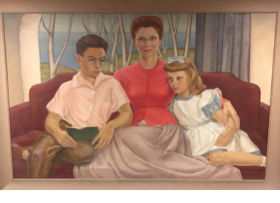 Here
is a family portrait from early in WWII, after my dad went off to create some
defense plants in the Midwest. The artist was the semi-famous Belle Baranceanu,
a friend of my mom, and this portrait has been shown in a number of art museums
over the years. That’s me on the
left, my mom in the middle and my sister Pat on the right, with a cleaned-up
version of San Diego Bay in the background.
Here
is a family portrait from early in WWII, after my dad went off to create some
defense plants in the Midwest. The artist was the semi-famous Belle Baranceanu,
a friend of my mom, and this portrait has been shown in a number of art museums
over the years. That’s me on the
left, my mom in the middle and my sister Pat on the right, with a cleaned-up
version of San Diego Bay in the background.
Being a bad boy, while posing for this portrait I often looked around
with my eyes, wiggled my eyebrows, and learned to move my ears independently.
For some reason, just after completing this portrait, the artist entered a
mental institution.
Concurrently, I and my best buddy, Bobby
Bond, got interested in cryptography and found the only book then available on
that topic. We then used it to create an advanced cryptographic scheme and I
carried my one-page copy of our crypto sheet folded up in my pocket glasses
case, since I had also become myopic.
Unfortunately, it slipped out of my pocket while riding a streetcar home
from the beach one day and evidently was turned over to the FBI, to whom it
looked like the work of a Japanese spy, given that we were early in WWII. A
bunch of agents reportedly worked for months to find me and were disappointed
to learn that I was only 11 years old.
Moving On. I continued on my bigoted path for
many years until after I voted for Richard Nixon over John F. Kennedy, then
figured out that I was on the wrong track and eventually evolved into an
atheist, anti-capitalist who aims to destroy Wall Street and other piracy
organizations around the world.
I have since accomplished quite a bit, in spite of having survived 15
brushes with death so far and retiring in 1988 because of a misdiagnosed
physical ailment that put me in a mental fog for 14 years. Happily, I eventually
got it fixed and am again now going strong, both mentally and physically,
though I am having increasing problems with anomia (inability to retrieve
proper nouns, including people’s names), but am generally able to work around
that using search engines, which I invented in 1961.
 Computer Networks
have evolved to create the world-changing Internet based on seven main
inventions so far, with more to come. Only one person in the world contributed
to more than three of those inventions. That was me – I accidentally
contributed to six. To see more about the initial developments, including what
should happen next, click on the globe to the left.
Computer Networks
have evolved to create the world-changing Internet based on seven main
inventions so far, with more to come. Only one person in the world contributed
to more than three of those inventions. That was me – I accidentally
contributed to six. To see more about the initial developments, including what
should happen next, click on the globe to the left.
The first computer network was the SAGE air defense system,
which was started by MIT in the 1950s and was a technological marvel but an
operational fraud in that they pretended that bombers would not use radar
jamming, which all have done since WWII. This was a product of the
Military-Industrial-Congressional-Conspiracy (MICC), which President Eisenhower
referred to as the Military-Industrial-Complex. It was created to enrich a
number of corrupt corporations, including IBM, AT&T, GE, Boeing, Lockheed,
Convair, etc., but that fact was classified SECRET so that if anyone talked
about it openly they would go to jail. Similar schemes are being used today to
hide the many fake U.S. defense systems still under development by the Defense
Department at the expense of taxpayers.
Some other MIT people, led by Prof. John McCarthy,
carried the SAGE technology a step further by inventing general-purpose
timesharing, which enabled people to share a computer concurrently. That was
then used in the first general-purpose computer network, also initiated by MIT
people and called Arpanet. The main technologies that came out of that project
were interactive computing (as opposed to the awkward batch processing) and
packet-switching using modems, though those terms were not introduced until
later.
Arpanet used a specialized network that was not available to the public
but a group at Stanford led by Prof. Vinton Cerf then developed Internet
Protocols that allowed various kinds of communication schemes to be
interconnected so as to create the Internet.
One more development was the World-Wide-Web,
introduced by Tim
Berners-Lee,
a Brit working at CERN, which standardized graphical interfaces,
enabling interactive graphics such as drawing or selecting part of an image to
work on a wide variety of display terminals. The ongoing development of this
scheme is continuing under Berners-Lee, who now does it at MIT.
Thus, MIT has played a significant part in developing networking
technologies and these developments have all been done in open-source mode,
enabling rapid progress. I expect more such developments will soon improve
security and enable a more versatile and useful Internet. For more details,
click on the global planet above.
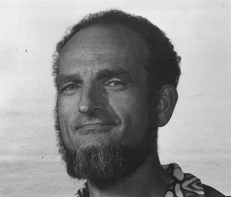 Lester Earnest (1930-2043), was born in San
Diego, California, and enjoyed bicycling, body surfing and being a
bad boy but eventually matured into a happy badass troublemaker.
Lester Earnest (1930-2043), was born in San
Diego, California, and enjoyed bicycling, body surfing and being a
bad boy but eventually matured into a happy badass troublemaker.
After a medical
scare in early 2016, he decided to write a Bucket List
of things to accomplish and, in order to complete it, plans to live to age 112.
Then in May 2043 he plans to be shot in the back while running away from a
jealous husband and have his body turned over to the Stanford Medical Group for
use in training future surgeons.
He invented a lot
of things that are now in use around the world and, having accomplished quite a
bit while doing a poor job of publicizing it, he is now trying to remedy that
by converting this web site to full brag mode. Here are some inventions that
are now in use around the world, or soon will be, that he initiated, often with
help from colleagues.
1. Spelling checker (1961), which was
part of the first cursive handwriting recognizer. It was added to text editors
in the 1970s,
2. Search engine (ROUT, 1961), an idea
that was reinvented by others about 35 years later and blossomed in the new
millennium in Google and others.
3. SAIL facility (DIY-Office,1966)
provided everyone with computer access but with few secretaries. Everyone was
expected to prepare their own documentation.
4. Self-driving vehicle (Stanford Cart,
1966) which, over 50 years later is about to blossom,
5. Digital photography (1967), which
continues to blossom,
6. Document compiler with spreadsheets,
automatic indexing and other advances (PUB, 1971), done in collaboration with
Larry Tesler, which gave rise to a number of more
advanced documentation systems,
7. Social networking and blogging
service (FINGER, 1972), which got ripped off by the corrupt Facebook, which Les
aims to destroy.
8. Online restaurant reviews
(California YumYum, 1973), one of the many modern
versions of which is on yelp.com,
9. Computer controlled vending machine
(Prancing Pony, 1974), a scheme now widely used,
10. Network news service (NS, 1974), done in collaboration with
Martin Frost, with many modern versions now,
11. Lots more – see my personal web page.
I believe that those inventions generally improved the quality
of life, which was my goal. For some reason, public media measure the success
of inventions by the amount of profits they bring in, which I view as nonsense,
but on that basis, it appears that the value of my inventions exceeded those of
anyone else, having brought in many hundreds of billions of dollars, though I
haven’t done the math because I don’t care.
I did all that inventing in
open-source mode, taking no patents, and freely provided documentation to
anyone who wanted it. I considered it an honor when someone turned one of my
inventions into a multi-billion-dollar product even though they never gave me a
nickel.
If I did all that, you may wonder,
why have you never heard of me? It is mainly because, unlike others, I did it
quietly without hiring publicists to call attention to my accomplishments or to
distort the facts so as to expand the scope of my brags, as was done for my old
friend Doug Engelbart and an arrogant twit named Steve Jobs, who I had
introduced to interactive computing along with Steve Wozniak, when they visited
our Stanford Artificial Intelligence Laboratory (SAIL) in 1975, a year before
they ate the Apple.
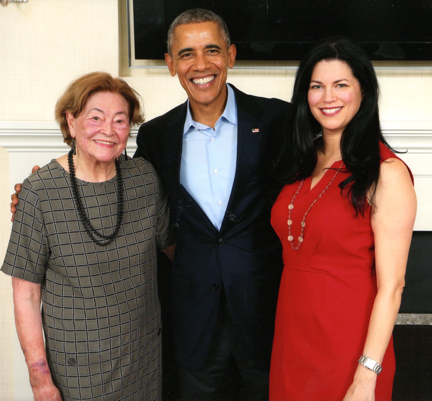
My wife Marian and her daughter Carrie made friends with a
prominent Irishman
Marian is a retired PhD psychologist. Carrie worked as a
model in Paris and elsewhere during college and is now a photographer and mom. O’Bama and I each have substantial Irish heritage and we
both now enjoy the freedom of retirement while still stirring the pot.
 Computer networks (1953-) are a result of seven main
developments so far, with more to come. Click on the photo at left for more
details. The Internet is a result of the following seven main developments,
with more to come.
Computer networks (1953-) are a result of seven main
developments so far, with more to come. Click on the photo at left for more
details. The Internet is a result of the following seven main developments,
with more to come.
· First
Computer Network: SAGE air defense system, initiated
by MIT in the early 1950s using four main inventions: core memory, Interactive
computing, packet switching, and large screen graphic displays, and built by
corrupt contractors. In operation 1958-1982 even though it never worked. Thus,
MIT played a major part in creating the Internet. By chance, Lester Earnest
contributed to each of the above developments other than core memory and the
additional inventions just below and is evidently the only person in the world
who did that.
· General
Purpose Interactive Computing: timesharing systems, developed at
MIT. Began operating in 1962 and went commercial in 1965.
· General
Purpose Computer Networking, initiated by people from MIT and
funded by the Defense Department’s Advanced Research Projects Agency (ARPA),
resulting in the ARPANET, which largely interconnected academic institutions.
· Network
Interconnections: Internet Protocols developed at
Stanford University, released in 1974 and eventually adopted widely, forming
the Internet. Also called TCP/IP.
· Standardized
Graphical Terminal Interface: World-Wide-Web, started at CERN in
Switzerland in 1990, came into widespread use by 2000 and its standards are now
maintained at MIT.
 Cyclops USA (1979-2043)
is an irregular journal of bicycle racing, proposed reforms and helmet
standards. It was initially published in pamphlet form and switched to the web
in the new millennium.
Cyclops USA (1979-2043)
is an irregular journal of bicycle racing, proposed reforms and helmet
standards. It was initially published in pamphlet form and switched to the web
in the new millennium.
I began
cycling in 1933 and my wife and I were drawn into bike racing in 1972 by our two
sons. I was initially successful in improving many racing rules
while liberalizing clothing regulations and in 1979 I completely rewrote the American
rules to make them less ambiguous, adding penalty standardization, and got them
adopted.
In 1984, I wrote the first medical
control rules for cycling and got them adopted. After investigating the
unethical but legal use of blood doping by the American cycling team in the
1984 Olympics, I introduced a rule prohibiting that practice, which then spread
around the world in many sports and eventually nailed Lance Armstrong
and his fellow crooks.
After a lengthy battle, I also got
a rule adopted in 1986 requiring that strong helmets be worn. It too spread
around the world and has since saved thousands of lives.
In 1993, I
initiated the creation of a new national bike racing association called USA
Cycling. However corrupt commercial interests bribed their way into control of
the legislative process and succeeded in amending it to give a majority of the
seats on the Board of Directors to commercial interests who made up less than
1% of the participants in the sport. Unfortunately, despite repeated attempts
at reform, the crooks still control this sport as well as most of the US
Olympic Committee and its subordinate athletic organizations.
Meanwhile, I have organized an
underground group of former and current participants in bike racing aimed at
reorganizing an overthrowing the crooks. Our name reflects the way we plan to
do it: ROSA (Reform the Olympic Sports Act).
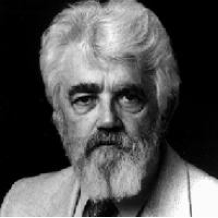 John McCarthy (1927-2011)
was a world-class innovator who introduced the term “artificial intelligence”
(AI) and did a lot of pioneering work in that field. He was raised as a
Communist, then later toured Russia, learning to speak the language and made
friends with a number of Russian scientists.
John McCarthy (1927-2011)
was a world-class innovator who introduced the term “artificial intelligence”
(AI) and did a lot of pioneering work in that field. He was raised as a
Communist, then later toured Russia, learning to speak the language and made
friends with a number of Russian scientists.
1943-49 Graduated from the California
Institute of Technology (Caltech) in mathematics then spent another year there
in graduate studies.
1950-53 went to Princeton University and
received a PhD in 1951, then taught there.
1953-55 Assistant Professor of Mathematics
at Stanford.
1955-58 Assistant Professor of Mathematics
at Dartmouth College and co-editor of a book with Claude Shannon titled Automata
Studies (1956). Also introduced the term “artificial intelligence” at a
summer conference there.
1958-62 Assistant Professor of Communications
at MIT and with Marvin Minsky cofounded the AI Project there. Created the list
programming language called LISP, which has been widely used in AI work, and
oversaw creation of one of the earliest chess-playing programs. He also wrote a
paper on how to do general purpose timesharing that inspired several groups in
the MIT community to develop such systems. That technology soon dominated the
world of computing and enabled computer networking.
1962-1965 Returned to Stanford as a Professor
of Mathematics and started a new AI Project funded by ARPA (Advanced Research
Projects Agency), a part of the U.S. Defense Department. When a Computer
Science Department was formed in early 1965, McCarthy joined it, as did Edward
Feigenbaum. They then put together a proposal to ARPA for an expanded AI
research facility that was funded by ARPA.
1965-2000 Lester Earnest joined McCarthy and
Feigenbaum in late 1965 and set up the new SAIL research lab (see below). In
1980, after SAIL moved back to the main campus, McCarthy shut it down and fired
Earnest, but asked him to come back four years later, which he did. McCarthy
retired in 2000 and passed away in 2011. Meanwhile Sebastian Thrun revived SAIL in 2003 and it has continued.
 Planet Earth. Life first appeared on
Earth about 4 billion years ago and has evolved a lot while surviving five mass
extinctions caused by environmental disasters, the most recent being the result
of a large asteroid striking the north end of the Yucatan Peninsula about 66
million years ago, which wiped out all life above ground including the large
dinosaurs. A few small dinosaurs survived, which we call birds, but mammals
then began dominating and eventually hominids (proto-humans) appeared about 6
million years ago, evolving as hunter-gatherers for millions of years.
Adaptations to that lifestyle put a lot of genetic knowledge and fantasies in
their minds that have been passed down to us, but many of those fantasies do
not work well in the modern world of rapidly advancing technology.
Consequently, mankind is now causing the sixth mass extinction of life, which
may turn the planet over to a new species unless we can find a way to change
our ways quickly.
Planet Earth. Life first appeared on
Earth about 4 billion years ago and has evolved a lot while surviving five mass
extinctions caused by environmental disasters, the most recent being the result
of a large asteroid striking the north end of the Yucatan Peninsula about 66
million years ago, which wiped out all life above ground including the large
dinosaurs. A few small dinosaurs survived, which we call birds, but mammals
then began dominating and eventually hominids (proto-humans) appeared about 6
million years ago, evolving as hunter-gatherers for millions of years.
Adaptations to that lifestyle put a lot of genetic knowledge and fantasies in
their minds that have been passed down to us, but many of those fantasies do
not work well in the modern world of rapidly advancing technology.
Consequently, mankind is now causing the sixth mass extinction of life, which
may turn the planet over to a new species unless we can find a way to change
our ways quickly.
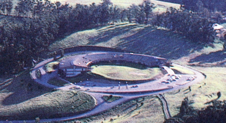 SAIL, the Stanford Artificial Intelligence
Laboratory (1966-80, 2003-) was funded by the Defense Department's Advanced
Research Projects Agency (ARPA) and Lester Earnest was recruited to create and
manage the new research lab. Earnest started by designing a new computer
research facility to fit in an incomplete building in the foothills above the
Stanford Campus, then got it built, named it SAIL, and managed it for many
years. It ran with a population of 100+ doing graduate research on various
projects in AI, mechanical engineering, electronic system design, music
composition and synthesis, and some other fields. SAIL enabled many graduate
students to earn PhDs and other degrees.
SAIL, the Stanford Artificial Intelligence
Laboratory (1966-80, 2003-) was funded by the Defense Department's Advanced
Research Projects Agency (ARPA) and Lester Earnest was recruited to create and
manage the new research lab. Earnest started by designing a new computer
research facility to fit in an incomplete building in the foothills above the
Stanford Campus, then got it built, named it SAIL, and managed it for many
years. It ran with a population of 100+ doing graduate research on various
projects in AI, mechanical engineering, electronic system design, music
composition and synthesis, and some other fields. SAIL enabled many graduate
students to earn PhDs and other degrees.
There
are many successful spinoffs from SAIL,
including the four richest corporations in the World at the end of 2018:
Apple, Alphabet, Microsoft, and Amazon. The ACM Turing Awards, which are widely
viewed as the Nobel prizes of Computer Science, provide another measure: of the
65 worldwide awards given so far, 18 have gone to people from
SAIL, which evidently is more than any
other research group in the world, even those with much larger populations.
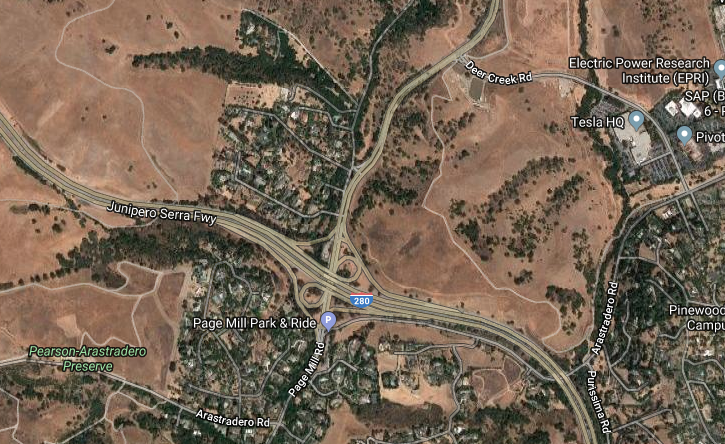 Road Safety.
The image at left shows the interchange between Interstate Freeway 280 and the
Page Mill Expressway/Road which runs along the boundary between the cities of
Palo Alto and Los Altos Hills, California, and is arguably the most dangerous
interchange in the World for non-vehicular traffic such as pedestrians,
cyclists, and people pushing baby buggies or riding in wheelchairs. In fact,
most of these potential users do no even try to get
through during rush hours because it is clear that they would die if they tried
to do that.
Road Safety.
The image at left shows the interchange between Interstate Freeway 280 and the
Page Mill Expressway/Road which runs along the boundary between the cities of
Palo Alto and Los Altos Hills, California, and is arguably the most dangerous
interchange in the World for non-vehicular traffic such as pedestrians,
cyclists, and people pushing baby buggies or riding in wheelchairs. In fact,
most of these potential users do no even try to get
through during rush hours because it is clear that they would die if they tried
to do that.
Given that this interchange
was on the main route from the Stanford Campus to SAIL, Lester Earnest spent
years trying to get it made safer, but the incompetence of the engineers who
design it and the disinterest of the various governmental agencies that are
involved has resulted in a series of injuries and a death, likely with more to
come unless there is an uprising.
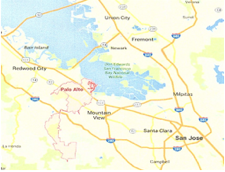 SillyCon Valley (1972-), which
some people like to call “Silicon” is the promotional name given to the
southern part of San Francisco Bay in 1971 and became a great marketing success
as the name “Silicon” was added to other places around the world. This place
had earlier developed an innovative culture, but it needs a better name. Soon
see Renaming Silly Con Valley, which will reflect the geographic
expansion of technological organizations that has taken place here.
SillyCon Valley (1972-), which
some people like to call “Silicon” is the promotional name given to the
southern part of San Francisco Bay in 1971 and became a great marketing success
as the name “Silicon” was added to other places around the world. This place
had earlier developed an innovative culture, but it needs a better name. Soon
see Renaming Silly Con Valley, which will reflect the geographic
expansion of technological organizations that has taken place here.
When I came to Stanford at the end
of 1965 and bought a house in the Town of Los Altos Hills, it was a quiet and
friendly rural community dominated by apricot orchards, with a few horse
ranches and cattle fields. There were few fences or gates, so people could walk
or ride cross-country in almost any direction. Some people now pretend that it
was called the “Valley of Heart’s Delight,” which is a myth. Now, after real
estate values have shot skyward, my home value is about 100 times what I paid
for it and the construction of many mansions has caused this place to become
very snooty. However, the headquarters of SillyCon
Valley, which earlier shifted from Stanford toward San Jose has now moved
toward San Francisco.
 Stanford Spinners. During
1963-89, five related research groups at Stanford trained hundreds of computer
scientists, engineers, musicians and others who have settled around the world
but have especially influenced the development of SillyCon
Valley. I call them spinners because they produced a lot of spinoff
organizations, products and services:
Stanford Spinners. During
1963-89, five related research groups at Stanford trained hundreds of computer
scientists, engineers, musicians and others who have settled around the world
but have especially influenced the development of SillyCon
Valley. I call them spinners because they produced a lot of spinoff
organizations, products and services:
SAIL (Stanford Artificial
Intelligence Laboratory),
HPP (Heuristic Programming Project),
CCRMA (Center for Computer Research
in Music and Acoustics),
NPDP (Network Protocol Development
Project),
TeX+MF
(TeX/METAFONT Project)
Most started as parts of SAIL, then blossomed separately.

Rush to Microbial Judgement
The Canadian rock band called Rush was popular around the
world for decades but have now retired. Above, left to right, are Geddy Lee (bass, vocals, keyboards), Neil Peart (percussion, lyrics), and Alex Lifeson (guitars). This band
created eccentric hits like “Natural Science” and “Tom Sawyer” and three new species of microbe
were recently named after them due to their former long hair and what
scientists describe as “rhythmic wiggling.”
Neal Peart also wrote several popular books and happens to be Les’s stepson-in-law.
Visions of How the World Works and
How to Fix It
 Views of Planet Earth. Life first appeared on Earth about 4 billion years ago and has
evolved a lot while surviving five mass extinctions caused by environmental
disasters, the most recent being the result of a large asteroid striking the north
end of the Yucatan Peninsula about 66 million years ago, which wiped out all
life above ground, including the large dinosaurs. A few small dinosaurs
survived, which we call birds, but mammals then began dominating and eventually
hominins (proto-humans) appeared about 6 million years ago, evolving as
hunter-gatherers for millions of years. Adaptations to that lifestyle put a lot
of genetic knowledge and fantasies in their minds that have been passed down to
us, but many of those fantasies do not work well in the modern world of rapidly
advancing technology. Consequently, mankind is now causing the sixth mass
extinction of life, which may turn the planet over to a new species unless we
can find a way to change our ways quickly.
Views of Planet Earth. Life first appeared on Earth about 4 billion years ago and has
evolved a lot while surviving five mass extinctions caused by environmental
disasters, the most recent being the result of a large asteroid striking the north
end of the Yucatan Peninsula about 66 million years ago, which wiped out all
life above ground, including the large dinosaurs. A few small dinosaurs
survived, which we call birds, but mammals then began dominating and eventually
hominins (proto-humans) appeared about 6 million years ago, evolving as
hunter-gatherers for millions of years. Adaptations to that lifestyle put a lot
of genetic knowledge and fantasies in their minds that have been passed down to
us, but many of those fantasies do not work well in the modern world of rapidly
advancing technology. Consequently, mankind is now causing the sixth mass
extinction of life, which may turn the planet over to a new species unless we
can find a way to change our ways quickly.
In 1988, because I had more assets than I would need for the rest of my
life and was embarrassed by the mental fog I was living in, which went on for
fourteen years (1985-1999), I chose to retire from Stanford University, then
switched my primary field of interest from computer science to mythology. I had
figured out that human brains had many fantasies from birth, encoded in the DNA
that initiates our brains, so I began trying to figure out when and why those
fantasies were implanted. I began by writing a 1989 computer journal article
refuting racial classifications of all kinds that are in use around the world
but are based on scientific nonsense. However, because our world is full of
scientific nitwits, including the American government, American medical
professionals, and their colleagues, the Ku Klux Klan, those fantasies persist,
as discussed further below.
 Travel.
Over the years I have travelled all over the Earth by foot, bicycle, tricycle,
motorcycle, car, bus, train, boat, ship, aircraft and look forward to rocket
travel to get around faster but do not plan to join the dimwits planning trips
to the Moon, Mars, etc. I do hope they will be accompanied by robot diggers to
bury them, since most will arrive dead due to solar and spacial
radiation.
Travel.
Over the years I have travelled all over the Earth by foot, bicycle, tricycle,
motorcycle, car, bus, train, boat, ship, aircraft and look forward to rocket
travel to get around faster but do not plan to join the dimwits planning trips
to the Moon, Mars, etc. I do hope they will be accompanied by robot diggers to
bury them, since most will arrive dead due to solar and spacial
radiation.
I have cycled in nearly all USA states as well as on all continents
except Antarctica and have ridden around many islands. Happily, while doing
that I have never been touched by a motor vehicle.
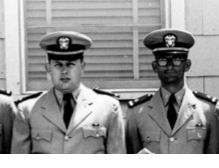 Racism:
As you can see, the picture at left shows a “white” and a “black” guy, who get
treated differently by our society. Since their classification is supposedly
based on skin color (i.e. reflectance), in order to make that distinction
accurately it is essential to define the reflectance level that separates
whites from blacks, but that has never been done. In other words, racial
classification is a fantasy. It was invented about 600 years ago by some arrogant
jerks living in northwest Eurasia who then became the top-level killers on
Earth and successfully took control almost everywhere while killing off a
number of superior cultures around the world.
Racism:
As you can see, the picture at left shows a “white” and a “black” guy, who get
treated differently by our society. Since their classification is supposedly
based on skin color (i.e. reflectance), in order to make that distinction
accurately it is essential to define the reflectance level that separates
whites from blacks, but that has never been done. In other words, racial
classification is a fantasy. It was invented about 600 years ago by some arrogant
jerks living in northwest Eurasia who then became the top-level killers on
Earth and successfully took control almost everywhere while killing off a
number of superior cultures around the world.
They then
wrote world histories that are fantasies but are generally accepted today.
Meanwhile, modern historians continue to write fantasies, which are widely
accepted as real even though they are full of lies, in many cases because the
writers were hired by corporations or rich guys to do that. Thus, fantasized
histories cause erroneous thinking not only about racial classifications but
about all human life.
I entered
this fight in 1963 when my family and I moved from semi-racist Massachusetts to
deeply racist Virginia, where everyone was supposed to be either “White” or
“Colored”. I started listing my race as “Mongrel” based on my observation that
no existing racial classification system had a scientific basis. That got me
into trouble with both state and local authorities as well as the Defense
Department, but it ended well. Incidentally, I am the guy on the right in the
above photo but I turned “white” every winter when I
got out if the sun.
 Fantasia.
Each of us makes hundreds of decisions each day about such things as what to do
next and how to do it and our decisions are generally instantaneous rather than
based on a careful analysis of alternatives. That is because our brains are
prewired from birth with a lot of knowledge about how the world works, how to
perceive it, and how to take actions – all recorded in our DNA from birth,
courtesy of our parents.
Fantasia.
Each of us makes hundreds of decisions each day about such things as what to do
next and how to do it and our decisions are generally instantaneous rather than
based on a careful analysis of alternatives. That is because our brains are
prewired from birth with a lot of knowledge about how the world works, how to
perceive it, and how to take actions – all recorded in our DNA from birth,
courtesy of our parents.
That
knowledge was put there by evolution, which automatically selects for things
that enhance one’s ability to survive and reproduce. However, some of the
things that worked were actually fantasies rather than accurate representations
of reality and, given that the world has since changed, some of those fantasies
no longer work in the modern world and are leading us in directions that may extnguish our descendants.
I happened
to get involved in digital electronics development in 1949 and have followed it
ever since, so I know much of that history first-hand, but after reading
hundreds of articles and books on that subject I have found almost none that
give accurate accounts of what actually happened. Furthermore, I made
donations, both equipment donations and cash, to the first Digital Computer
Museum, in Boston, then was a founding member of its successor, the Computer
History Museum in Mountain View, California, and have continually donated big
money to them, hoping I could get them to tell the truth, but I have failed so
far. As things stand, the Computer History Museum should be renamed as the
Computer Fantasy Museum.
Beginning
in 1985 I found myself in an odd mental fog, which I was able to self-diagnose
as caused by sleep apnea, but when I went to my Stanford doctor and asked to be
tested for that, she refused, saying “You are much too lively to have sleep
apnea.” I foolishly believed her and went on for 14 years in a depressed,
semi-comatose state. During that time, my mind started revealing more about a
number of fantasies that were embedded in my brain, so I started looking into
why, how, and when those fantasies got into the DNA of my ancestors. Because of
my malfunctioning brain, I ended up retiring from Stanford in 1988, then wrote
a computer journal article (CACM) about how racism got into our brains, a topic
discussed below in more detail.
I now claim
to have figured out when and how a bunch of other fantasies got into our DNA
and will shortly post an article on this web site that will explain how that
happened, why it is causing modern humans to make billions of bad decisions
each day, and how we and our descendants are likely to be wiped out soon unless
we begin dealing with this problem in a rational way.
 Bucket List. At left
is Les’s predicted appearance in 2043, when he plans
to croak at age 112.
Bucket List. At left
is Les’s predicted appearance in 2043, when he plans
to croak at age 112.
This
Bucket List was started in early 2016 after Les was told by a doctor that he
had pancreatic cancer, which meant that he had only a few months to live.
Happily, a short time later that diagnosis was changed to having a pancreatic
tumor, the same thing that killed Steve Jobs, but much less lethal. Les knew
Jobs casually, having introduced him and his friend Steve Wozniak to
interactive computing when they visited the SAIL computer facility in 1975 as
members of the Homebrew Computer Club. A year later they started Apple.
As
Les learned, Jobs did nothing to track his tumor, probably based on his
egotistical assumption that he was a god, and before long it turned into a
cancer that killed him. Being not quite as stupid as Jobs, Les is having annual
MRI scans to see whether the tumor has started growing. If it does, he will get
it whacked surgically, which is a somewhat dangerous operation but a better
strategy than doing nothing, like Jobs.
Les
initially compiled a list of about 25 bucket projects aimed at improving the
world, but that list has since grown. Any successes or failures will be moved
to the Brag & Blunder list above and there may be some more histories to
write. The current version of the Bucket List can be seen by clicking on the
photo on the left.