
By Right of Purchase (1918) Norma Talmadge Film Corporation/Select Pictures Corporation. Presented by Joseph Schenck. Directed by Charles Miller. Scenario by Harry O Hoyt. Camera by Edward Wynard and Alfred Moses, Jr. Cast: Norma Talmadge, Eugene O'Brien, Ida Darling, William Courtleigh, Jr. Charles Wellesley, Florence B. Billings, Hedda Hopper. 6 reels. A copy of this film is located at the Library of Congress (35 mm., some deterioration, possibly missing the last reel)
| A lobby card courtesy of Derek Boothroyd | 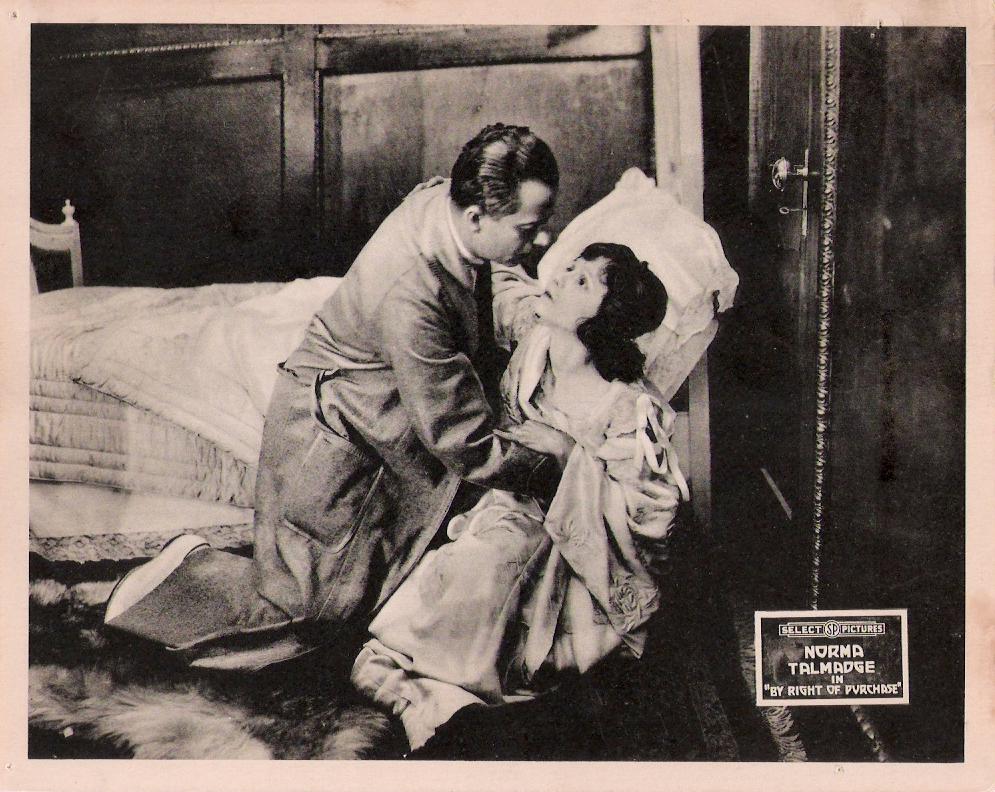 |
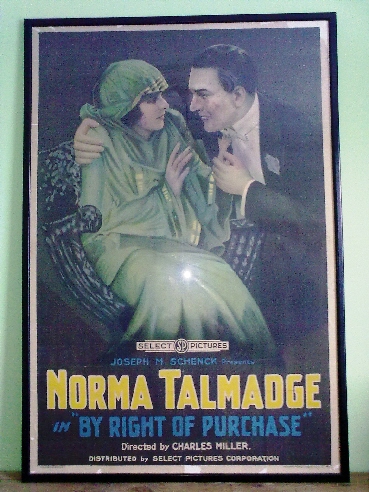 | A poster courtesy of Paul S. Marshall |
| Margot Hughes | Norma Talmadge |
| Chadwick Himes | Eugenie [i.e. Eugene!] O'Brien |
| Mrs. Hughes | Ida Darling |
| Dick Derwent | William Courtleigh, Jr. |
| Donald Nugent | Charles Wellsley |
| Madge Sears | Florence B. Billings |
Norma Talmadge has been supplied with an interesting picture story by Margery Laird Mason for her latest Select release and the scenario has been given a touch of reality by having the opening scenes set in "Hero-land," the big bazaar held at Grand Central Palace early in the winter. It is here that Margot Hughes is helping the Allied charity cause by posing as a fashionable fortune teller. And here, too, she meets Chadwick Himes, a successful young man of wealth whose position in society hasn't impaired his being a regular business man. Margot is infatuated with Dick Derwent, also in society, but basically "all wrong," and he extracts a living from precarious bucket shop manipulations. Chad Himes falls deeply in love with Margot. Since she doesn't reciprocate he offers her the odd contract of marrying her and if within two years he doesn't win her love she is not only to become free, but to be given a substantial fortune. When Margot finds from her mother that they are "on the rocks" financially Margot accepts. The bridal pair start off on a honeymoon aboard Chad's yacht, and, though it isn't specifically stated, the marriage is never actually consummated, though, of course, the ceremony has been performed. Whenever Chad would caress his bride she would remind him of his "promise." A storm arises, and with Margot quite miserable the yacht puts back to New York.
Himes, as time goes on loses faith that he will win his bride's regard, yet before his unseeing eyes she has really learned to love him. Derwent renews his friendship with Margot, who lends him money for his schemes. They being together sets the gossips' tongues wagging and Himes finally demands that she cease being seen with Derwent. Yet he discovers her coming from the man's apartment. She had gone there to demand the return of the money that she might explain all to her husband. But Chad leaves her in a rage, intent on sailing off on his yacht. Before he departs he learns the real purpose of Margot's visit to Derwent and his heart's desire is obtained when he finds her waiting for him aboard the boat--to really start off on their second honeymoon.
The picture is rather cleverly directed by Charles Miller. Just as a touch of reality was given the scenario, touches of realism were lent the action aboard the yacht. Motion inside the storm is an excellent illusion. Yet it was so strenuously done that the sides of the set wobbled with the movement.
"By Right of Purchase" is somewhat longer than the average feature length and might has been held down to the customary five reels. There are portions which could have been eliminated to accomplish that, but it makes a first-class program release. Miss Talmadge hasn't opportunity for much in an emotional way, but is characteristically good. Eugene O'Brien makes a splendid showing as Himes, and William Courtleigh, Jr. (who died on the day the picture was given a private showing) played equally well as Derwent. May Hopkins has a small but well-played bit as his mistress.
Joseph M. Schenck Presents the Charming Star Norma Talmadge in the Story of a Loveless Marriage That Ended Well
Cast.
| Margot Hughes | Norma Talmadge |
| Chadwick Himes | Eugene O'Brien |
| Mrs. Hughes | Ida Darling |
| Dick Derwent | William Courtleigh, Jr. |
| Donald Nugent | Charles Wellsley |
| Madge Sears | Florence B. Billings |
Directed by Charles Miller
The Story: Margot Hughes is a butterfly society girl who sells herself to the highest bidder. Her husband does not press his ownership "by right of purchase," and his delicacy is misunderstood by her and she thinks that love is lost to her. She goes to France to serve the cause of humanity. There they meet again and understanding comes. For the Program: A loveless marriage that turned out differently.
Norma Talmadge's newest triumph.
Advertising Phrases: Cupid reins mid shot and shell
Her bought her hand, but he won her heart.
Feature These Players: Norma Talmadge, with reference to Ghosts of Yesterday, The Secret of the Storm Country, Poppy, and The Moth, if you have played these.
Eugene O'Brien as the man she marries for money.
Stunt suggestions: Do window work with hand-lettered legends such as "Wife for Sale," "Want to buy a wife?" with instructions to apply at your theater on the playing dates to see By Right of Purchase. For lobby display get a collection of battle-front pictures from the newspapers or news service. Cut out tiny cupids from valentines or other sources and paste them against the skies of the picture. Letter a title card, "Even on the battle front Cupid manages to work his wiles and in By Right of Purchase (A Norma Talmadge picture) he brought two loving hearts together midst bursting shells. (Date)."
Advertising Aids: Two styles each, one and three-sheets. One each, six and 24 sheets. Half sheet window cards. Die-cut heralds. Lobby displays, 8x20, 11x14 and three 22x28, including pictures of star. One, two and three-column scene cuts. One-half, one and two-column star cuts. Press book.
Released in February.
[Note, there is noting about the war in the final version of the film, so they must have recut or reshot drastically before release. Isn't that a completely tasteless advertising campaign they suggest above!]
One of those plots where a woman is forced
to marry a rich man instead of the man she loves. But in this case it
turns out the man she loves is a jerk and the rich man is more or less
saintly (though Eugene O'Brien does have his obligatory scene of fighting off
his lustful urges). Norma plays her part well, but her character comes off as a selfish spoiled
brat (I think she's supposed to be sympathetic). One can't imagine
what Gene sees in her. Of course, they somehow end up together but the
characters are completely unconvincing.
Print viewed: 35 mm print at the Library of Congress.
Last revised, October 14, 2010