 |
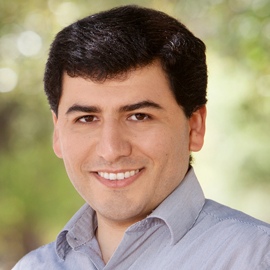
Mohsen Bayati Professor of Operations, Information and Technology at Graduate School of Business |
Activities
-
I am associate editor for Management Science (Data Science and Healthcare Management),
Operations Research (Machine Learning and Data Science), and Stochastic Systems.
Research interests (for papers click here)
- Applied machine learning in healthcare: I am interested in improving healthcare using data-driven learning and decision models.
- Graphical models and message-passing algorithms: I work on random graph models and methods motivated from statistical physics, with applications in statistical inference.
- Mathematics of learning and decision-making: I develop mathematical models and algorithms for problems that involve experimentation, learning, and personalized decision-making.
Teaching
- Winters 2013-2024: OIT 367 Business Intelligence from Big Data (Data and Decisions - Advanced)
- Spring 2015, and Springs 2018-2020: OIT 604: Data, Learning, and Decision-Making (in 2015 it was offered under a different name, OIT 637)
- Autumn 2018, Winters 2015-2017: OIT 536 Data for Action: From Insights to Applications (Co-taught with Guido Imbens)
- Spring 2012: OIT 267 Data and Decisions - Accelerated
Articles About Research
- When "Greedy" Is Good.
- Many Health Care Workers Are Emotionally Exhausted, and Technology May Be to Blame.
- Avoiding Experimentation in Online Decision-Making.
- Why Hospitals Underreport the Number of Patients They Infect.
- Why Hospital ER Wait Times Are Often Wrong.
- How Hospitals Avoid Penalties for Making Patients Sick.
- IMS Presidential Address by Erwin Bolthausen.
- How Decision Software Can Improve Health Care.
- The Big Idea: The Next Scientific Revolution.
Research Collaborators
-
Kathryn Adair,
Erjie Ang,
Michael Aratow,
Susan Athey,
Nevin C Baker,
Hamsa Bastani,
Neda Beheshti,
Jose Bento,
Sonia Bhaskar,
Margaret Bjarnadottir,
Cristian Borgs,
Alfredo Braunstein,
Mark Braverman,
Mark K. Buyyounouski,
Jennifer Chayes,
Wanning Chen,
Junyu Cao,
Lee Dicker,
Nikolay Doudchenko,
Murat. A Erdogdu,
David Gamarnik,
Margot Gerritsen,
Michael Gillam,
David Gleich,
Joel Goh,
Ramki Gummadi,
Kapil Gupta,
Nima Hamidi,
J. Michael Harrison,
Eric Horvitz,
Guido Imbens,
Adel Javanmard,
Ramesh Johari,
Satyen Kale,
Yash Kanoria,
Dmitry Katz,
Raghu Keshavan,
Abtin Keshavarzian,
Khashayar Khosravi,
Carolyn Kim,
Jeong Han Kim,
Neha Kumar,
Sara Kwasnick,
Marc Lelarge,
John Leppert,
Xi Ling,
Danqi Luo,
Yuwei Luo,
Karen Mack,
Yury Makarychev,
Andrea Montanari,
David Moore,
Shubha Nabar,
Chandra Nair,
Sewoong Oh,
Neil Panjwani,
Erica Plambeck,
Balaji Prabhakar,
Jochen Profit,
Sheng Qiang,
Zhaonan Qu,
Abolfazl Ramezanpour,
Hank Rappaport,
George Ruiz,
Amin Saberi,
Bryan Sexton,
Devavrat Shah,
Tait Shanafelt,
Alireza Sharafat,
Mayank Sharma,
Kazem Shirani,
Sadegh Shirani,
Sundeep Singh,
Amrita Sinha,
Mark Smith,
Marc Squillante,
Sandy Srinivas,
Erika Strandberg,
Daniel Tawfik,
Prasad Tetali,
Rebecca Torguson,
Ron Waksman,
Ying Wang,
Jacqueline Vallon,
Sushmita Vij,
Ruoxuan Xiong,
Riccardo Zecchina,
Stefanos Zenios
Contact Info
|
Knight Management Center |
Assistant: Sandra Davis 655 Knight Way, E324 Stanford, CA 94305 Phone:(650) 736-0939 Fax:(650) 724-7402 Email: yyyyyyy@stanford.edu yyyyyyy=srdavis |