Table of Contents — Stories on this Page
2017
- December 7, 2017 — Software in development at Stanford advances the modeling of astronomical observations
- October 16, 2017 — Stanford experts weigh in on LIGO’s kilanova binary neutron star milestone
- October 2017— Stanford’s Student Space Initiative Group (SSI) Sets Up Shop in HEPL South / End Station III
- January 30, 2017 — NASA's Fermi Gamma Ray Telescope has detected gamma rays eminating from flares on the back side of our sun
2016
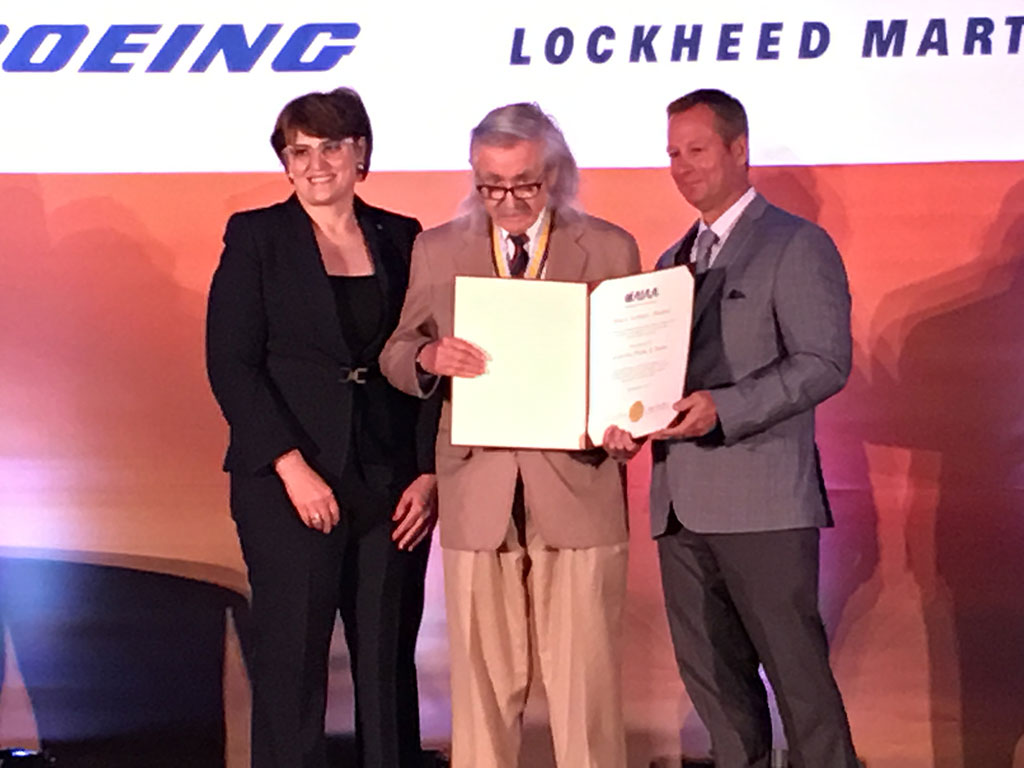
- September 15, 2016 — AIAA Honors the Stanford/NASA/Lockheed Martin Gravity Probe B Team with 2016 Space Science Award
- September 1, 2016 — Professor Daniel Palanker becomes Interim Director of HEPL
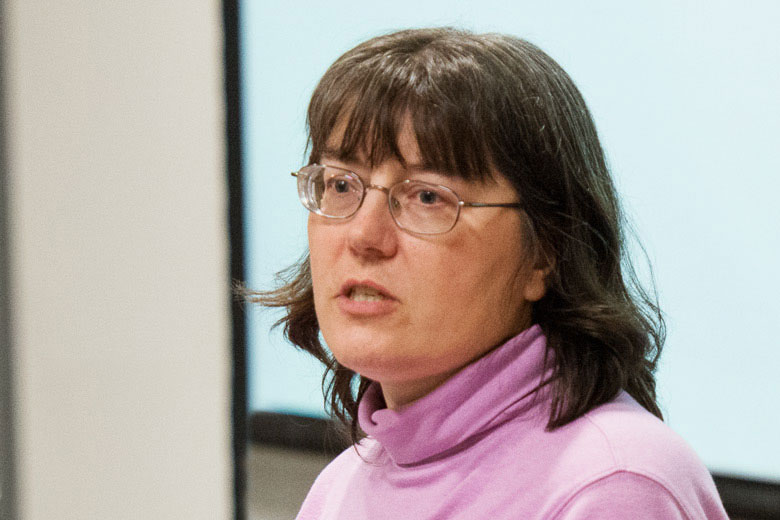
- August 2, 2016 — Physics Professor Sarah Church relinquishes post as HEPL Director to become senior associate vice provost for undergraduate education
- May 16, 2016 — Stanford engineer Bradford Parkinson, the ‘Father of GPS,’ wins prestigious Marconi Prize
- February 11, 2016 — Stanford Researchers Celebrate Their Collaboration in the Technological Advances Enabling the Long-Sought Detection of Gravitational Waves by the LIGO Observatories
2015
- November 19, 2015 — Volume 32, Issue #22 of the Journal, Classical and Quantum Gravity, Devoted Entirely to the Landmark, 48-Year Stanford/HEPL Gravity Probe B Experiment
- April 27, 2015 — Photovoltaic retinal implant developed by HEPL's Palanker Group, could restore functional sight
- April 27, 2015 — Stanford and UC Berkeley partner on NASA's new effort to detect life on other planets
- January l4, 2015 — Artificial intelligence Helps StanfordPhysicistsPpredict DangerousSolarFlares
2014
- June 19, 2014 — HEPL PhD Candidate’s Charge-Control Experiment is Flight Certified at NASA Ames, Integrated into a Saudi Arabian Satellite and Launched into Orbit Aboard a Russian-Ukrainian Rocket
- March 17, 2014 — New Evidence from Space Supports Stanford Physicist's Theory of How the Universe Began
- February 10, 2014 — HEPL Physicist, Leo Hollberg, and Two Former NIST Colleagues Share 2014 Rank Optoelectronics Prize for Their Development of Chip-Scale Atomic Clock
2013
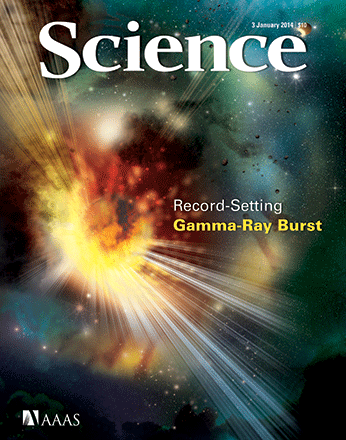
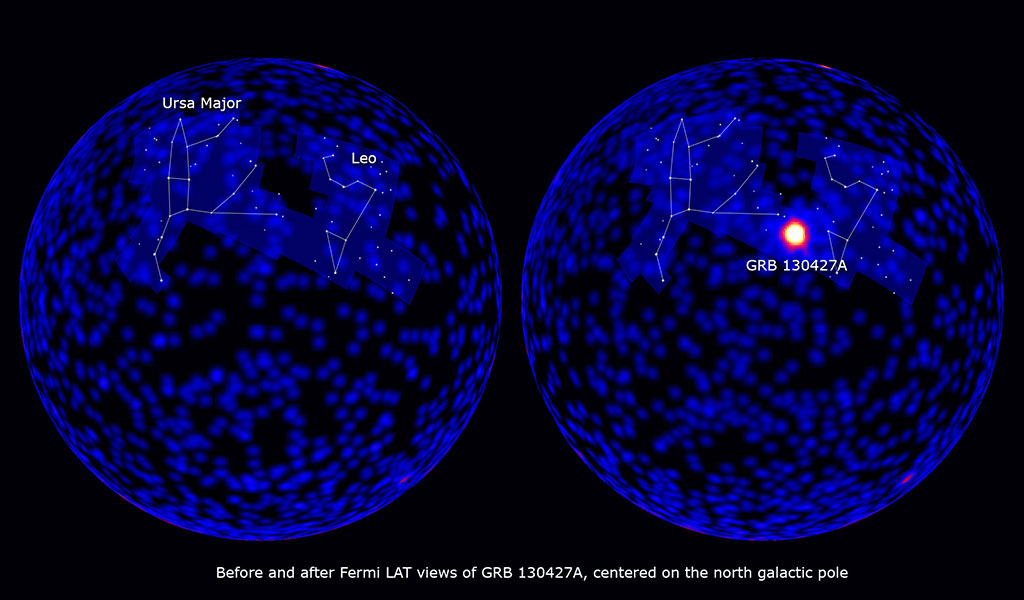
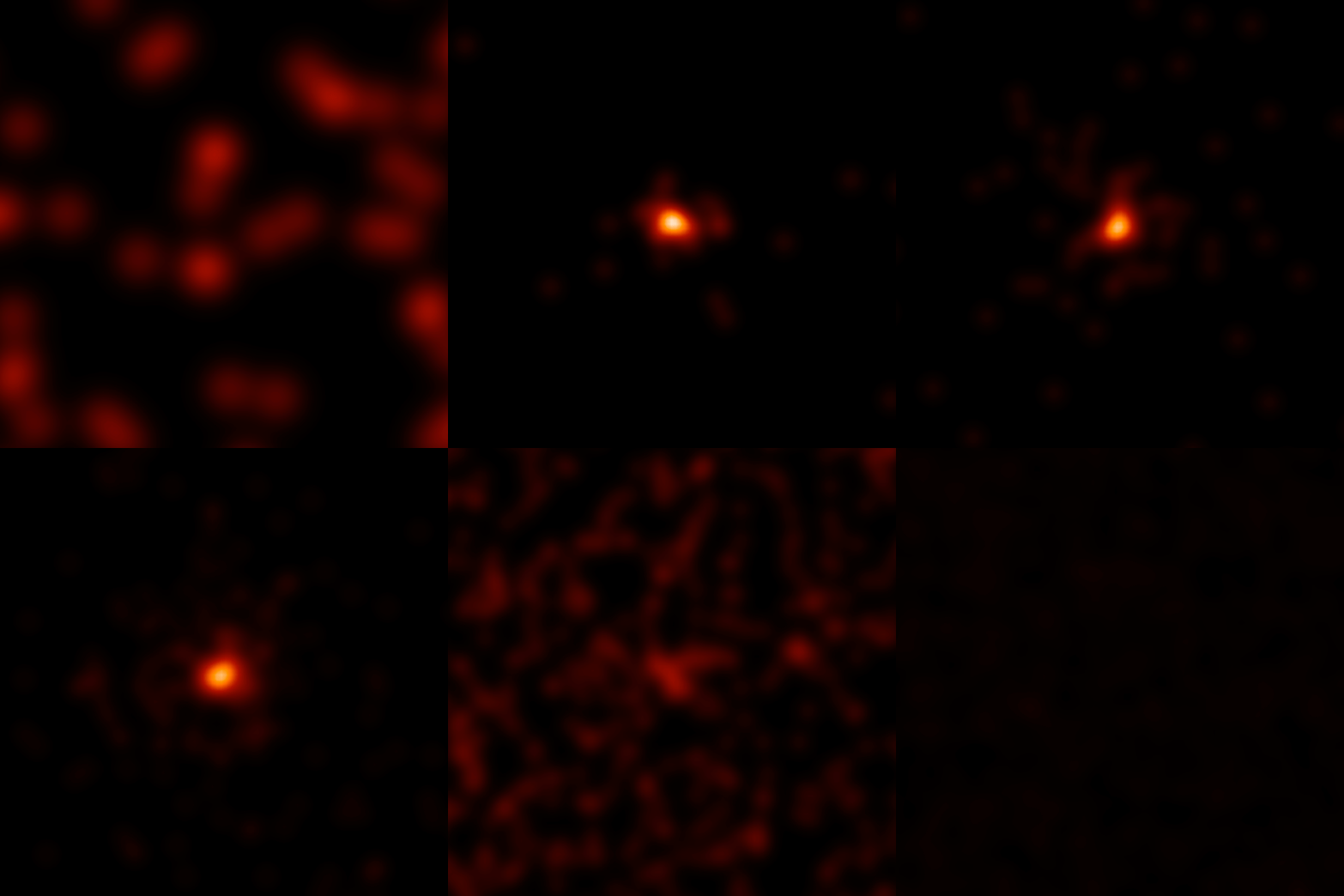
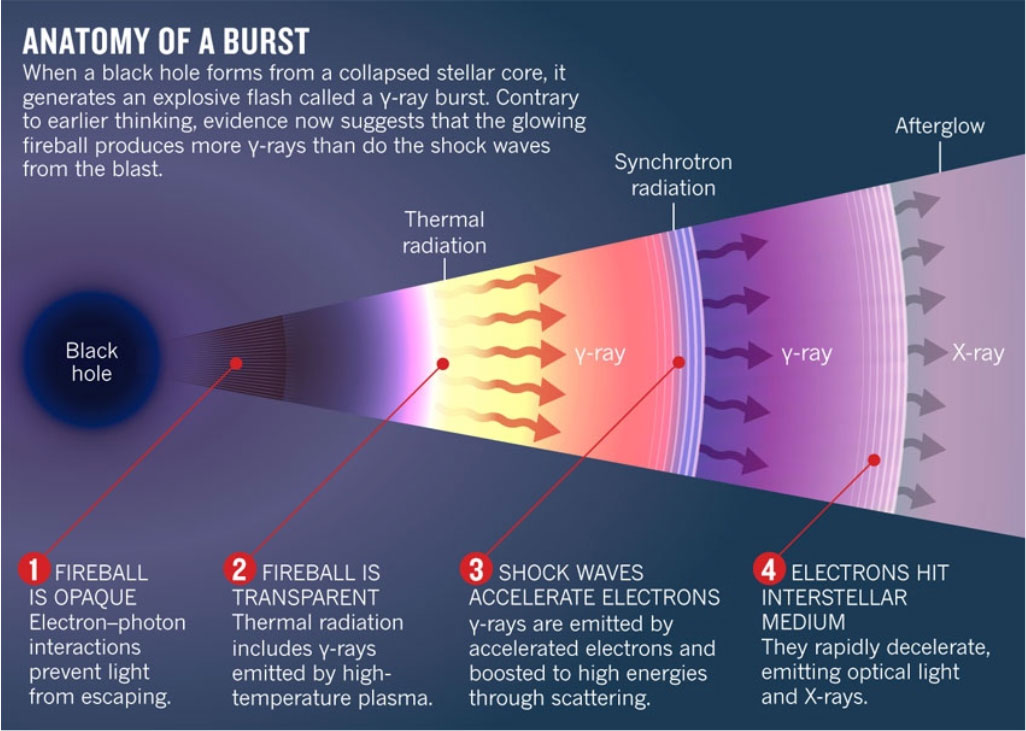
- November 21, 2013 — Stanford's Fermi Gamma-ray Large Area Space Telescope Detects Most Energetic Gamma-ray Burst On Record
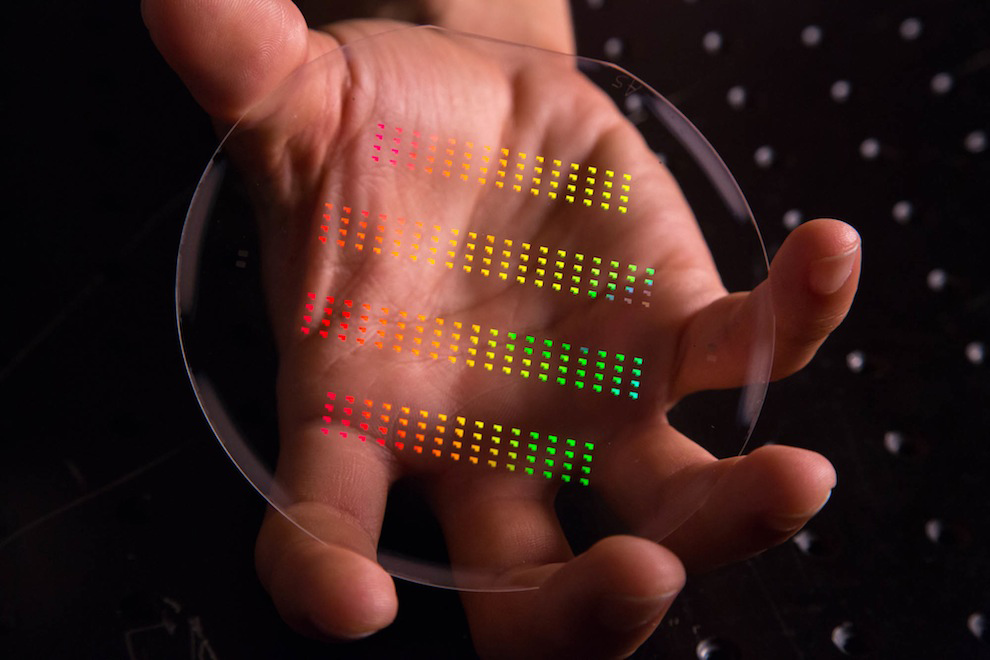
- November 6, 2013 — A Particle Accelerator on a Silicon Chip
- September 1, 2013 — Sarah Church succeeds Peter Michelson as HEPL Director
- January 29, 2013 —Fermi-LAT Physicist, Roger Romani, wins 2013 Bruno Rossi Prize
- January 14, 2013 — Roger Blandford Receives Royal Astronomical Society's Top Honor
2012
- June 4, 2012 —Underground search for neutrino properties unveils first results
- May 13, 2012 — Restoring sight to the blind with a photovoltaic retinal prosthesis
2011
- August 19, 2011 — New method developed by HEPL's Solar Research Group detects emerging sunspots deep inside the sun
- May 4, 2011 — Gravity Probe B Announces Final Experimental Results in Press and Media Event at NASA Headquarters
- February, 2011 — HEPL's Igor Moskalenko and Stanford Professors Mark Brongersma and Juan Santiago Selected as 2010 APS Fellows
- January 12, 2011 — Fermi Large Area Telescope Team Awarded Rossi Prize
2010
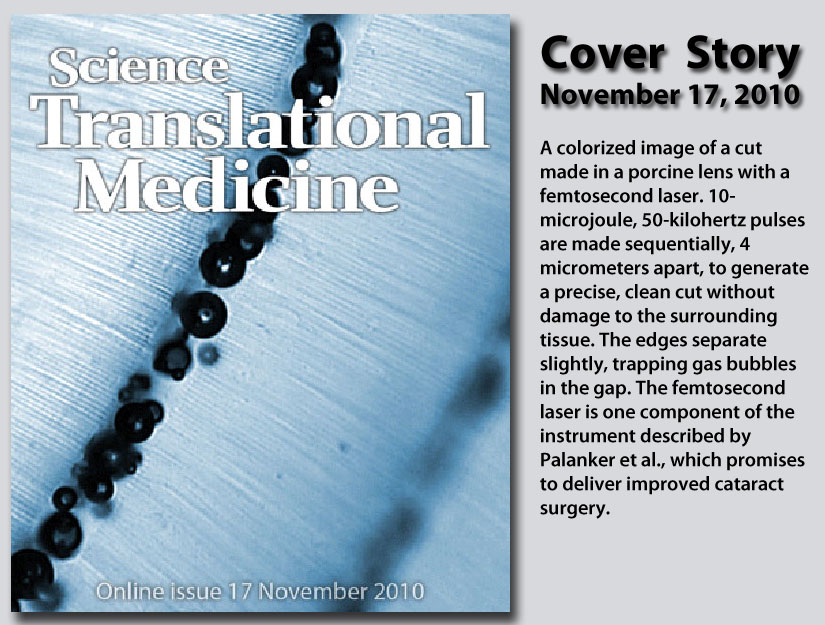
- November 17, 2010 — Palanker Group's Laser Cataract Surgery Technique is Cover Story in November 17th Issue of Science Translational Medicine
- March 11, 2010 — Francis Everitt and Sir Roger Penrose awarded 2010 Trotter Prize and Delivered Trotter Lectures at Texas A&M University
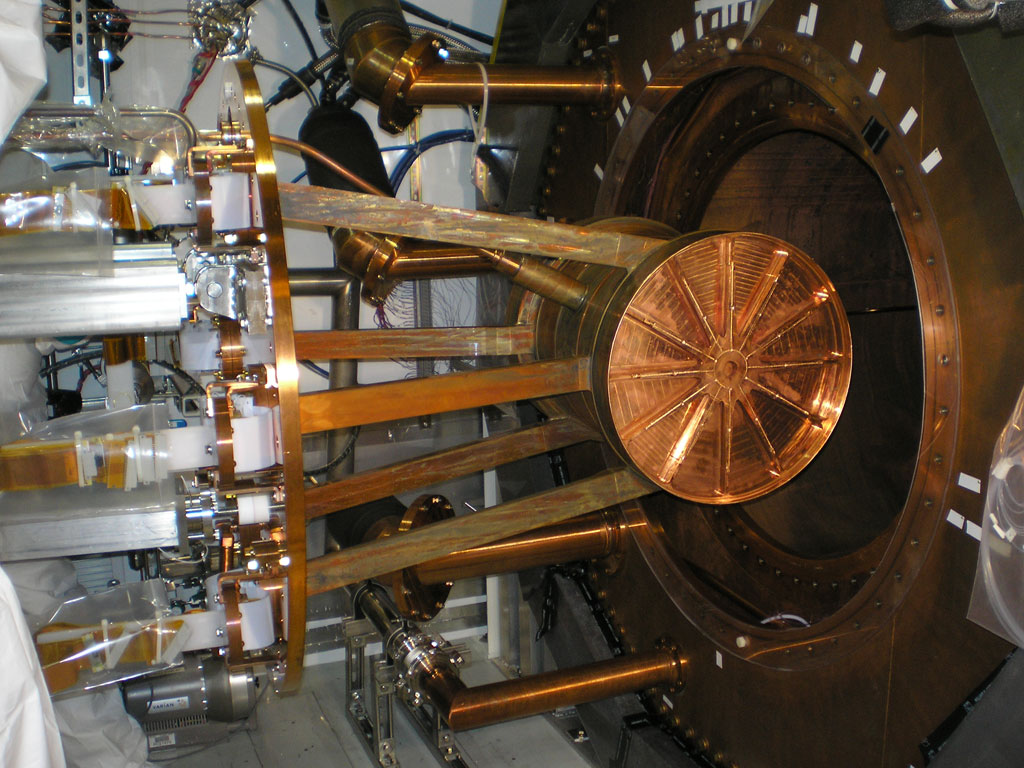
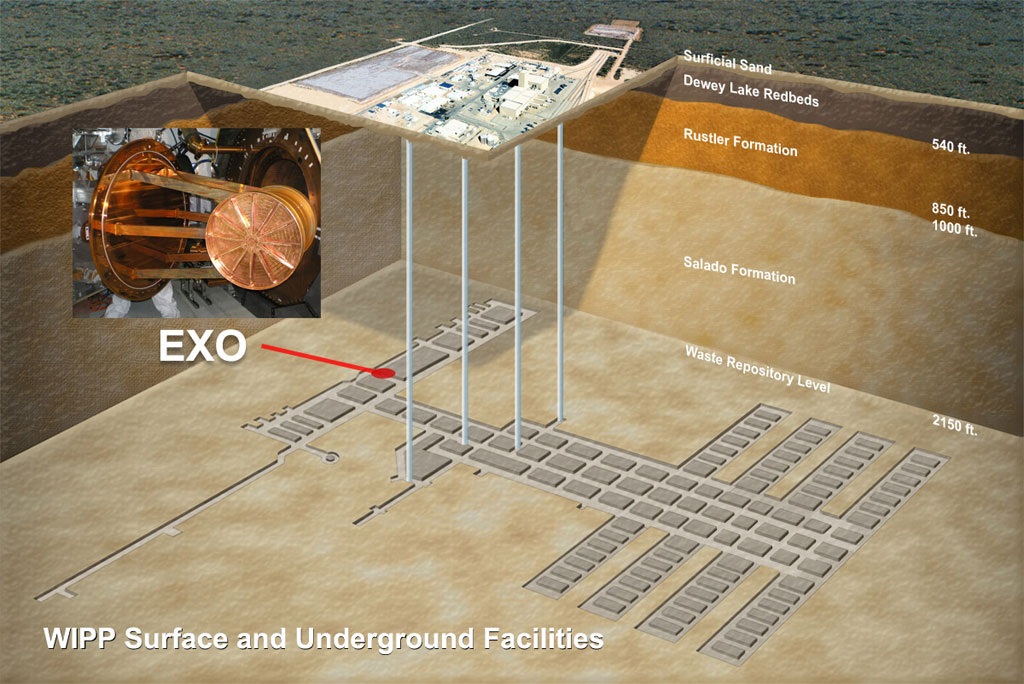
- Winter, 2010 — EXO Takes Clean to an Extreme
- February 11, 2010 — Stanford Helioseismic and Magnetic Imager (HMI) Launches on NASA SDO Satellite
2009
- December 17, 2009 — Dark Matter Search: Latest CDMS-II Results
- November 2, 2009 — Fermi Telescope Celebrates First Year's Results with Cosmic Reflection Concert
- September, 2009 — Peter Michelson succeeds Blas Cabrera as HEPL Director
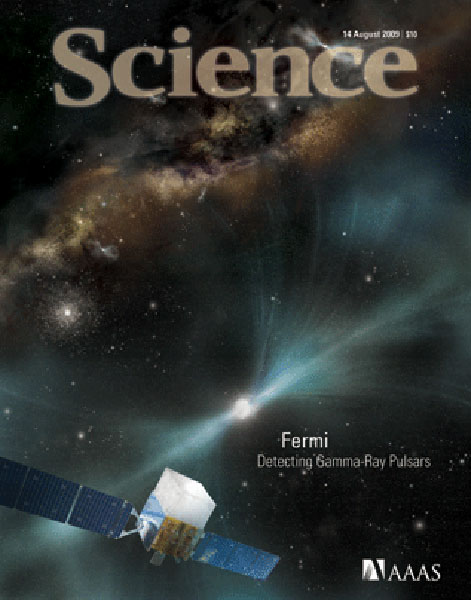
- August 2009 —Fermi Gamma-ray Space Telescope results prominently featured in 8/14 issue of AAAS Science
- June/July, 2009 — Gravity Probe B Data Analysis Update
- May 2009 — NASA's Fermi Telescope Measures Spectrum of Electrons and Positrons; Celebratory 'Cosmic Reflection' Concert
- April 28, 2009 — Bob Byer Awarded the Frederic Ives Medal/Jarus W. Quinn Endowment by the OSA
- February 19, 2009 - NASA's Fermi Telescope
Sees Most Extreme Gamma-ray Blast Yet
- January 5, 2009 - CDMS Leading the Search for Dark Matter in the Form of WIMPs
- January 7, 2009 - Fermi Gamma Ray Space Telescope Discovers Slew of New Pulsars
2008
- August 26, 2008 - GLAST Observatory Renamed for Fermi, Reveals Entire Gamma-Ray Sky
- August 2008 - Palanker Research Group Develops Pulsed Electron Avalanche Knife (PEAK)
- August 2008 —Professor Robert Byer Wins 2009 IEEE Photonics Award
- June 11, 2008 — NASA's GLAST Launch Successful
- March 2008 — Crystal bells stay silent as physicists look for dark matter
- January 30, 2008 — On the frontiers of science for decades, a storied building is soon to be razed
2007
- October 31, 2007 — Physicists chase Einstein’s equivalence principle down a hole
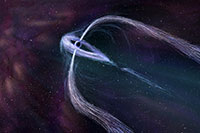
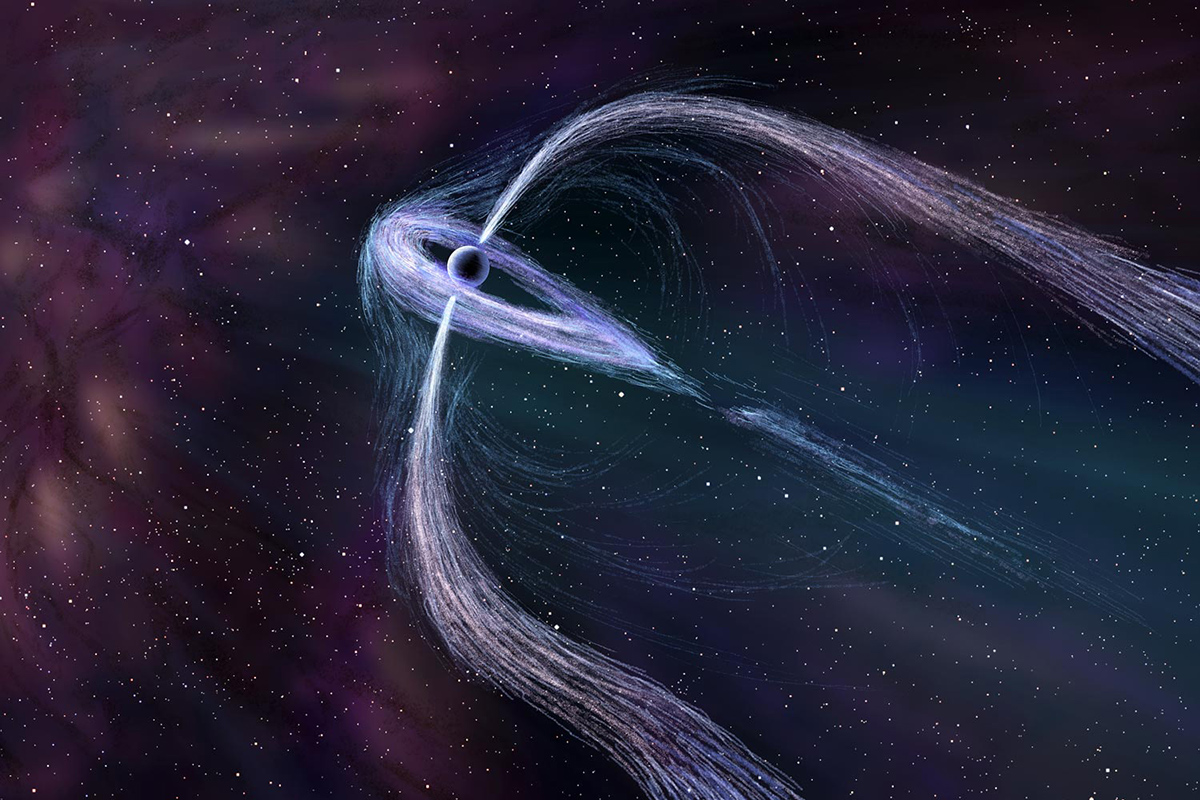
Observations of the Geminga pulsar,
shown in this illustration, made by the
High-Altitude Water Cherenkov
Observatory in Mexico indicate that it
and another nearby pulsar are unlikely
to be the origin of excess antimatter
near Earth.
(Image credit: Nahks TrEhnl)
December 7, 2017 — Software in development at Stanford advances the modeling of astronomical observations
Software developed by Stanford astrophysicist Giacomo Vianello models and combines otherwise incompatible astronomical observations. It contributed to recent research into the origin of antimatter near Earth.
Reprint of a news story by Taylor Kabota in the Stanford Report, December 7, 2017
A recent study in Science cast doubt on one formerly favored explanation for why an abundance of positrons – the antimatter counterparts of electrons – has been found near Earth. Two nearby collapsed stars, it turns out, aren’t likely to blame because their positrons couldn’t have traveled as far as the Earth.
This finding, which reopens a debate about a possible role for dark matter in creating those anomalous positrons, required piecing together complex data from the High Altitude Water Cherenkov Observatory (HAWC) in Mexico. HAWC, which looks like an array of giant, corrugated steel water tanks, can precisely reconstruct the direction and energy of incoming light – in the form of high-energy gamma-rays – by recording the particle shower that the gamma-ray photons generate when they enter the atmosphere above the detector.
In order to analyze that complex dataset, the HAWC collaboration turned to a software designed by Giacomo Vianello, a research scientist in the lab of Peter Michelson at Stanford University and a co-author of the study. The software, called the Multi-Mission Maximum Likelihood (3ML) framework, was originally designed to combine the data of the Fermi gamma-ray space telescope with the data from other instruments. Its ability to handle data in multiple formats and the unprecedented flexibility of its modeling tools allowed the HAWC team to question the pulsars’ role in generating the unexpected positrons.
“My collaborators and I spent many hours designing and developing 3ML for our research but also for other people to use,” Vianello said. “It is very exciting to see that some researchers find it so useful that they decide to use it for high-impact science like what HAWC published.”
Vianello and the rest of the 3ML team plan to continue improving the software. In addition to working across wavelengths and instruments, they hope it can be used with messengers other than light, such as polarization of electromagnetic radiation, cosmic rays and neutrinos.
The inspiration to create 3ML came from Vianello’s own work with the Fermi gamma-ray space telescope. Fermi has two main instruments, the Gamma-Ray Burst Monitor and the Large Area Telescope (LAT), which is led by Michelson, professor and chair of physics at Stanford. Even though these instruments exist on the same telescope, bringing their data together meant lengthy and cumbersome operations that often sacrificed some of the sensitivity of the LAT.
The situation worsens when the data come from completely different experiments and collaborations.
“It’s like completing a puzzle, where each instrument contributes a piece,” Michelson said. “However, the different pieces of the puzzle are very difficult and sometimes impossible to put together because they have different formats and require very different analysis methods and software.”
Scientists at Fermi have used 3ML for studying gamma-ray bursts. The project has also grown, now including 15 collaborators from the United States and Europe.
“Other missions and instruments have expressed the desire to join the effort and develop plug-ins for their data, so we’ve started working with them toward that,” Vianello said. “Some of them are even joining the development team, which is a very good thing because there is still a lot that can be done to improve 3ML.”
Michelson said he believes that, as it continues to improve, the software could be particularly useful for studying faint sources across multiple wavelengths. It could even play a vital role in solving the mystery of the excess antimatter.
“When completed, 3ML will, for the first time, allow for a powerful combination of Fermi, HAWC and other instruments for detailed analysis of extended sources, such as the one analyzed in the Science paper,” Michelson said.
For More Information:
Research Paper: The Multi-Mission Maximum Likelihood framework (3ML). Authors: Giacomo Vianello, Robert J. Lauer, Patrick Younk, Luigi Tibaldo, James M. Burgess, Hugo Ayala, Patrick Harding, Michelle Hui, Nicola Omodei, Hao Zhou.
arXiv:1507.08343. Submitted 29 Jul 2015
Fermi Gamma-Ray GLAST-StanfordSpace Telescope: Stanford Website
Fermi Gamma-Ray Space Telescope: NASA Website
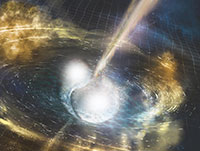
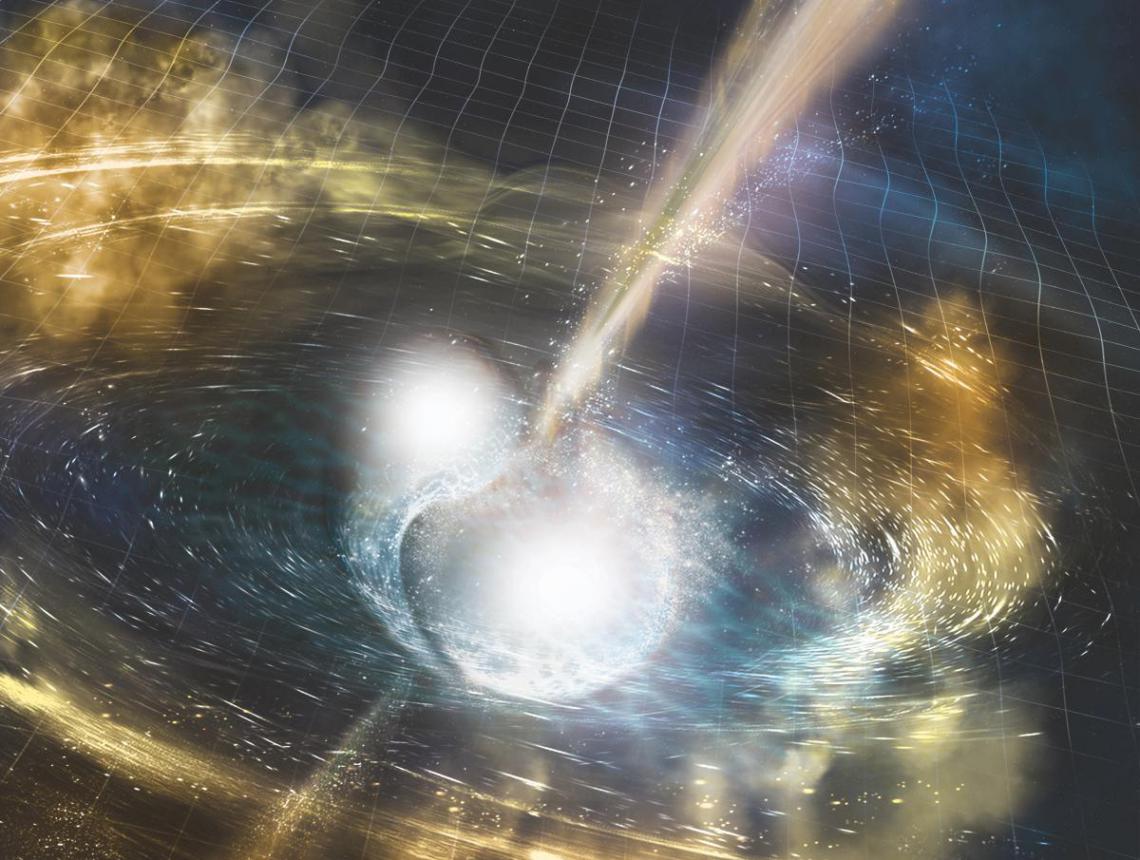
Artist’s rendering of two merging
neutron stars. (Image credit:
NSF/LIGO/Sonoma State
University--A. Simonnet)
October 16, 2017 — Stanford experts weigh in on LIGO’s kilanova binary neutron star milestone
The Advanced LIGO gravitational wave detectors have announced their first observation of a binary neutron star coalescence.
Reprint of a news story by Taylor Kabota in the Stanford Report, October 16, 2017
On August 17, 2017, the two detectors of Advanced LIGO, along with VIRGO, zeroed in on what appeared to be gravitational waves emanating from a pair of neutron stars spinning together – a long-held goal for the LIGO team. An alert went out to collaborators worldwide and within hours some 70 instruments turned their sights on the location a mere 130 million light-years away.
Their combined observations, spanning the electromagnetic spectrum, confirm some of what physicists had theorized about this type of event and also open up new areas of research. Thousands of scientists contributed to this accomplishment, including many at Stanford University, and published the initial findings Oct. 16 in Physical Review Letters and The Astrophysical Journal Letters.
“It’s a frighteningly disordered, energetic place out there in the universe and gravitational waves added a new dimension to looking at it,” said Robert Byer, professor of applied physics at Stanford and member of LIGO who provided the laser for the initial detector. “For this event, that new dimension was complemented by the signals from the other electromagnetic wavelengths and all those together gave us a completely different view of what’s going on inside the neutron stars as they merged.”
This observation and the others that are likely to follow could help further the understanding of General Relativity, the origins of elements heavier than iron, the evolution of stars and black holes, relativistic jets that squirt from black holes and neutron stars, and the Hubble constant, which is the cosmological parameter which determines the expansion rate of the universe.
Stanford and LIGO
LIGO is led by the Massachusetts Institute of Technology and the California Institute of Technology, but Stanford was brought into the collaboration in 1988, largely due to the ultra-clean, stable lasers developed by Byer. The Byer lab developed the chip for the laser in the initial LIGO detector, which they installed in the early 2000s and lasted the lifetime of the initial LIGO project, which concluded in 2010. Lasers for the Advanced LIGO built upon Byer’s earlier work, an effort led by Benno Wilkie of the Albert Einstein Institute Hannover, a former postdoctoral scholar in Stanford’s Ginzton lab.
“We were looking for the problems that LIGO couldn’t actually worry about yet. We wanted to find those and solve them before they became roadblocks,” said Byer. “One thing that allowed Stanford to contribute to LIGO in these extraordinary ways is we have this long tradition of engineering and science working together – and that’s not common. Great credit also goes to our extraordinary graduate students who are the glue that hold it all together.”
Daniel DeBra, professor emeritus of aeronautics and astronautics, designed the original platform for LIGO, a nested system so stable that, in the LIGO detection band, it moves no more than an atom relative to the movement of Earth’s surface. Another crucial element of the vibration isolation system is the silicate bonding technique used to suspend LIGO’s mirrors. As a visiting scholar at Stanford, Sheila Rowan of the University of Glasgow adapted this technique from previous work at Stanford on the Gravity Probe B telescope.
The Dark Energy Camera (DECam), the instrument used by the Dark Energy Survey, was among the first cameras to see in optical light what the LIGO-VIRGO detectors observed in gravitational waves earlier that morning. DECam imaged the entire area within which the object was expected to be and helped confirm that the event was a unique object – and very likely the event LIGO had seen earlier that day.
Many people at Stanford and the SLAC National Accelerator Laboratory are part of the Dark Energy Survey team. Aaron Roodman, professor and chair of particle physics and astrophysics at SLAC, developed, commissioned and continues to optimize the Active Optics System of DECam.
Looking to the future, DeBra and colleagues including Brian Lantz, a senior research scientist who leads the Engineering Test Facility for LIGO at Stanford, are improving signal detection of Advanced LIGO by damping the effects of vibrations on the optics.
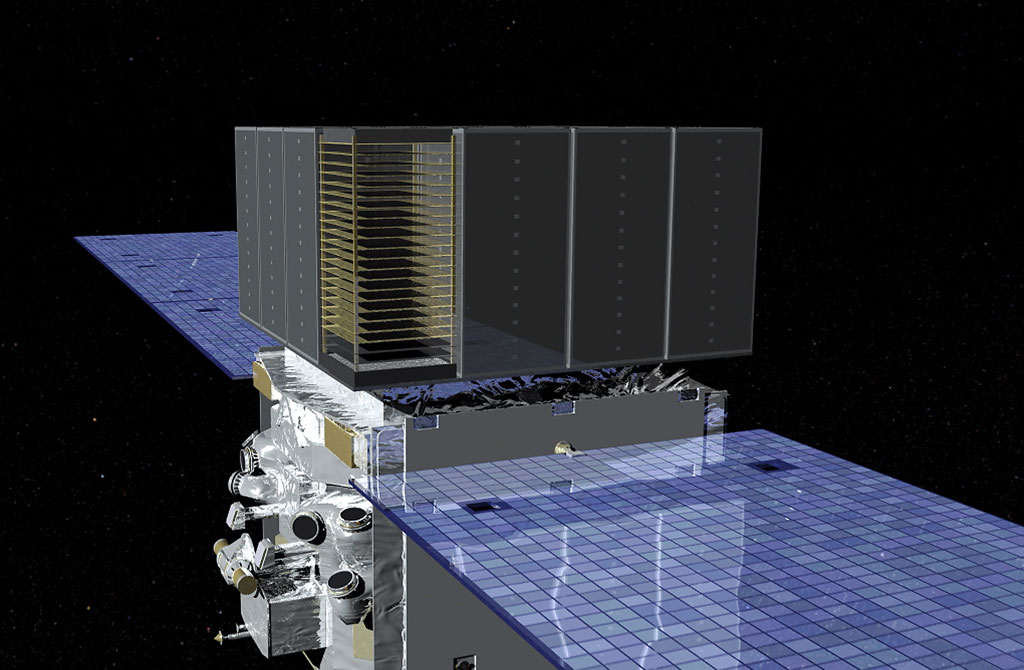
Other faculty are improving the sensitivity of the Fermi Large Area Telescope (LAT), a instrument helmed by Peter Michelson, a professor of physics, that can both confirm the existence of a binary neutron star system and rule out other possible sources. Its sister instrument on Fermi, the Gamma-Ray Burst Monitor, detected a gamma ray burst coming from the location given by LIGO and VIRGO 14 seconds after the gravitational wave signal.
LIGO is offline for scheduled upgrades for the next year, but many of the researchers are already working on LIGO Voyager, the third-generation of LIGO, which is anticipated to increase the sensitivity by a factor of 2 and would lead to an estimated 800 percent increase in event rate.
“This is only a beginning. There are many innovations to come and I don’t know where we’re going to be in 10 years, 20 years, 30 years,” said Michelson. “The window is open and there are going to be mind-blowing surprises. That, to me, is the most exciting.”
What’s so special about neutron stars
A neutron star results when the core of a large star collapses and the atoms get crushed. The protons and electrons squeeze together and the remaining star is about 95 percent neutrons. A tablespoon full of neutron stars weighs as much as Mt. Everest.
“Neutron stars have some of the strongest gravity you’ll find – black holes have the strongest – and thus they give us handles on studying strong-field gravity around them to see if it deviates at all from General Relativity,” said Mandeep Gill, the outreach coordinator at KIPAC at SLAC and Stanford, and a member of the Dark Energy Survey collaboration.
Astronomers proposed the existence of neutron stars in 1934. They were first found in 1967, and then in 1975 a radio telescope observed the first instance of a binary neutron star system. From that discovery, Roger Blandford, professor of physics at Stanford, and colleagues confirmed predictions of the General Theory of Relativity.
Blandford said the calculations related to the system Advanced LIGO saw are even more complicated because the stars are much closer together and could only be completed by a computer. This observation continues to support the General Theory of Relativity but Gill is hopeful that additional binary neutron star systems may begin to inform extension to the theory that could reveal how it fits with quantum theory, dark energy and dark matter.
“One of the things I find terribly exciting about these observations is that not only do they confirm aspects of astronomical and relativistic precepts but they actually teach us things about nuclear physics that we don’t properly understand,” said Blandford. “We certainly have many things that we’ve speculated about and thought about – and I have to believe that some of that will be right – but some of it will be much more interesting than what we could anticipate.”
As we observe more of these systems, which scientists anticipate, we may finally understand long-standing mysteries of neutron stars, like whether they have earthquakes on their crust or if, as suspected, they have small mountains that send out their own gravitational wave signal.
“Even though we’ve been doing astronomy since the dawn of civilization, every time we turn on new instruments, we learn new things about what’s going on in the universe,” said Lantz. “If the elements heavier than iron are actually made in events like this, that stuff is here on Earth and it’s likely that was generated by events like this. It gives you sort of a way to reach out and touch the stars.”
Blandford is also KIPAC Division Director in the Particle Physics and Astrophysics Directorate and professor of particle physics and astrophysics at SLAC; Byer is also a professor in SLAC’s Photon Science Directorate.
Additional Stanford contributors to the LIGO multi-messenger observation include Edgard Bonilla, Riccardo Bassiri, Elliot Bloom, David Burke, Robert Cameron, James Chiang, Carissa Cirelli, C.E. Cunha, Christopher Davis, Seth Digel, Mattia Di Mauro, Richard Dubois, Martin Fejer, Warren Focke, Thomas Glanzman, Daniel Gruen, Ashot Markosyan, Manuel Meyer, Igor Moskalenko, Nicola Omodei, Elena Orlando, Troy Porter, Anita Reimer, Olaf Reimer, Leon Rochester, Aaron Roodman, Eli Rykoff, Brett Shapiro, Rafe Schindler, Jana B. Thayer, John Gregg Thayer, Giacomo Vianello and Risa Wechsler.
For More Information:
Media Contact for this story: Taylor Kubota, Stanford News Service: (650) 724-7707, Email: tkubota@stanford.edu
Stanford LIGO Group, MIT News Story: LIGO and Virgo make first detection of gravitational waves produced by colliding neutron stars
Stanford LIGO Group, Nobel Prize News Story: Discovery of Gravitational Waves wins 2017 Nobel Prize in Physics
LIGO Scientific Collaboration: News Website
Stanford Student Space Initiative website
October 2017 — Stanford's Student Space Initiative Group (SSI) Sets Up Shop in HEPL South / End Station III
Story by Bob Kahn—HEPL Communications & Webmaster
An energetic group of Stanford undergraduate and graduate students comprising the Stanford Student Space Initiative (SSI) has set up its office/workspace in a warren of rooms on the third floor of HEPL South/End Station III.
Founded in 2013 and now having over 200 members, SSI is a completely student-run organization with the mission of giving future leaders of the space industry the hands-on experience and broader insight they need to realize the next era of space development.
SSI is organized into six teams: High-Altitude Balloons, Rockets, Satellites, Biology, Operations and Policy. Based on their interests and academic specialties, students participate in space-related projects and activities, which range from building and launching high-altitude balloons and rockets to developing a Why Go To Space class in the Stanford Aeronautics and Astronautics Department to inviting speakers from NASA and aerospace companies such as Space X to give presentations. In 2016, a high-altitude balloon launched by the SSI Balloon team from Holister, CA flew for 79 hours, landing in Quebec, Canada—setting a new world record for the longest latex high-altitude balloon flight.
Read full story…
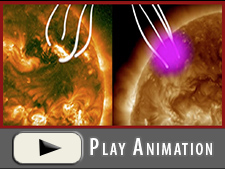
Anmimation showing gamma rays from a
solar flare on the far side of the sun
moving along magnetic field lines to the
front side where they are
detected by the
Fermi Gamma-ray Space Ttelescope.
Animation by NASA GSFC
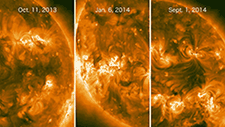
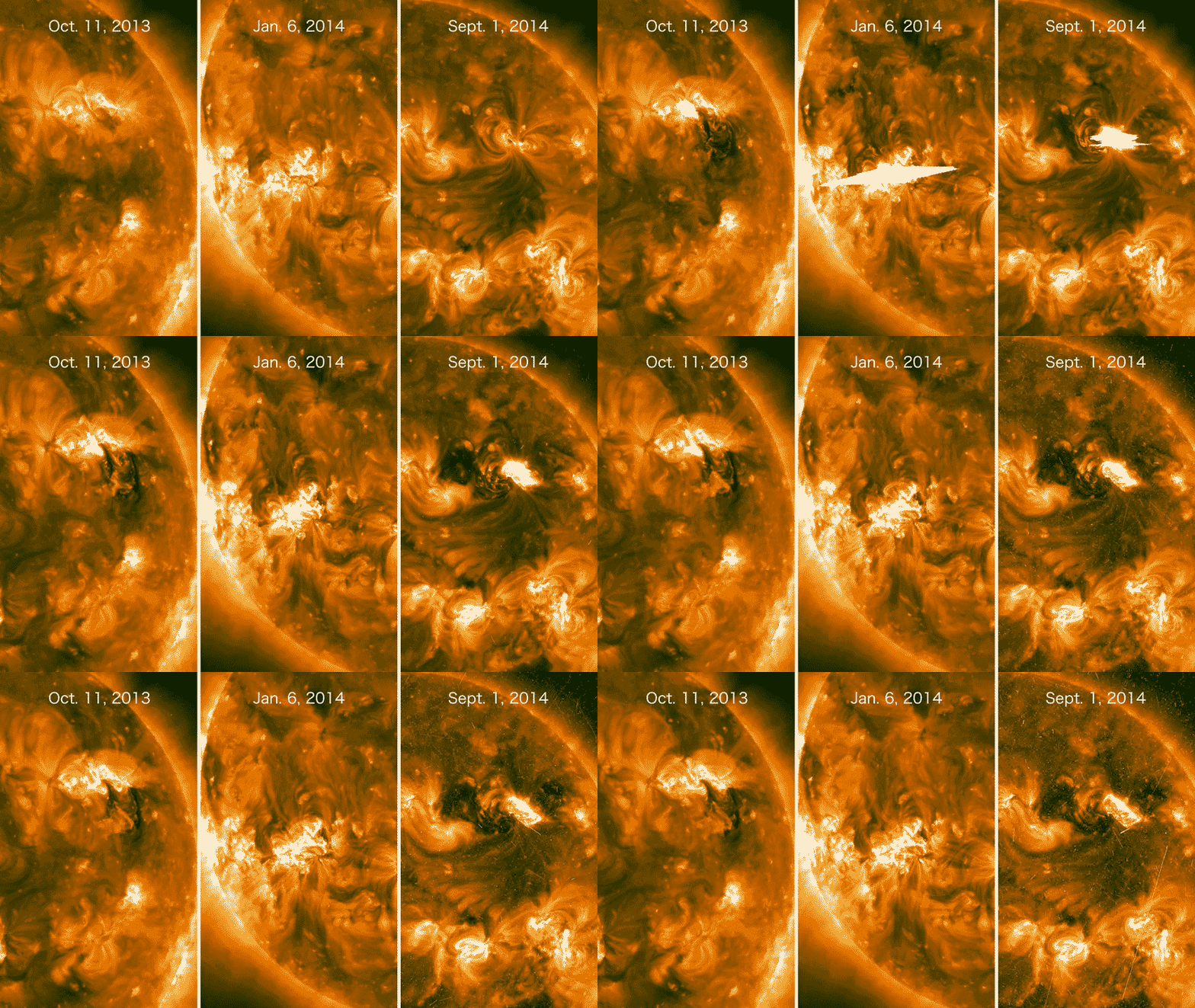
These solar flares were imaged in
extreme
ultraviolet light by NASA's
STEREO
satellites, which at the time
were viewing
the side of the sun facing
away from Earth.
All three events launched
fast coronal mass
ejections (CMEs).
Scientists think particles accelerated by
the
CMEs rained onto the Earth-facing
side of
the sun and produced the gamma
rays. Click thumbnail above to view
animated images.
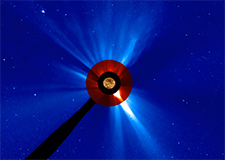
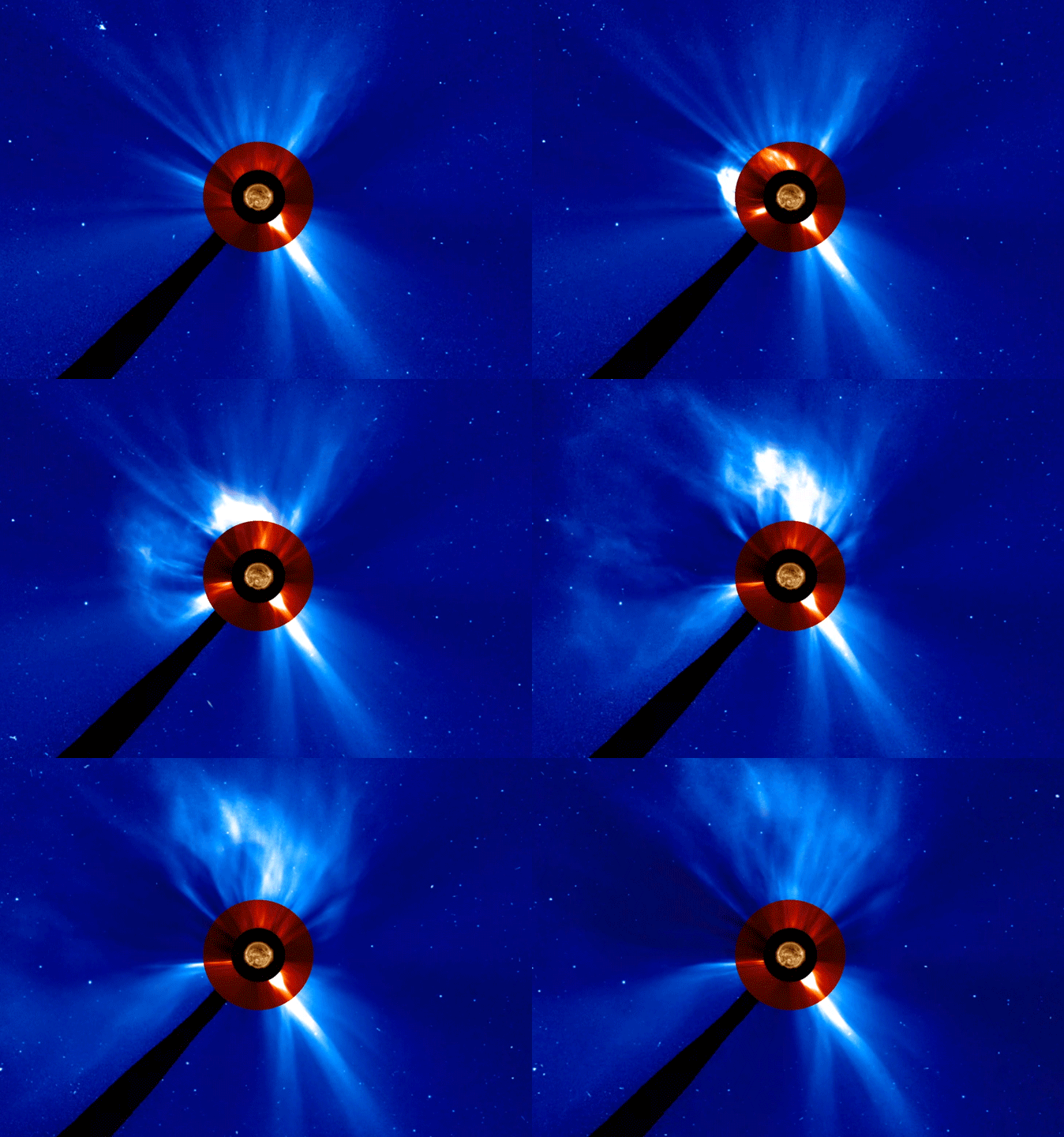
Combined images from NASA's Solar
Dynamics Observatory (center) and the
NASA/ESA Solar and Heliospheric
Observatory (red and blue) show an
impressive coronal mass ejection
departing the far side of the sun on
Sept. 1, 2014. This massive cloud raced
away at about 5 million mph and likely
accelerated particles that later produced
gamma rays Fermi detected.
Click t humbnail above to view
animated image.
January 30, 2017 — NASA's Fermi Gamma Ray Telescope has detected gamma rays eminating from flares on the back side of our sun
Reprint of story by Francis Reddy, NASA Goddard Space Flight Center
An international science team says NASA's Fermi Gamma-ray Space Telescope has observed high-energy light from solar eruptions located on the far side of the sun, which should block direct light from these events. This apparent paradox is providing solar scientists with a unique tool for exploring how charged particles are accelerated to nearly the speed of light and move across the sun during solar flares.
"Fermi is seeing gamma rays from the side of the sun we're facing, but the emission is produced by streams of particles blasted out of solar flares on the far side of the sun," said Nicola Omodei, a member of the Fermi research team at Stanford University's Hansen Experimental Physics Lab in California. "These particles must travel some 300,000 miles within about five minutes of the eruption to produce this light."
Omodei presented the findings on January. 30, 2017 at the American Physical Society meeting in Washington, and a paper entitled Fermi-LAT Observations of High-energy Behind-thd-limb Solar Flares, describing the results were published online in The Astrophysical Journal on Jan. 31.
"Observations by Fermi's LAT continue to have a significant impact on the solar physics community in their own right, but the addition of STEREO observations provides extremely valuable information of how they mesh with the big picture of solar activity," said Melissa Pesce-Rollins, a researcher at the National Institute of Nuclear Physics in Pisa, Italy, and a co-author of the paper.
The hidden flares occurred Oct. 11, 2013, and Jan. 6 and Sept. 1, 2014. All three events were associated with fast coronal mass ejections (CMEs), where billion-ton clouds of solar plasma were launched into space. The CME from the most recent event was moving at nearly 5 million miles an hour as it left the sun. Researchers suspect particles accelerated at the leading edge of the CMEs were responsible for the gamma-ray emission.
Large magnetic field structures can connect the acceleration site with distant part of the solar surface. Because charged particles must remain attached to magnetic field lines, the research team thinks particles accelerated at the CME traveled to the sun's visible side along magnetic field lines connecting both locations. As the particles impacted the surface, they generated gamma-ray emission through a variety of processes. One prominent mechanism is thought to be proton collisions that result in a particle called a pion, which quickly decays into gamma rays.
In its first eight years, Fermi has detected high-energy emission from more than 40 solar flares. More than half of these are ranked as moderate, or M class, events. In 2012, Fermi caught the highest-energy emission ever detected from the sun during a powerful X-class flare, from which the LAT detected highenergy gamma rays for more than 20 record-setting hours.
NASA's Fermi Gamma-ray Space Telescope is an astrophysics and particle physics partnership, developed in collaboration with the U.S. Department of Energy and with important contributions from academic institutions and partners in France, Germany, Italy, Japan, Sweden and the United States.
Francis Reddy (Syneren Technologies): Lead Science Writer
Scott Wiessinger (USRA): Lead Producer
Tom Bridgman (GST): Data Visualizer
Scott Wiessinger (USRA): Animator
For More Information:
Original Francis Reddy article on NASA Goddard Space Flight Center Website
NASA Goddard Media Studios: Fermi Sees Gamma Rays from Farside Solar Flares (January 30, 2017)
National Geographic Online Story:
Our Sun Produces Bizarre Radiation Bursts—Now NASA Knows Why (February 14, 2017)
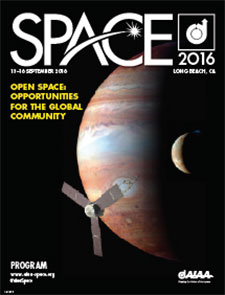
AIAA Space 2016 Program Cover
Clcik to view AIAA Space 2016 web page
and download PDF copy of program
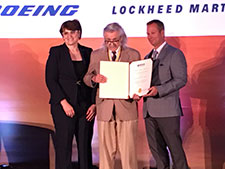
HEPL Emeritus Professor Francis Everitt,
Principal Investigator of Gravity Probe
B,
accpting the 2016 AIAA Space Science
Award
(Image credit: Diane Larson)
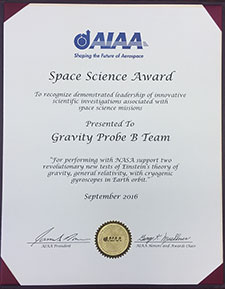
AIAA 2016 AIAA Space Science
Award
Image credit: Diane Larson)
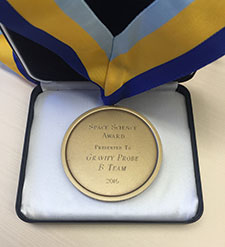
2016 AIAA Space Science
Award
Medallion
(Image credit: Diane Larson)
September 15, 2016 — AIAA Honors the Stanford/NASA/Lockheed Martin Gravity Probe B Team with 2016 Space Science Award
Every election year, the American Institute of Aeronautics and Astronautics (AIAA) hosts a Space and Astronautics Forum and Exposition. This year’s forum and exhibition was called AIAA Space 2016, and was held at the Long Beach, CA Convention Center from September 13-15.
The theme of Space 2016 was: Open Space: Opportunities for the Global Community.
This year’s forum and exhibition included six main sections:
Plenary Program
The plenary program began with talks by NASA Administrator, Charles Bolden Jr., Winston Beauchamp and Steve Jurveston. Other plenary talks focused on two themes: Technologies for the New LEO Economy and Next Stop: Mars.
Forum 360
The Forum 360 panel discussions built on the themes and discussions of each day’s opening plenary session. Topics included:
- Icy Moons and Ocean Worlds
- Commercial Crew Update
- Thriving Within Complexity
- Limiting or Unlimited: Envisioning a Free Market Space Industry
- Earth Observations: Space & the Paris Agreement
- Launch 2020
- On-Orbit Satellite Servicing
- Space Traffic Management
- Global Perspectives
Technical Program
The technical program contains more than 650 technical papers from about 600 government, academic, and private institutions in 28 countries reporting on the latest in space and astronautics research, and offering scores of opportunities for collaboration and discussion on high-impact topics.
Continuing Education
A number of continuing education courses were offered during the conference.
Recognition
Recognition events included the William H. Pickering Lecture with Juno project manager Nybakken and principal investigator Bolton, Wanda Austin delivering the Yvonne C. Brill Lecture, the von Kármán Lecture and a recognition luncheon to celebrate achievements in space and astronautics.
During the Recognition Luncheon, seven awards were presented, including the Space Science Award given to the Gravity Probe B team “For performing with NASA support two revolutionary new tests of Einstein’s theory of gravity, general relativity, with cryogenic gyroscopes in Earth orbit.” The award was accepted by Stanford Research Professor Emeritus, Francis Everitt, Principal Investigator of the Gravity Probe B mission, which was administered by HEPL for nearly half a century, from first NASA funding in 1963 through the spacecraft launch in April 2004, the final results announcement in 2011 and, most recently, the publication of the November 2015 focus issue of the journal, Classical and Quantum Gravity, containing a preface and 21 scientific and technical papers covering every aspect of this landmark experiment and space mission.
Special Events
During special events, conference participants had opportunities to Meet and hear stories from astronauts; network during receptions, luncheons, and poster sessions; attend book signings, explore the exposition hall, and make a silent auction bid for the benefit of the AIAA Foundation.
Space 2016 included nearly 1,500 participants from 28 countries. More than 650 papers were delivered, covering the latest innovation in astrodynamics, space technology, exploration and operations. The conference also included dedicated events for students and young professionals and an evening of astronaut stories.
For More Information:
AIAA Space 2016 web page
Stanford Gravity Probe B Website
Gravity Probe B History
Special November 19, 2015 issue of Classical and Quantum Gravity
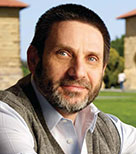
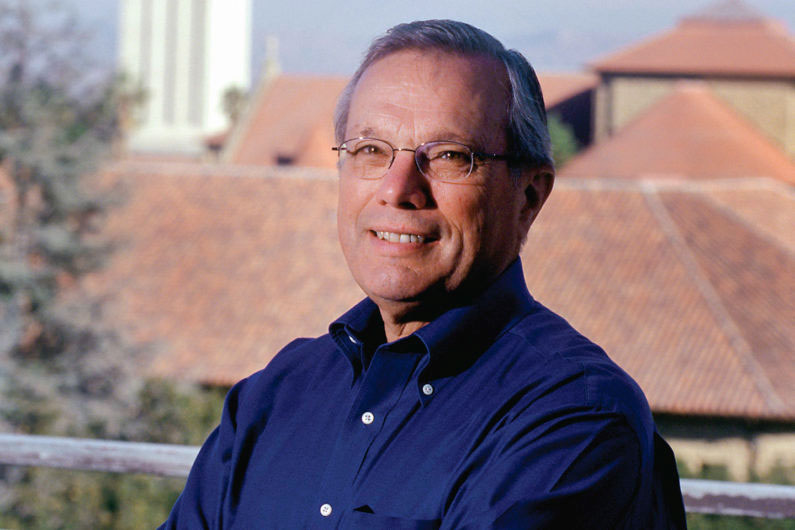
Professor Daniel Palanker
Interim HEPL Director
for 2016-17 Academic Year
September 1, 2016 — Ophthalmology Professor Daniel Palanker accepts position as Interim HEPL Director for the 2016-17 Academic Year
On September 1, 2016, professor Daniel Palanker became the new Director of HEPL. Dr. Palanker is the twelfth person to oversee and direct the lab's activities during its 65-year history, beginning in 1951, when the lab was founded as the Stanford "High Energy Physics Lab" (abbreviated HEPL). In 1990, the lab was renamed the "W.W. Hansen Experimental Physics Lab", honoring pioneering physicist and engineer, William W. Hansen.
The directorship of HEPL is a rotating position among the faculty members whose research programs are administered by HEPL. Having just completed her three-year term as HEPL Director, Professor Sarah Church is becoming a senior associate vice provost for Undergraduate Education.
Professor Palanker is working at the interface of physics and medicine. His group studies interactions of electric field with biological cells and tissues, and develops optical and electronic technologies for diagnostic, therapeutic, surgical and prosthetic applications, primarily in ophthalmology. These studies include laser-tissue interactions with applications to ocular therapy and surgery, as well as interferometric imaging of neural signaling. Dr. Palanker is also developing various electro-neural interfaces, including retinal prosthesis for restoration of sight to the blind, and electronic control of secretory glands and blood vessels.
Several of his developments are in clinical practice world-wide: Pulsed Electron Avalanche Knife (PEAK PlasmaBlade), Patterned Scanning Laser Photocoagulator (PASCAL), and OCT-guided Laser System for Cataract Surgery (Catalys). Several others are in clinical trials: Gene therapy of the retinal pigment epithelium (Ocular BioFactory); Neural stimulation for enhanced tear secretion (TearBud, Allergan Inc.); Smartphone-based ophthalmic diagnostics and monitoring (Paxos, DigiSight Inc.).
Dr. Palanker is going to lead a transition of HEPL into a hub for physics-centered interdisciplinary collaborations at Stanford, representing multi-faceted interfaces of Physics with Engineering, Neuroscience and Medicine.
You can read more about the colorful history of HEPL and its previous directors on the About HEPL page of this web site.
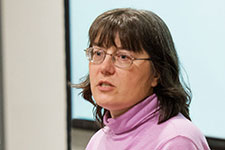
Physics Professor Sarah Church
(Image credit: L.A. Cicero)
September 1, 2016 — Physics Professor Sarah Church relinquishes post as HEPL Director to become senior associate vice provost for undergraduate education
Church, who will assume her new role Sept. 1, succeeds Stanford biology Professor Elizabeth A. "Liz" Hadley, who will complete her three-year term on Aug. 31.
Excerpted from a news story by Kathleen J. Sullivan in the Stanford Report, August 2, 2016
Stanford physics Professor Sarah Church will become the senior associate vice provost for undergraduate education on Sept. 1. Harry J. Elam Jr., vice provost for undergraduate education, recently announced the appointment.
Elam said Church will assist and advise him on the management of the Office of the Vice Provost for Undergraduate Education (VPUE ) and on additional matters related to undergraduate education across campus.
Church chaired the Committee on Undergraduate Standards and Policies from 2013-2016, which in recent years has developed the pilot program for the joint majors program and new policies governing coterminal master’s degrees. She served on the ad hoc committee that designed Stanford’s new course-evaluation form.
Church, who joined Stanford’s faculty in 1999, served as the director of the Hansen Experimental Physics Laboratory from 2013-2016 and the deputy director of the Kavli Institute for Particle Astrophysics and Cosmology from 2007-2011.
Her research is focused on understanding how galaxies are formed and how they are evolving. As part of this effort, the Church Group is building an experiment to map the large-scale distribution of highly redshifted carbon monoxide.
Church also is leading the Argus experiment, a 16-pixel radio spectrometer at the 100-meter Green Bank Telescope in Green Bank, West Virginia – the world’s largest, fully steerable radio telescope – that will investigate star formations in nearby galaxies and our own.
In 2014, Stanford named Church the Pritzker University Fellow in Undergraduate Education in recognition of her extraordinary contributions to undergraduate education.
Elam said he is very excited that Church is joining VPUE in the fall.
Read Kathleen Sullivan's full story in the Stanford Report, August 2, 2016
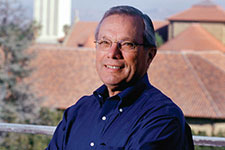
Aero/Astro Professor Emeritus Brad
Parkinson at Stanford.
(Image credit: Bradford Parkinson)
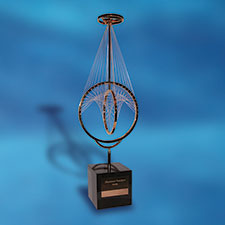
Marconi Prize Trophy. To be awarded to
Professoe Emeritus, Bradford Parkinson
in November 2016.
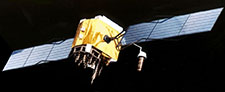
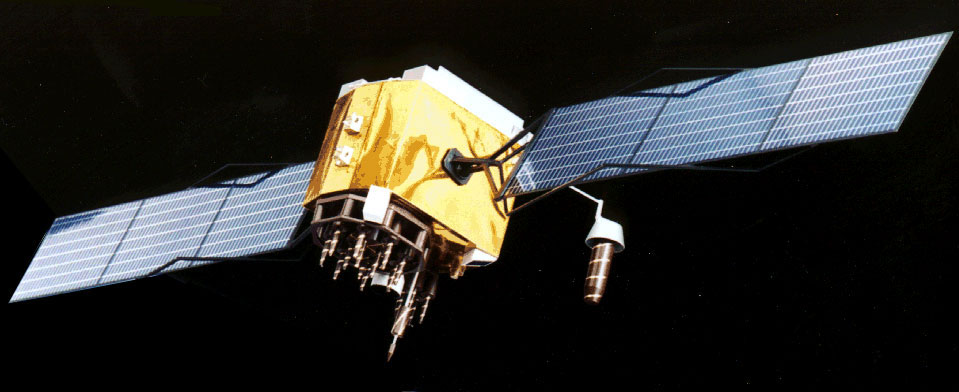
Artist's rendering of a GPS satellite
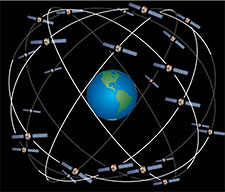
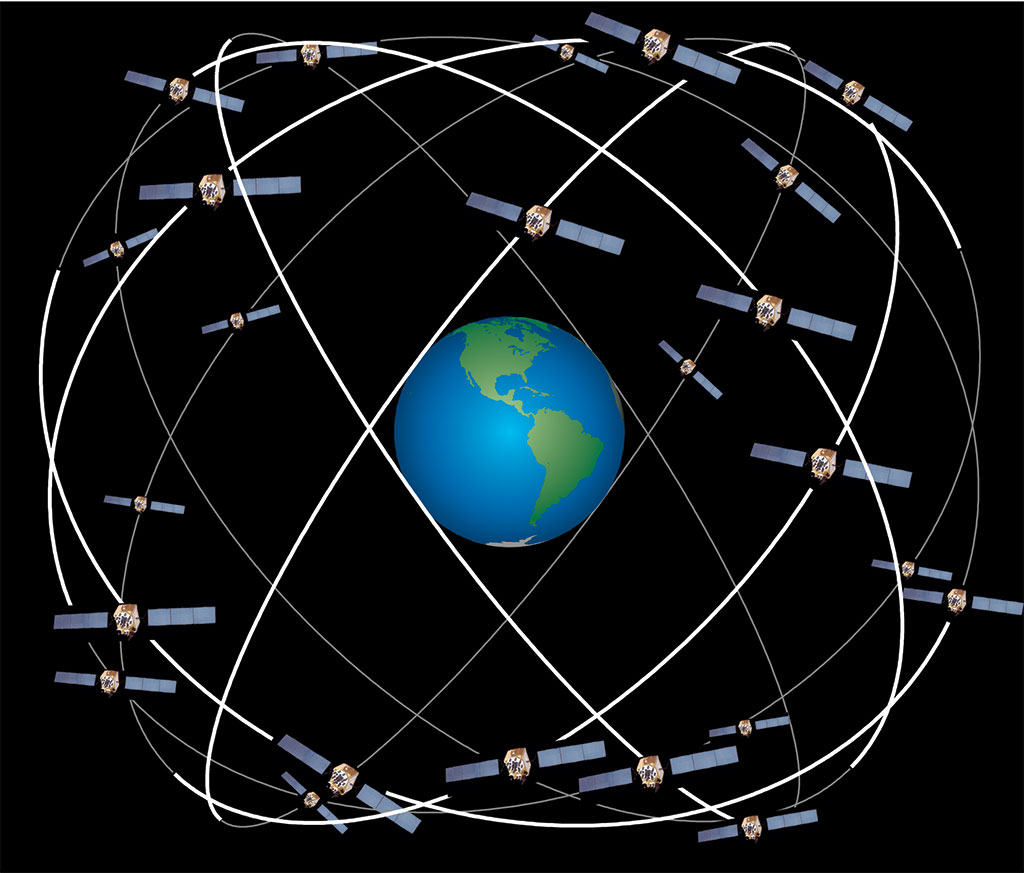
The GPS Satellite Constellation:
24 satellites
in 6 earth-centered orbital
planes with four
operational satellites
and a
spare satellite
slot in each plane.
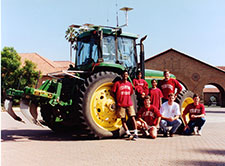
Stanford engineering graduate students,
standing in
front of a GPS-controlled tractor
Read Story on the GP-B Website
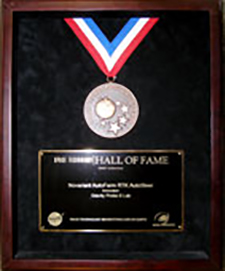
April 2006 — Space Technology Hall
of Fame Award for
development and
commercialization of
GPS precision
guidance technology.
Read Story on GP-B Website
May 20, 2016 — Brad Parkinson
interviewed on NPR Science Friday:
"How
GPS
Found It's Way"
May 16, 2016 — Stanford engineer Bradford Parkinson, the ‘Father of GPS,’ wins prestigious Marconi Prize
The Marconi Prize is awarded each year to recognize major advances in the communications field that benefit humanity.
This year's Marconi award ceremony will occur in Palo Alto, in conjunction with the Stanford Center for Position, Navigation and Time annual symposium in November.
A news story by Bjorn Carey in the Stanford Report, May 16, 2016
It is difficult to imagine that 50 years ago, practically no one wanted to fund the development of a Global Positioning System (GPS). Not only were governments uninterested in funding such a project, they didn’t consider it useful.
Today, Bradford Parkinson, the Edward C. Wells Professor in the School of Engineering, Emeritus, at Stanford, has been awarded the Marconi Prize for his role in guiding the development of GPS from an orphaned project to a technology that is deeply seeded in nearly every aspect of modern life. The $100,000 Marconi Prize, given annually, recognizes major advances in the communications field that benefit humanity.
t all started in late 1972, when Parkinson, then a colonel in the Air Force, was tasked with reviving a foundering USAF program called 621B, which called for creating a global navigation system using satellites. He was initially reluctant to take on the task, given its ugly duckling reputation. Although he soon ran into the same budget issues and infighting within the Department of Defense that had stonewalled his predecessors, Parkinson quickly realized the project’s potential. And he has the pen-and-paper sketches of GPS-guided driving systems to prove it.
“I was certainly a zealot for GPS in any sense of the word,” Parkinson said. “And zealots are not easily discouraged.”
Indeed, he and his team of talented engineers pushed and pushed, drawing up new system plans and making impassioned pitches to military and government officials until finally, in December 1973, they got the green light.
The novel plan called for a network of satellites, each broadcasting the same signal frequency and outfitted with incredibly precise atomic clocks that provide the heartbeat of the system. A receiver on the ground can pick up these signals, the location of the satellite and the exact time that the signal was broadcast – this is where the atomic clocks are essential – to determine its location on Earth with incredible precision.
Funding secured, the first GPS satellite was launched 44 months later – lightning speed in the satellite business. The signal was open to both military and civilian users, a decision Parkinson fought for vigorously, and to which he attributes the current ubiquity of the technology. Today there are 30 Global Positioning satellites robing the planet, providing timing and location data that guides automated agricultural equipment, helps land planes, tracks your running routes and plots the shortest driving route home from work.
After retiring from military service as an Air Force colonel in 1984, Parkinson joined the faculty at Stanford and inspired a new generation of GPS scientists to develop hundreds of system enhancements and applications. While he describes his time here as a student (PhD ’66) as an intellectual delight, coming back as a member of the faculty was “even better.”
“It wasn’t just my colleagues in Aero/Astro who were very skilled, but the young men and women I taught were the absolute cream of the universities of the United States. The best and the brightest,” he said. “I’m still amazed at the things we accomplished. It was just awesome.”
Parkinson and his allied faculty and students developed the concept and first demonstration of the Federal Aviation Administration’s now-operational GPS integrity system, called WAAS, and, with his students, demonstrated the first GPS auto-guided farm tractor, now an $800 million worldwide GPS farming business. In 1992 they demonstrated the first completely blind landing of a commercial airline.
“What was unique back then about Stanford was that department boundaries were really fuzzy. A lot of our work involved professors and students from everywhere around campus,” Parkinson said. “And, frankly, that’s the real world. It was a truly collegial place to be, and I loved every minute.”
Despite those prescient sketches of GPS guidance systems in cars, Parkinson said he is still amazed at all the applications people have developed based on the technology. He does regret, however, that the prevalence of the technology has eroded people’s map-reading skills.
“It grieves me that we’ve lost some of our situational awareness,” he joked, echoing language from his military background. “When I am sailing, I continuously cross-check the GPS. I trust it, but I make sure to verify.”
Parkinson is the latest Stanford-affiliated scientist to win the Marconi Prize, given each year to recognize significant advancements in communication technologies. Past winners with Stanford ties include Martin Hellman, John Cioffi, Arogyaswami Paulraj, Ron Rivest, Sergey Brin and Larry Page.
For More Information
Marconi Society Announcement of Professor Parkinson's Award
Stanford Report News Story by Bjorn Carrey, May 16, 2016
Stanford GPS Lab website
Stanford Center for Position, Navigation and Time website
Stanford Profiles — Professor Bradford Parkinson
Bradford Parkinson's Role in Managing the Stanford/NASA Gravity Probe B Mission
From Einstein to Farming: The Adaptation of GPS Satellite Positioning Technology for Precision Farming (Gravity Probe B Website Story)
The GPS Wiki page
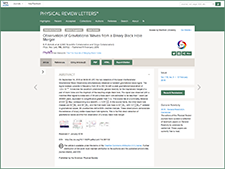
APS Physical Review Letters journal
article documenting the LIGO detection on
14 September 2015
of
gravitational waves
from a binary black
hole merger.
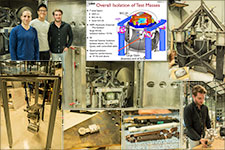
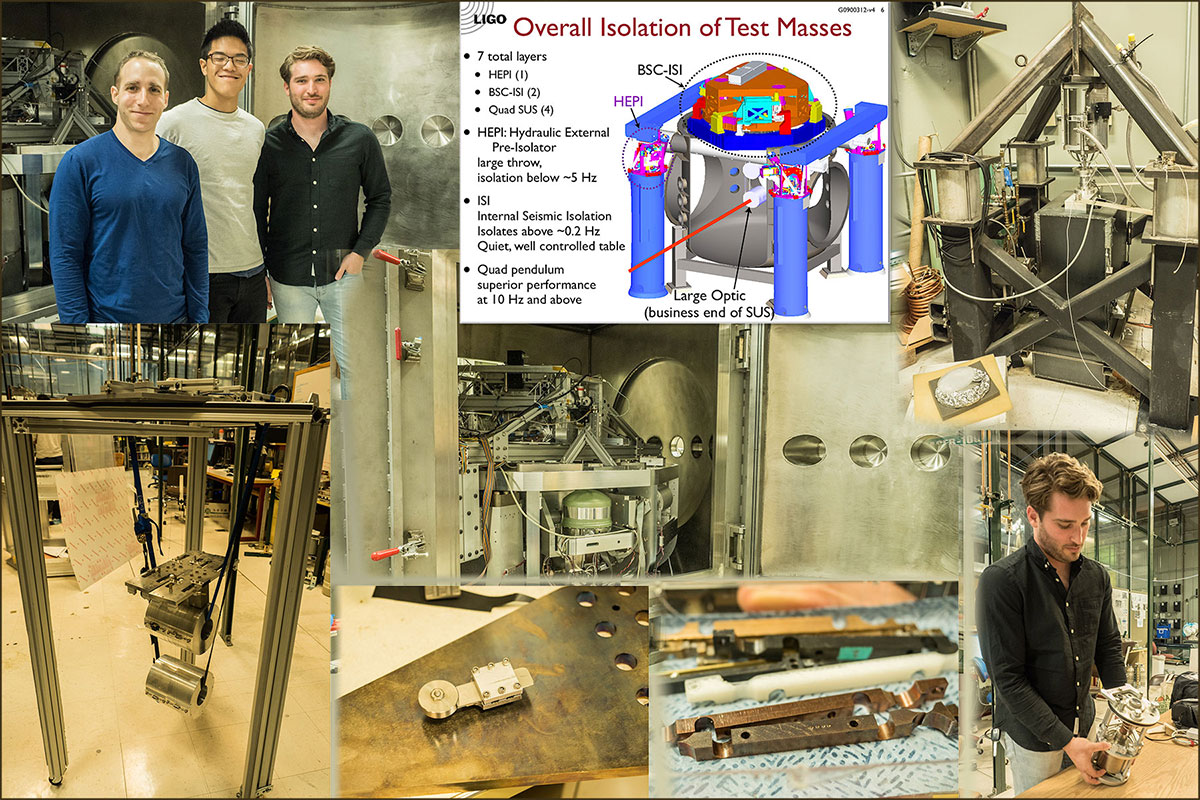
Photo collage from the Stanford LIGO Lab
(Click to view full size.)
View 2-minute Stanford LIGO Lab video by
Kurt Hickman and Aaron Kehoe
View PHD Comics enlightening and
entertaining
3.5 min YouTube video on
gravitational waves and
their detection
by LIGO.
View 5.5-minute MIT video on LIGO and
its first confirmed detection
of gravitational
waves on
14 September 2015
View 70-minute streaming YouTube video
of the 11 Feb 2016 NSF Press Conference
announcing the first
confirmed LIGO
detection of gravitational
waves on
14 Sep 2015.
February 11, 2016 — Stanford Researchers Celebrate Their Collaboration in the Technological Advances Enabling the Long-Sought Detection of Gravitational Waves by the LIGO Observatories
Excerpted from a news story by Bjorn Carey in the Stanford Report, February 11, 2016
Today an international team of scientists excitedly announced that they had directly observed gravitational waves, often described as ripples in the fabric of spacetime. The discovery of gravitational waves confirms a prediction that Albert Einstein made nearly 100 years ago to shore up his general theory of relativity.
The detection was made by the twin Laser Interferometer Gravitational-wave Observatory (LIGO) detectors, an experiment led by researchers at Caltech and MIT that includes more than 1,000 affiliated scientists, including several Stanford physicists and engineers who have played key roles in the program since it was launched. The instrument systems that made the detection possible were built in part on a legacy of interdisciplinary technological advances made by Stanford scientists.
"LIGO is by far the most precise measurement machine that man has ever built," said Robert L. Byer, the William R. Kenan, Jr. Professor of Applied Physics at Stanford, and an original member of the LIGO team. "It's finally sensitive enough to see the bells that are ringing in the universe."
The ringing bell that LIGO heard early in the morning of Sept. 14, 2015, was the result of two massive black holes merging together 1.3 billion light-years away. As the two black holes spiraled around each other, they radiated energy in the form of gravitational waves. While they merged into one even more massive black hole, they released three solar masses of energy.
"This was a huge signal," said Martin Fejer, a professor of applied physics. "It's more energy than our sun will release in its entire lifetime, and it all happened in about a fifth of a second as these two massive black holes coalesced."
Although the peak power output of the event was about 50 times that of the whole visible universe, it required an extremely sensitive device to detect the ensuing gravitational waves. LIGO consists of twin instruments, located 1,865 miles apart in Louisiana and Washington. Each of these instruments involves a single laser, each directed into two 4-kilometer-long arms that run perpendicular to one another.
As a gravitational wave passes through a detector, it distorts spacetime such that one arm lengthens, and the other shortens. By comparing the disturbances at the two detectors, the scientists can confirm the direct detection of a gravitational wave.
"We spend a lot of time making sure that the instruments are very reliable, it doesn't have any funny noise glitches, so you wonder is this a noise glitch or is this a real signal?" said Lantz, who is a senior research scientist in the Gintzon Lab at Stanford. "We [the LIGO team] immediately went through all the things that we know can cause glitches. I started looking around for earthquakes anywhere in the world that might have triggered this, and for funny misbehaviors of our instruments. But we didn't see any."
After carefully considering and eliminating all other possibilities, the LIGO researchers came to the black hole conclusion.
Separating the signal from the noise
Making the detection is incredibly difficult, in part because the amount that a gravitational wave affects the detector arms is incredibly small, only about a thousandth the diameter of an atom's nucleus. To give that some perspective, it's comparable to being able to detect if the distance between the sun and Earth increased by the width of an atom. Eliminating noise from the system has been a central challenge since LIGO's inception, and one in which Stanford research has contributed in several ways.
First, the heart of the instrument, its 1-micron, solid-state laser, was developed through Stanford. Compared to technology being used at that time, these lasers were significantly more reliable but, more important, smaller. By scaling down to a single, monolithic chip, the researchers were able to greatly reduce the instabilities caused by acoustic noise.
Hydraulic and electromagnetic systems developed by Daniel DeBra, the Edward C. Wells Professor of Engineering, Emeritus, moves the mirrors to compensate for the tidal stretching of Earth's crust. Motion of the ground is another major source of noise affecting LIGO. DeBra and Lantz have taken the lead on helping implement measures to prevent these motions from influencing the detectors, reducing vibrational disruptions caused by passing trucks and trains, earthquakes and even the moon.
Another source of noise comes from the mirrors that reflect the lasers in the arms of the detectors. Thermal energy in the mirrors causes the mirror faces to vibrate, which can lead to motions that interfere with the observation of gravitational waves. Modeling these effects and finding materials that minimize these vibrations has been a major focus of Fejer's work, which contributed to the eventual design of the mirrors used in Advanced LIGO. This work continues together with Jonathan Stebbins, a professor of geological sciences, and Riccardo Bassiri, a research associate, who are helping to identify and test high-performance glassy materials to further reduce this noise source in future detectors. Experiments on these materials are being conducted at the Stanford Synchrotron Radiation Lightsource at SLAC National Accelerator Laboratory, with staff scientist Apurva Mehta. Further reduction in the thermal vibrations was obtained through the design of pure silica wires to suspend the mirrors, developed by physicists Norna Robertson and Sheila Rowan.
"While this is a physics experiment, there were challenges in optics and photonics and precision controls engineering and materials science," Fejer said. "Faculty members from all over campus – Applied Physics, Mechanical Engineering, Aeronautics and Astronautics, SLAC and the School Earth, Energy and Environmental Sciences – all participated. The interdisciplinary nature of the faculty at Stanford who enjoy bringing their knowledge and tools to bear on broader problems made Stanford an excellent environment in which to make these contributions to the larger project."
LIGO research is supported by the National Science Foundation and is carried out by the LIGO Scientific Collaboration (LSC), a group of more than 1,000 scientists from universities around the United States and in 14 other countries. More than 90 universities and research institutes in the LSC develop detector technology and analyze data, and approximately 250 students are strong contributing members of the international collaboration.
Read Bjorn Carey's full story from Stanford News, February 11, 2016
More Information About LIGO and Gravitational Waves
Caltech LIGO Information and News web page
MIT LIGO Information and News web page
LIGO Information and News web page
National Science Foundation web site
New York Times: Gravitational Waves Detected, Confirming Einstein’s Theory by Dennis Overbye
New York Times: Finding Beauty in the Darkness by Lawrence Krauss
Washington Post: Einstein predicted gravitational waves 100 years ago. Here’s what it took to prove him right. by Sarah Kaplan
New Yorker Magazine: Gravitational Waves Exist: The Inside Story of How Scientists Finally Found Them by Nicola Twilley
CQG 19 Nov 2015
Focus Issue on
Gravity Probe B
GP-B in a Nutshell: A 2-page overview
of the GP-B Experiment (PDF)
GP-B in a Nutshell Video: A 14-minute
YouTube
video
overview of the GP-B
Experiment
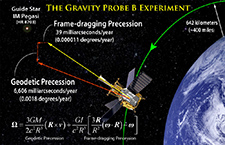
Einstein's predicted geodetic and frame-
dragging effects, with the Schiff
Equation for calculating them.
(Click to enlarge image.)
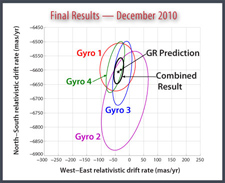
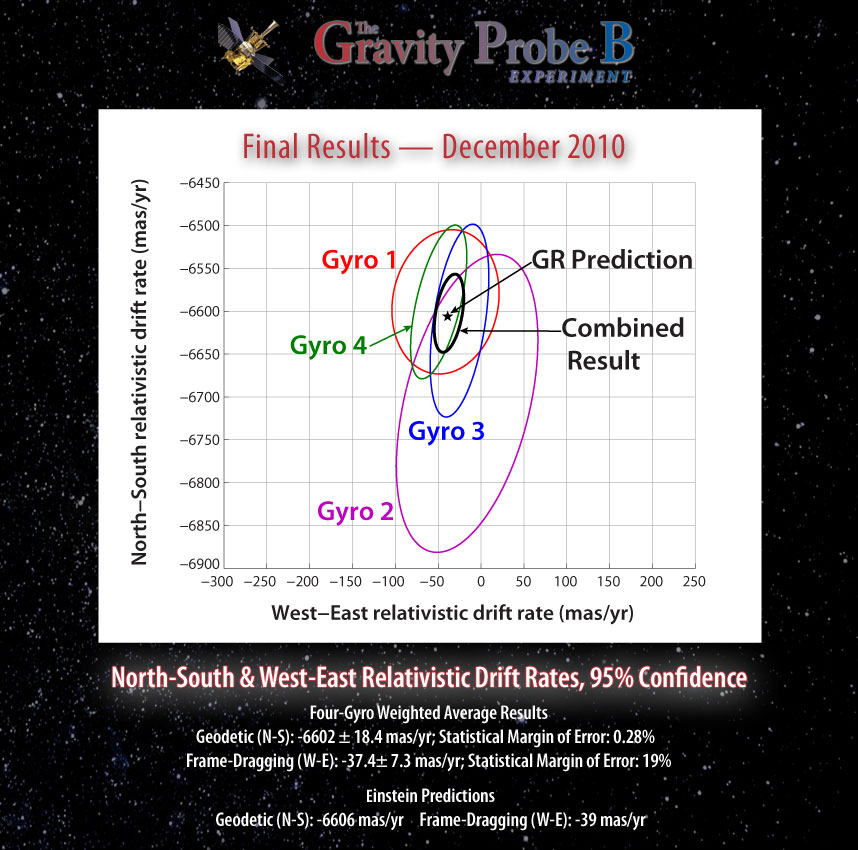
Graph of the results for each gyroscope
individually, and all four gyroscopes
combined.The area inside each colored
ellipse represents a 95% conficence
interval for a gyroscope's measurement
of both the N-S (geodetic) and the W-E
(frame-dragging) effects.
(Click to enlarge image.)
November 19, 2015 — Volume 32 Issue #22 of the Journal, Classical and Quantum Gravity, Devoted Entirely to the Landmark, 50-Year Stanford/HEPL Gravity Probe B Experiment
In November 1915, Albert Einstein presented his field equations—the basis of his general theory of relativity—to the Prussian Academy of Science. Exactly 100 years later, a definative volume detailing the science, technologies and data analysis of the landmark Gravity Probe B experiment was published in a special focus issue of the Institute of Physics Journal, Classical and Quantum Gravity (Volume 32, Number 22, 19 November 2015).
Gravity Probe B (GP-B) was a 48-year HEPL/NASA/Lockheed Martin experimental physics mission that used four ultra-precise, spherical gyroscopes and a telescope, housed in a satellite orbiting 642 km (400 mi) above the Earth, to measure directly, with unprecedented accuracy, two extraordinary effects predicted by Einstein's general theory of relativity: 1) the geodetic effect—the amount by which the Earth warps the local spacetime in which it resides and 2) the frame-dragging effect—the amount by which the rotating Earth drags its local spacetime around with it.
First proposed in 1960 by Leonard Schiff, then chairman of the Stanford Physics Department and funded by NASA from 1963-2008, the GP-B spacecraft finally launched on 20 April 2004. Experimental data collection began at the end of August 2004 and lasted for 50 weeks, followed by five weeks of instrument calibration testing. Data analysis commenced in October 2005 and concluded early in 2011. The final results, verifying Einstein's predicted geodetic and frame-dragging measurements, were announced at a press conference at NASA Headquaters on 4 May 2011.
Since that time, members of the GP-B team have been busy documenting all aspects of this landmark experiment in 21 peer-reviewed papers that have now been collectively published in the CQG focus issue, along with a preface by Classical and Quantum Gravity editor, Clifford Will.
Below is the table of contents of the CQG Focus issue on the GP-B experiment, with links to each of the 21 papers in the issue. Note that some of the papers are marked OPEN ACCESS. PDF full-text links to these papers are available free of charge on the respective CQG web pages linked from the table of contents below. For all the other papers, abstracts are available on the respective CQG web pages, with options to purchase the full-text articles for people or institutions that do not have IOP/CQG subscriptions.
Preface
Mission Overview Papers
- 224001 OPEN ACCESS — The Gravity Probe B test of general relativity. C W F Everitt, B Muhlfelder, D B DeBra, B W Parkinson, J P Turneaure, A S Silbergleit, E B Acworth, M Adams, R Adler, W J Bencze, J E Berberian, R J Bernier, K A Bower, R W Brumley, S Buchman, K Burns, B Clarke, J W Conklin, M L Eglington, G Green, G Gutt, D H Gwo, G Hanuschak, X He, M I Heifetz, D N Hipkins, T J Holmes, R A Kahn, G M Keiser, J A Kozaczuk, T Langenstein, J Li, J A Lipa, J M Lockhart, M Luo, I Mandel, F Marcelja, J C Mester, A Ndili, Y Ohshima, J Overduin, M Salomon, D I Santiago, P Shestople, V G Solomonik, K Stahl, M Taber, R A Van Patten, S Wang, J R Wade, P W Worden Jr, N Bartel, L Herman, D E Lebach, M Ratner, R R Ransom, I I Shapiro, H Small, B Stroozas, R Geveden, J H Goebel, J Horack, J Kolodziejczak, A J Lyons, J Olivier, P Peters, M Smith, W Till, L Wooten, W Reeve, M Anderson, N R Bennett, K Burns, H Dougherty, P Dulgov, D Frank, L W Huff, R Katz, J Kirschenbaum, G Mason, D Murray, R Parmley, M I Ratner, G Reynolds, P Rittmuller, P F Schweiger, S Shehata, K Triebes, J VandenBeukel, R Vassar, T Al-Saud, A Al-Jadaan, H Al-Jibreen, M Al-Meshari and B Al-Suwaidan
- 224002 —The three-fold theoretical basis of the Gravity Probe B gyro precession calculation. Ronald J Adler
- 224003 — Spacetime, spin and Gravity Probe B. J M Overduin
Payload Technologies Papers
- 224004 — The Gravity Probe B gyroscope. S Buchman, J A Lipa, G M Keiser, B Muhlfelder and J P Turneaure
- 224005 OPEN ACCESS — The Gravity Probe B electrostatic gyroscope suspension system (GSS).W J Bencze, R W Brumley, M L Eglington, D N Hipkins, T J Holmes, B W Parkinson, Y Ohshima and C W F Everitt
- 224006 — Gravity Probe B gyroscope readout system. B Muhlfelder, J Lockhart, H Aljabreen, B Clarke, G Gutt and M Luo
- 224007 — Precision spheres for the Gravity Probe B experiment. F Marcelja, D B DeBra, G M Keiser and J P Turneaure
- 224008 — The design and performance of the Gravity Probe B telescope. Suwen Wang, J A Lipa, D-H Gwo, K Triebes, J P Turneaure, R P Farley, D Davidson, K A Bower, E B Acworth, R J Bernier, L W Huff, P F Schweiger and J H Goebel
- 224009 OPEN ACCESS — Gravity Probe B cryogenic payload. C W F Everitt, R Parmley, M Taber, W Bencze, K Burns, D Frank, J Kolodziejczak, J Mester, B Muhlfelder, D Murray, G Reynolds, W Till and R Vassar
- 224010 — Porous plug for Gravity Probe B. Suwen Wang, C W Francis Everitt, David J Frank, John A Lipa and Barry F Muhlfelder
- 224011 OPEN ACCESS — Control of fluid mass center in the Gravity Probe B space mission Dewar. D Frank
Spacecraft Technologies Papers
- 224012 — Gravity Probe B spacecraft description. Norman R Bennett, Kevin Burns, Russell Katz, Jon Kirschenbaum, Gary Mason and Shawky Shehata
- 224013 — Gravity Probe B data system description. Norman R Bennett
- 224014 — Timing system design and tests for the Gravity Probe B relativity mission. J Li, G M Keiser, J M Lockhart, Y Ohshima and P Shestople
- 224015 — Precision attitude control of the Gravity Probe B satellite. J W Conklin, M Adams, W J Bencze, D B DeBra, G Green, L Herman, T Holmes, B Muhlfelder, B W Parkinson, A S Silbergleit and J Kirschenbaum
- 224016 — Proportional helium thrusters for Gravity Probe B. D DeBra, W J Bencze, C W F Everitt, J VandenBeukel and J Kirschenbaum
- 224017 — Gravity Probe B orbit determination. P Shestople, A Ndili, G Hanuschak, B W Parkinson and H Small
Data Analysis/Results Papers
- 224018 OPEN ACCESS — Gravity Probe B data analysis: I. Coordinate frames and analysis models. A S Silbergleit, G M Keiser, J P Turneaure, J W Conklin, C W F Everitt, M I Heifetz, T Holmes and P W Worden Jr
- 224019 OPEN ACCESS — Gravity Probe B data analysis: II. Science data and their handling prior to the final analysis. A S Silbergleit, J W Conklin, M I Heifetz, T Holmes, J Li, I Mandel, V G Solomonik, K Stahl, P W Worden Jr, C W F Everitt, M Adams, J E Berberian, W Bencze, B Clarke, A Al-Jadaan, G M Keiser, J A Kozaczuk, M Al-Meshari, B Muhlfelder, M Salomon, D I Santiago, B Al-Suwaidan, J P Turneaure and J Wade
- 224020 OPEN ACCESS —Gravity Probe B data analysis: III. Estimation tools and analysis results. J W Conklin, M I Heifetz, T Holmes, M Al-Meshari, B W Parkinson, A S Silbergleit, C W F Everitt, A Al-Jaadan, G M Keiser, B Muhlfelder, V G Solomonik and H Al-Jabreen
- 224021 — VLBI for Gravity Probe B: the guide star, IM Pegasi. N Bartel, M F Bietenholz, D E Lebach, R R Ransom, M I Ratner and I I Shapiro
For more information:
Stanford's Gravity Probe B Website
Institute of Physics, Classical and Quantum Gravity Journal Website
HEPL News Story on Gravity Probe B Final Results Announcement at NASA Headquarters, 4 May 2011
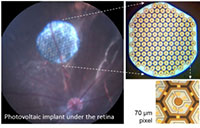
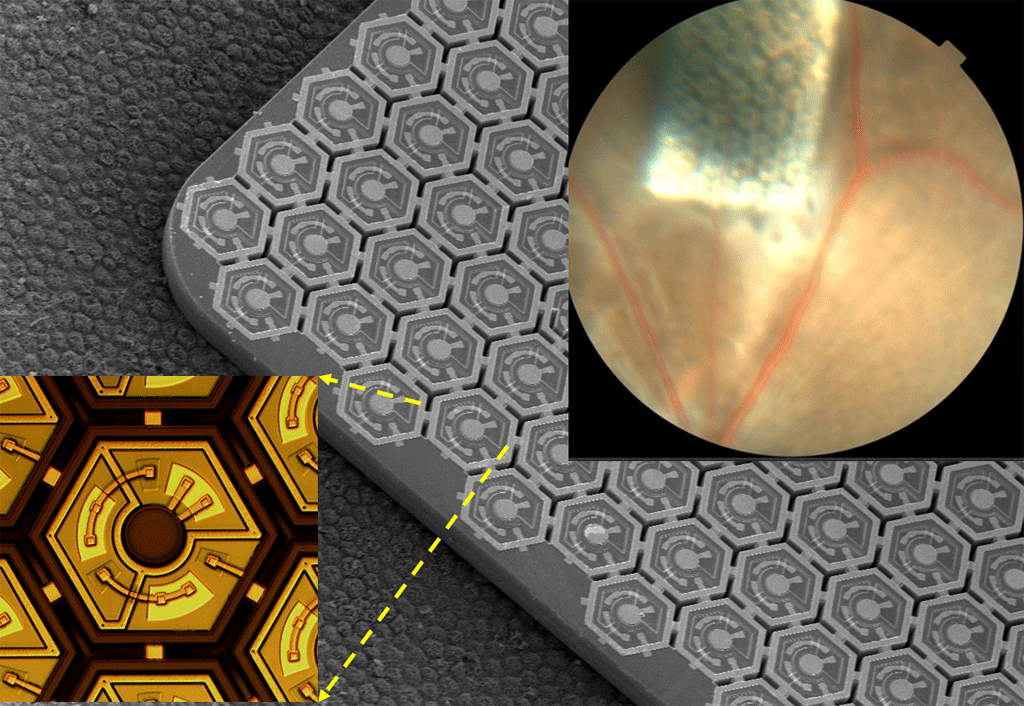
The wireless retinal implants convert
light
transmitted from special glasses
into
electrical current, stimulating
the retina's
bipolar cells. (Click to view
full size.)
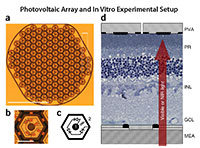
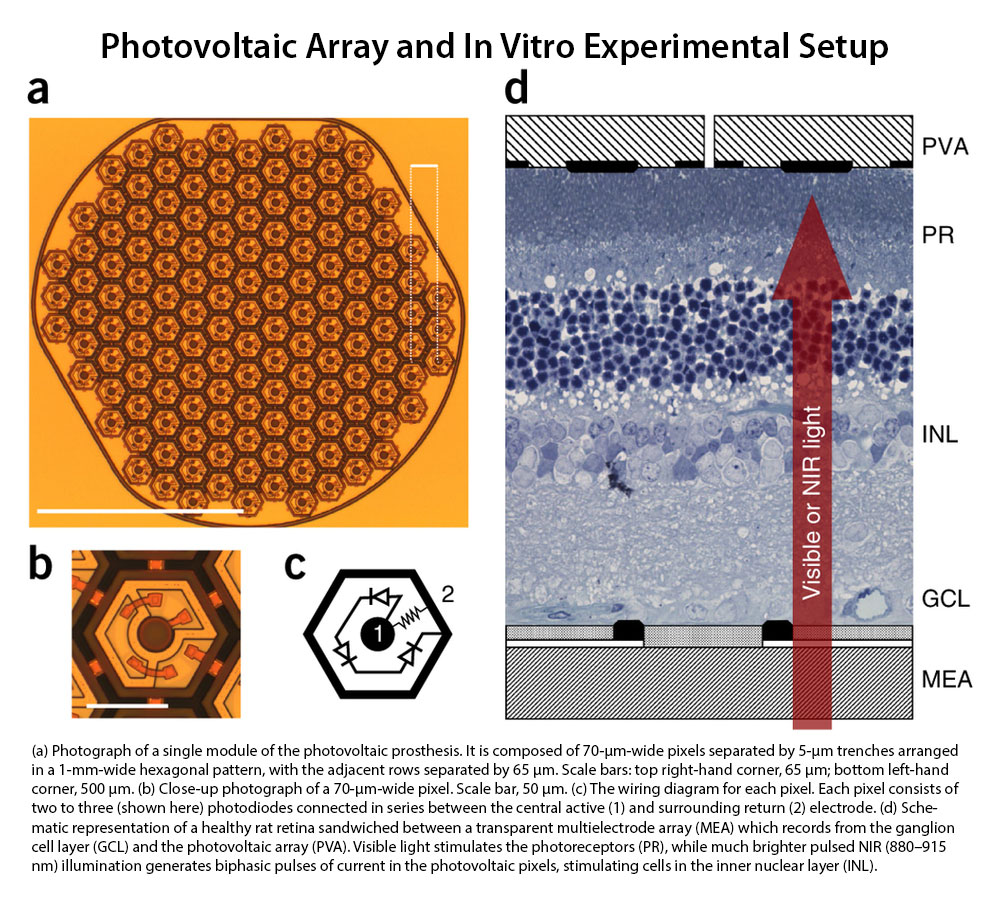
a) Photo of a single photovoltaic prosthesis
module; b) Close-up photograph
of a 70μm
wide pixel;
c)
Wiring diagram for each pixel;
d) Schematic representation of
implant in a
healthy rat. (Click to
view full size.)
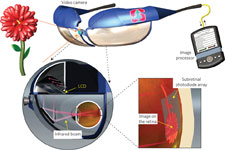
Schematic diagram of the photovoltaic
retinal prosthesis (Click to view full size.)
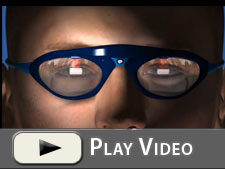
View 90-second YouTube video describing
the
photovoltaic retinal prostheisis.
All images and video courtesy of The
Palanker Group.
April 27, 2015 — Photovoltaic retinal implant developed by HEPL's Palanker Group, could restore functional sight
So far, the Palanker Group researchers have tested the device only in animals, but a clinical trial is planned next year in France.
Story by Becky Bach, Digital Media Specialist, Stanford Medical School Office of Communications & Public Affairs
A multidisciplinary Stanford/HEPL research team, led by Professor Daniel Palanker, has developed a wireless retinal implant that they say could restore vision five times better than existing devices.
Results in rat studies suggest it could provide functional vision to patients with retinal degenerative diseases, such as retinitis pigmentosa or macular degeneration.
A paper describing the implant was published online April 27 in Nature Medicine.
“The performance we’re observing at the moment is very encouraging,” said Georges Goetz, a lead author of the paper and graduate student in electrical engineering at Stanford. “Based on our current results, we hope that human recipients of this implant will be able to recognize objects and move about.”
Retinal degenerative diseases destroy photoreceptors — the retina’s rods and cones — but other parts of the eye usually remain healthy. The implant capitalizes on the electrical excitability of retinal neurons known as bipolar cells. These cells process the photoreceptors’ inputs before they reach ganglion cells, which send retinal signals to the brain. By stimulating bipolar cells, the implant takes advantage of important natural properties of the retinal neural network, which produces more refined images than the devices that skip these cells.
Made of silicon, the implant is composed of hexagonal photovoltaic pixels that convert light transmitted from special glasses worn by the recipient into electrical current. These electrical pulses then stimulate the retina’s bipolar cells, triggering a neural cascade that reaches the brain.
Clinical trial planned
So far, the team has tested the device only in animals, but a clinical trial is planned next year in France, in collaboration with a French company called Pixium Vision, said Daniel Palanker, PhD, professor of ophthalmology and a senior author of the paper. Initially, patients blinded by a genetic disease called retinitis pigmentosa will be included in the study.
Existing retinal prostheses are powered by extraocular devices wired to the retinal electrode array, which require complex surgeries, and provide visual acuity up to about 20/1,200. This new photovoltaic implant could be a big improvement because its small size, modularity and lack of wires enable a minimally invasive surgery. Vision tests in rats have shown it restores visual acuity to an equivalent of 20/250.
Next, Palanker and his team plan to further improve acuity by developing chips with smaller pixels. To ensure the signals reach the target neurons, they plan to add a tiny prong to each electrode that will protrude into the target cell layer.
“Eventually, we hope this technology will restore vision of 20/120,” Palanker said. “And if it works that well, it will become relevant to patients with age-related macular degeneration.”
Henri Lorach, PhD, a Stanford research associate, is the other lead author, and Alexander Sher, PhD, assistant professor of physics at the University of California-Santa Cruz, is the other senior author.
Other Stanford co-authors are Xin Lei, graduate student in electrical engineering; Theodore Kamins, PhD, consulting professor of electrical engineering; Philip Huie, PhD, senior research associate; and James Harris, PhD, professor of electrical engineering.
The research was funded by the National Institutes of Health (grant R01EY018608), the Department of Defense, the NIH Clinical and Translational Science Award (UL1RR025744), the Stanford Spectrum fund, la Fondation Voir et Entendre and Pixium Vision.
Information about the Department of Ophthalmology, which also supported the work, is available at http://ophthalmology.stanford.edu/.
For More Information
Photovoltaic restoration of sight with high visual acuity. Nature Medicine Article by Henri Lorach, Georges Goetz, Richard Smith, Xin Lei, Yossi Mandel, Theodore Kamins, Keith Mathieson, Philip Huie, James Harris, Alexander Sher & Daniel Palanker. Nature Medicine 21, 476–482 (2015) doi:10.1038/nm.3851 Published online 27 April 2015
Stanford Medicine News Release on the Photovoltaic Retinal Prosthesis, April 27, 2015
Restoring sight to the blind with a new photovoltaic retinal prosthesis. HEPL News Story, May 13, 2012
The Palanker Group: Photovoltaic Retinal Prosthesis for Restoring Sight to the Blind

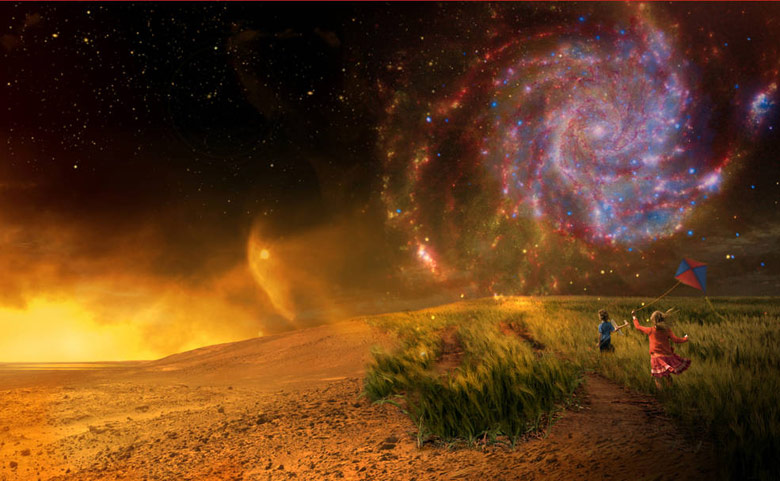
NASA Illustration.
A new program in the search for life
beyond our solar system will involve
Stanford, UC Berkeley and NASA and
will call on the skills of scientists
researching life on Earth, other
planets in our solar system,
and worlds that orbit other stars.
April 27, 2015 — Stanford and UC Berkeley partner on NASA's new effort to detect life on other planets
A new interdisciplinary research program from NASA brings together a team of scientists, including Stanford's Bruce Macintosh, to devise new technologies and techniques for detecting life on exoplanets.
(Story by Bjorn Carey. Reprinted from Stanford Report, April 27, 2015)
The study of exoplanets – planets around other stars – is a relatively new field, but planet-hunting efforts have been prolific. The discovery of the first exoplanet around a star like our sun was made in 1995, and NASA's Kepler space telescope has detected more than 1,000 exoplanets in the past six years.
Now a new NASA initiative aims to answer the big question: Is there life on these alien worlds? The NExSS (Nexus for Exoplanet System Science) initiative will bring together the "best and brightest," according to a NASA press release. NExSS will marshal the expertise of 10 universities, three NASA centers and two research institutes.
The program aims to better understand the various components of an exoplanet, as well as how the parent stars and neighboring planets might interact to support life. The program brings together planetary scientists, Earth scientists, heliophysicists and astronomers to identify and search for biosignatures, or signs of life.
"This interdisciplinary endeavor connects top research teams and provides a synthesized approach in the search for planets with the greatest potential for signs of life," said Jim Green, NASA’s director of planetary science. "The hunt for exoplanets is not only a priority for astronomers, it’s of keen interest to planetary and climate scientists as well."
One NExSS project, called "Exoplanets Unveiled," will specifically address this question: What are the properties of exoplanetary systems, particularly as they relate to their formation, evolution and potential to harbor life? The project is led by James Graham, a professor of astronomy at the University of California, Berkeley, and will draw upon the expertise of Bruce Macintosh, a professor of physics at Stanford and the principal investigator for the Gemini Planet Imager (GPI).
GPI, a new instrument for the Gemini Observatory, began its exoplanet survey at the Gemini South Telescope in November 2014. Most exoplanets are detected through the Doppler technique – measuring the "wobble" of the parent star as an unseen planet’s gravity tugs on it – or though detection of a transit, as the planet’s orbit brings it between the star and Earth.
As the newest generation of instruments for imaging exoplanets, GPI blocks out the bright star to directly see the faint planet next door. GPI has already imaged two previously known exoplanets and disks of planetary debris orbiting young stars where planets recently formed.
"Getting a complete picture of all the incredibly strange planetary systems out there will require every different technique," Macintosh said. "With this new collaboration, we will combine the strengths of imaging, Doppler and transits to characterize planets and their orbits."
The first image of an Earth-size exoplanet is still likely years away. GPI is currently only sensitive enough to detect infrared emission from hot, bright planets the size of Jupiter. Detecting the faint, reflected light of cooler, smaller planets will require next-generation technologies and techniques, which MacIntosh said will be developed via instruments like GPI for eventual use on future planet-finding missions such as NASA's Wide-Field Infrared Survey Telescope (WFIRST).
"If you could see reflected light, you might be able to see the signature of life," said Paul Kalas, an adjunct professor of astronomy at UC Berkeley and co-primary investigator for the project. "We are just now sowing the seeds to get to that point."
For More Information
Stanford and UC Berkeley partner on NASA's new effort to detect life on other planets by Bjorn Carrey, Stanford Report, April 27, 2015
Professor Bruce Macintosh — Stanford Physics Department Web Page
New planet-hunting camera produces best-ever image of an alien planet, says Stanford physicist. Stanford News Story by Bjorn Carey, May 16, 2014.
Gemni Planet Imager Website
Berkeley Nexus for Exoplanet System Science Website
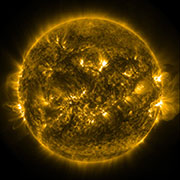
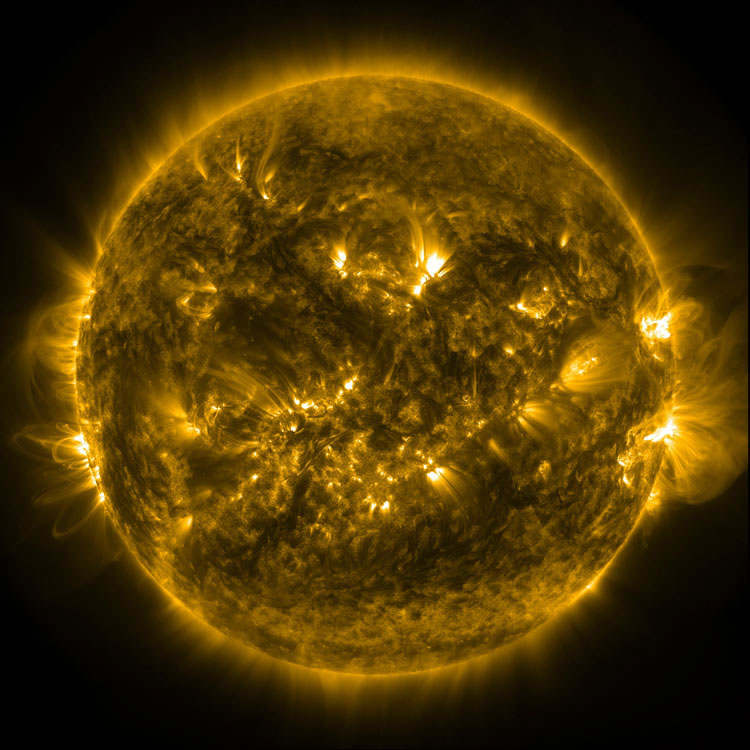
Image of a solar flare, captured
on 12 Jan 2015 by NASA's Solar
Dynamics Observatory (SDO).
Image Credit: NASA/SDO
and the
AIA,
EVE and HMI Science Teams
View a 20-minute silent video overview
of solar physics and the Stanford
Solar Observatories Group's HMI
(Helioseismic & Magnetic Imager)
January 14, 2015— Artificial Intelligence Helps Stanford Physicists Predict Dangerous Solar Flares
Though scientists do not completely understand what triggers solar flares, Stanford solar physicists Monica Bobra and Sebastien Couvidat have automated the analysis of those gigantic explosions. The method could someday provide advance warning to protect power grids and communication satellites.
Story by Leslie Willoughby. Reprinted from the Stanford Report, January 14, 2015
Solar flares can release the energy equivalent of many atomic bombs, enough to cut out satellite communications and damage power grids on Earth, 93 million miles away. The flares arise from twisted magnetic fields that occur all over the sun's surface, and they increase in frequency every 11 years, a cycle that is now at its maximum.
Using artificial intelligence techniques, Stanford solar physicists Monica Bobra and Sebastien Couvidat have automated the analysis of the largest ever set of solar observations to forecast solar flares using data from the Solar Dynamics Observatory (SDO), which takes more data than any other satellite in NASA history. Their study identifies which features are most useful for predicting solar flares.
Specifically, their study required analyzing vector magnetic field data. Historically, instruments measured the line-of-sight component of the solar magnetic field, an approach that showed only the amplitude of the field. Later, instruments showed the strength and direction of the fields, called vector magnetic fields, but for only a small part of the sun, or part of the time. Now an instrument on a satellite-based system, the Helioseismic Magnetic Imager (HMI) aboard SDO, collects vector magnetic fields and other observations of the entire sun almost continuously.
Adding machine learning
The Stanford Solar Observatories Group, headed by physics Professor Phil Scherrer, processes and stores the SDO data, which takes 1.5 terabytes of data a day. During a recent afternoon tea break, Bobra and Couvidat chatted about what they might do with all that data and talked about trying something different.
They recognized the difficulty of forming predictions when using pure theory and they had heard of the popularity of the online class on machine learning taught by Andrew Ng, a Stanford professor of computer science.
"Machine learning is a sophisticated way to analyze a ton of data and classify it into different groups," Bobra said.
Machine learning software ascribes information to a set of established categories. The software looks for patterns and tries to see which information is relevant for predicting a particular category.
For example, one could use machine-learning software to predict whether or not people are fast swimmers. First, the software looks at features of swimmers – for example, their heights, weights, dietary habits, sleeping habits, their dogs' names and their dates of birth.
And then, through a guess and check strategy, the software would try to identify which information is useful in predicting whether or not a swimmer is particularly speedy. It could look at a swimmer's height and guess whether that particular height lies within the height range of speedy swimmers, yes or no. If it guessed correctly, it would "learn" that the height might be a good predictor of speed.
The software might find that a swimmer's sleeping habits are good predictors of speed, whereas the name of the swimmer's dog is not.
The predictions would not be very accurate after analysis of just the first few swimmers. The more information provided, the better machine learning gets at predicting.
Similarly, the researchers wanted to know how successfully machine learning would predict the strength of solar flares from information about sunspots.
"We had never worked with the machine learning algorithm before, but after we took the course we thought it would be a good idea to apply it to solar flare forecasting," Couvidat said. He and Bobra applied the algorithms and characterized the features of the two strongest classes of solar flares, M and X. Though others have used machine learning algorithms to predict solar flares, nobody has done it with such a large set of data and or with vector magnetic field observations.
M-class flares can cause minor radiation storms that might endanger astronauts and cause brief radio blackouts at Earth's poles. X-class flares are the most powerful.
Better flare prediction
The researchers catalogued flaring and non-flaring regions from a database of more than 2,000 active regions and then characterized those regions by 25 features such as energy, current and field gradient. They then fed the learning machine 70 percent of the data, to train it to identify relevant features. And then they used the machine to analyze the remaining 30 percent of the data to test its accuracy in predicting solar flares.
Machine learning confirmed that the topology of the magnetic field and the energy stored in the magnetic field are very relevant to predicting solar flares. Using just a few of the 25 features, machine learning discriminated between active regions that would flare and those that would not flare. Although others have used different methods to come up with similar results, machine learning provides a significant improvement because automated analysis is faster and could provide earlier warnings of solar flares.
However, this study only used information from the solar surface. That would be like trying to predict Earth's weather from only surface measurements like temperature, without considering the wind and cloud cover. The next step in solar flare prediction would be to incorporate data from the sun's atmosphere, Bobra said.
Doing so would allow Bobra to pursue her passion for solar physics. "It's exciting because we not only have a ton of data, but the images are just so beautiful," she said. "And it's truly universal. Creatures from a different galaxy could be learning these same principles."
Monica Bobra and Sebastien Couvidat worked under the direction of physicist Phil Scherrer of the WW Hansen Experimental Physics Laboratory at Stanford.
Leslie Willoughby is an intern at the Stanford News Service.
For More Information
Stanford Solar Physics/Observatories Group Website—http://sun.stanford.edu
NASA Solar Dynamics Observatory (SDO) website
NASA Living With A Star Program
NASA SDO: StanfordHelioseismic and Magnetic Imager (HMI) Website
NASA SDO: Atmospheric Imaging Assembly (AIA) Website
NASA SDO: Extreme Ultraviolet Variability Experiment (EVE) Website
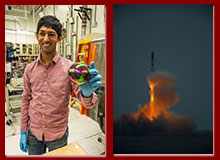
Left: HEPL doctoral candidate, Karthik
Balakrishnan
holds a spherical proof
mass from his UV-LED charge control
experiment in the lab. Right: A Russian-
Ukranian Dnepr rocket launches
Karthik's experiment, housed in a Saudi
Arabian satellite, into orbit.
Given the current political state of the world, you might think that the headline above describes a doctoral candidate’s pipe dream. However, back on June 19, 2014, this satellite launch event actually happened!
Karthik Balakrishnan is a doctoral student in the Aeronautics and Astronautics Department of Stanford’s School of Engineering. His research on charge control systems for satellite guidance is sponsored by HEPL and the Center for Excellence in Aeronautics and Astronautics (a collaboration between Stanford and the King Abdulaziz City for Science and Technology in Saudi Arabia), and it is being carried out in the laboratory of Robert Byer, Professor of Lasers and Optics in Stanford’s Department of Applied Physics. Professor Byer is also a former director of HEPL. Mr. Balakrishnan’s experimental apparatus uses low-power, ultraviolet frequency LEDs to remove electrostatic charge buildup from a baseball-sized, gold-coated sphere comprising the guidance control mechanism that enables a satellite to circle the Earth (or another planet or the Sun) as a gravitational reference sensor (GRS). Read Full Story...
March 17, 2014 — New Evidence from Space Supports Stanford Physicist's Theory of How the Universe Began
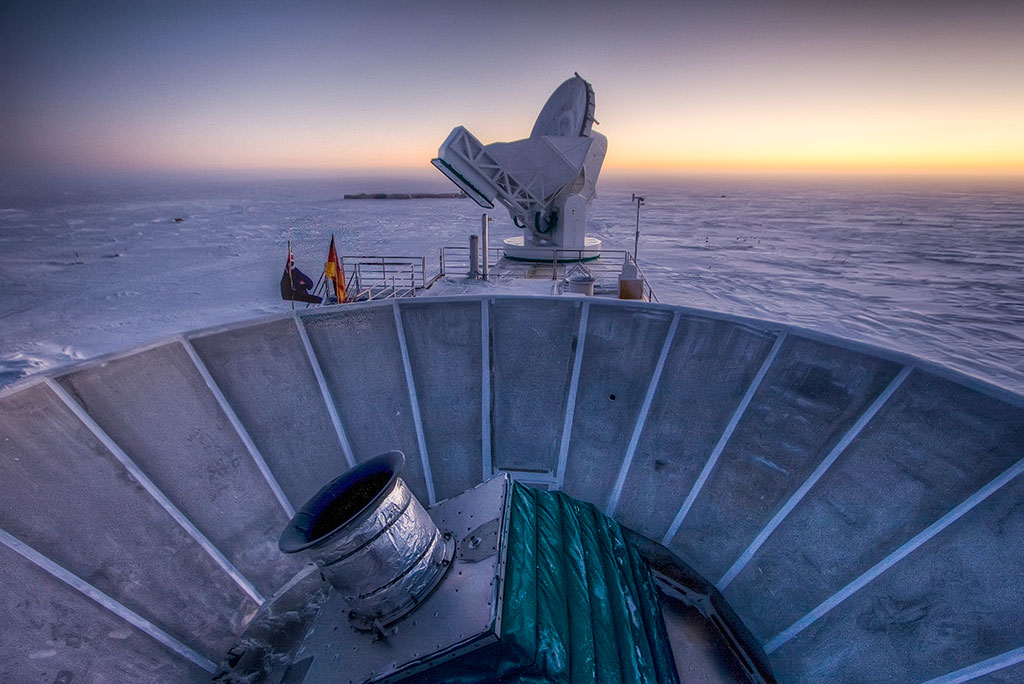
The detection of gravitational waves by the BICEP2 experiment at the South Pole supports the cosmic inflation theory of how the universe came to be. The discovery, made in part by Assistant Professor Chao-Lin Kuo, supports the theoretical work of Stanford's Andrei Linde.
(Story by Bjorn Carey. Reprinted from Stanford Report, March 17, 2014)
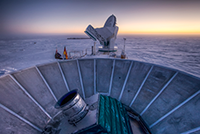
BICEP2 telescope (foreground) and
the South Pole Telescope
( background). Photo: Steffen Richter,
Harvard University
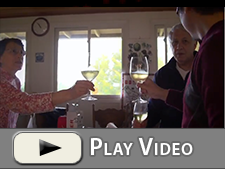
Stanford physicist, Andre Linde and his
wife, receive the news of data confirming
Linde's theory of cosmic inflaction from
Chao-Lin Kuo, Assistant Professor of
Physics at HEPL and SLAC.
Video by Kurt Hickman
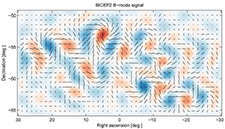
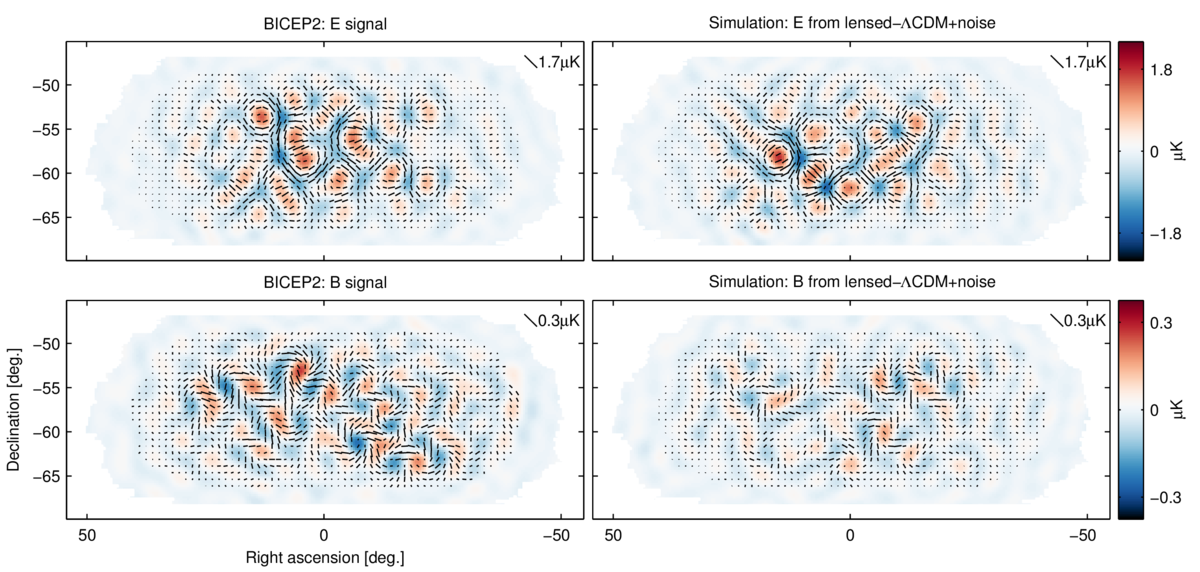
The signature of primordial gravitational
waves, as seen in the cosmic microwave
background in the image, are twisting
patterns known as B-mode polarization.
(Image Credit: BICEP2 Project)
Almost 14 billion years ago, the universe we inhabit burst into existence in an extraordinary event that initiated the Big Bang. In the first fleeting fraction of a second, the universe expanded exponentially, stretching far beyond the view of today's best telescopes. All this, of course, has just been theory.
Researchers from the BICEP2 collaboration today announced the first direct evidence supporting this theory, known as "cosmic inflation." Their data also represent the first images of gravitational waves, or ripples in space-time. These waves have been described as the "first tremors of the Big Bang." Finally, the data confirm a deep connection between quantum mechanics and general relativity.
"This is really exciting. We have made the first direct image of gravitational waves, or ripples in space-time across the primordial sky, and verified a theory about the creation of the whole universe," said Chao-Lin Kuo, an assistant professor of physics at Stanford and SLAC National Accelerator Laboratory, and a co-leader of the BICEP2 collaboration.
These groundbreaking results came from observations by the BICEP2 telescope of the cosmic microwave background – a faint glow left over from the Big Bang. Tiny fluctuations in this afterglow provide clues to conditions in the early universe. For example, small differences in temperature across the sky show where parts of the universe were denser, eventually condensing into galaxies and galactic clusters.
Because the cosmic microwave background is a form of light, it exhibits all the properties of light, including polarization. On Earth, sunlight is scattered by the atmosphere and becomes polarized, which is why polarized sunglasses help reduce glare. In space, the cosmic microwave background was scattered by atoms and electrons and became polarized too.
"Our team hunted for a special type of polarization called 'B-modes,' which represents a twisting or 'curl' pattern in the polarized orientations of the ancient light," said BICEP2 co-leader Jamie Bock, a professor of physics at Caltech and NASA's Jet Propulsion Laboratory (JPL).
Gravitational waves squeeze space as they travel, and this squeezing produces a distinct pattern in the cosmic microwave background. Gravitational waves have a "handedness," much like light waves, and can have left- and right-handed polarizations.
"The swirly B-mode pattern is a unique signature of gravitational waves because of their handedness," Kuo said.
The team examined spatial scales on the sky spanning about 1 to 5 degrees (two to 10 times the width of the full moon). To do this, they set up an experiment at the South Pole to take advantage of its cold, dry, stable air, which allows for crisp detection of faint cosmic light.
"The South Pole is the closest you can get to space and still be on the ground," said BICEP2 co-principal investigator John Kovac, an associate professor of astronomy and physics at Harvard-Smithsonian Center for Astrophysics, who led the deployment and science operation of the project. "It's one of the driest and clearest locations on Earth, perfect for observing the faint microwaves from the Big Bang."
The researchers were surprised to detect a B-mode polarization signal considerably stronger than many cosmologists expected. The team analyzed their data for more than three years in an effort to rule out any errors. They also considered whether dust in our galaxy could produce the observed pattern, but the data suggest this is highly unlikely.
"This has been like looking for a needle in a haystack, but instead we found a crowbar," said co-leader Clem Pryke, an associate professor of physics and astronomy at the University of Minnesota.
Physicist Alan Guth formally proposed inflationary theory in 1980, when he was a postdoctoral scholar at SLAC, as a modification of conventional Big Bang theory. Instead of the universe beginning as a rapidly expanding fireball, Guth theorized that the universe inflated extremely rapidly from a tiny piece of space and became exponentially larger in a fraction of a second. This idea immediately attracted lots of attention because it could provide a unique solution to many difficult problems of the standard Big Bang theory.
However, as Guth, who is now a professor of physics at MIT, immediately realized, certain predictions in his scenario contradicted observational data. In the early 1980s, Russian physicist Andrei Linde modified the model into a concept called "new inflation" and again to "eternal chaotic inflation," both of which generated predictions that closely matched actual observations of the sky.
Linde, now a professor of physics at Stanford, could not hide his excitement about the news. "These results are a smoking gun for inflation, because alternative theories do not predict such a signal," he said. "This is something I have been hoping to see for 30 years."
BICEP2's measurements of inflationary gravitational waves are an impressive combination of theoretical reasoning and cutting-edge technology. Stanford's contribution to the discovery extends beyond Kuo, who designed the polarization detectors. Kent Irwin, a professor of physics at Stanford and SLAC, also conducted pioneering work on superconducting sensors and readout systems used in the experiment. The research also involved several researchers, including Kuo, affiliated with the Kavli Institute for Particle Astrophysics and Cosmology (KIPAC), which is supported by Stanford, SLAC and the Kavli Foundation.
BICEP2 is the second stage of a coordinated program, the BICEP and Keck Array experiments, which has a co-principal investigator structure. The four PIs are Jamie Bock (Caltech/JPL,) John Kovac (Harvard), Chao-Lin Kuo (Stanford/SLAC) and Clem Pryke (UMN). All have worked together on the present result, along with talented teams of students and scientists. Other major collaborating institutions for BICEP2 include the University of California, San Diego; University of British Columbia; National Institute of Standards and Technology; University of Toronto; Cardiff University; and Commissariat à l'Énergie Atomique.
BICEP2 is funded by the National Science Foundation (NSF). NSF also runs the South Pole Station where BICEP2 and the other telescopes used in this work are located. The Keck Foundation also contributed major funding for the construction of the team's telescopes. NASA, JPL and the Moore Foundation generously supported the development of the ultra-sensitive detector arrays that made these measurements possible.
For More Information
New evidence from space supports Stanford physicist's theory of how universe began by Bjorn Carey, Stanford Report, March 17, 2014
SLAC, Stanford Scientists Play Key Roles in Confirming Cosmic Inflation by Glennda Chui, SLAC News, March 19, 2014
Many hands enable discovery of cosmic inflation by Craig Hogan and Glennda Chui, Symmetry Magazine, March 19, 2014
BICEP 2014 Results Release Website
First Direct Evidence of Cosmic Inflation, Harvard-Smithsonian Center for Astrophysics Press Release, March 17, 2014
How astronomers saw gravitational waves from the Big Bang by Ron Cowen, Nature.com, March 17, 2014
First Wrinkles in Spacetime Confirm Cosmic Inflation by Adrian Cho, Yudhijit Bhattacharjee, AAAS Science, March 21, 2014
Space Ripples Reveal Big Bang’s Smoking Gun by Dennis Overbye, New York Times, March 17, 2014
Gravitational waves unmask universe just after Big Bang by Christopher Crockett, Science News, March 17, 2014
Worlds Without End by Scott Shackelford, Stanford Report, November/December 2007
February 10, 2014 — HEPL Physicist, Leo Hollberg, and Two Former NIST Colleagues Share 2014 Rank Optoelectronics Prize for Their Development of Chip-Scale Atomic Clock
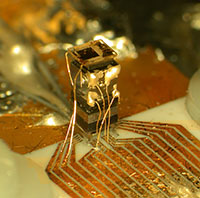
Photograph of the original NIST
atomic
clock on
a chip in 2004.
Photo Credit: NIST
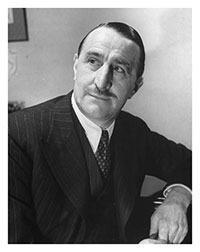
Lord Joseph Arthur Rank
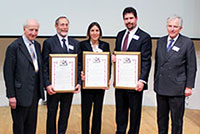
Atomic clock winners of the 2014
Rank
ptoelectronics Prize
(Left-Right) :
Lord Selborne (Rank
Prize Committee),
Stanford Physics
Professor Leo Hollberg,
Dr. Svenja
Knappe (NIST), Dr. John
Kitching
(NIST) and Lord Waldegrave
(Rank Prize
Committee)
On February 10, 2014, Stanford/HEPL physics Professor, Leo Hollberg, flew to London to join his former colleagues, Dr. Svenja Knappe and Dr. John Kitching from the National Institute of Standards and Technology (NIST), in accepting a £45,000 ($75,000) 2014 Optoelectronics Prize from the Rank Foundation. The prize was split equally between Hollberg, Knappe and Kitching.
Atomic Clocks on a Chip
The NIST Atomic Devices and Instrumentation (ADI) Group designs, builds, and characterizes innovative miniature atomic instruments and sensors using precision atomic spectroscopy and fabrication techniques traditionally used in the field of microelectronics and micro-electromechanical systems (MEMS).
Since 1967, atomic clocks based on cesium 133 vapor, defined the standard for the second. However such clocks were usually power hungry and bulky because they required a substantial resonant microwave cavity. A major breakthrough in improving such clocks occurred in 2001 when Hollberg, working in the NIST ADI Group with two associates, Knappe and Kitching, used MEMs technology to create a millimeter-sized cesium chamber.
Hollberg, Knappe and Kitching presented their first results in 2002. This work led to US research agency DARPA funding a project to develop chip-scale atomic clocks (CSACs). Such clocks are now commercially available for about $1500, but are expected to become cheaper as sales volumes increase. Measuring just 40x35x11mm, weighing 35g and using only 100mW of power these micro clocks are accurate to: +/- 1s in 300 years— three orders of magnitude better than the original crystal atomic clocks.
NIST's chip-scale atomic clock made highly accurate timekeeping portable. This is useful, for example, when navigating locations where GPS doesn't work such as in underwater resource exploration. Clocks of a similar basic design were commercialized several years ago. NIST's early experimental chip-scale atomic clock recently went on display in the Smithsonian Institution's Time and Navigation exhibit (http://timeandnavigation.si.edu/).
Kitching, Knappe and Hollberg also developed a spinoff technology, chip-scale atomic magnetometers, first introduced in 2005. Kitching and Knappe are now studying the possible use of these devices in medical applications such as measuring human brain activity.
The Rank Prize
The Rank Prize Funds is a charitable organization which seeks to recognize excellence and reward innovators for their dedication and outstanding contribution in two specific fields of research and development:
- Nutrition (Human and Animal Nutrition and Crop Husbandry)
- Optoelectronics (The interface between optics and electronics and nearly related phenomena)
This curious division of research areas for which the bi-annual Rank Prize is awarded results from Lord Rank's two career paths—his family milling business and his film studios and commercial cinema production companies.
Lord Joseph Arthur Rank (1888 - 1972) was the son of Joseph Rank, a prominent Yorkshire mill owner. At the age of 17 he joined his father's flour milling business, in which he was employed throughout the early part of his life. Lord Rank was a devout Christian and it was his interest in showing religious films to children in the Sunday school of his local church which first brought him into the world of cinema and so changed the course of his career. Starting by financing the production of films, he went on to acquire and develop interests in all areas of the cinema industry—exhibition, distribution, production, studios and technology.
Lord and Lady Rank undertook a wide range of charitable work throughout their lives. In 1953 they set up The J. Arthur Rank Group Charity (now The Rank Foundation http://www.rankfoundation.com), from which donations were later made to endow The Rank Prize Funds. In establishing charitable foundations, Lord Rank followed in a tradition established by his father, Joseph Rank, whose work continues today through The Joseph Rank Trust http://www.ranktrust.org
The Rank Prize Funds were established in February 1972, a month before Lord Rank's death. In addition to the 2014 Rank Optoelectronnics Prize awarded to Hollberg, Knappe and Kitching, a £60,000 ($100,000) Optoelectronics Prize was awarded to to four scientists for thier pioneering work on strained-layer laser structures.
Sources for this Story and More Information
NIST Tech Beat Newsletter (NIST Physical Measurement Laboratory) May 2013: NIST Scientists Win 2014 Rank Prizes for Chip-Scale Atomic Clock by Laura Ost
NIST Atomic Devices and Instrumentation Group website
Optics.org — Photonics World: Photonics R&D breakthroughs share in $300,000 Rank Prizes by Matthew Peach, February 2014
The Rank Prize Funds website
Professor Leo Hollberg, Stanford Physics Department
November 21, 2013 — Stanford's Fermi Gamma-ray Large Area Space Telescope Detects Most Energetic Gamma-ray Burst On Record
(Story by Bjorn Carey. Reprinted from Stanford Report, November 21, 2013)
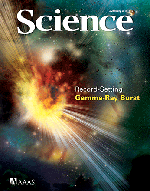
Artist's conception of gamma-
ray burst (GRB) 130427A, one
of the brightest and longest-
lived GRBs observed to date.
Image: NASA/Fermi and
Sonoma State University/
Aurore Simonnet
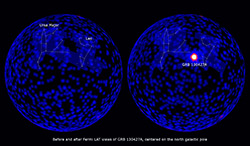
Gamma-ray sky map before (left) and during
GRB
130427A (right) in the constellation, Leo
(Click to view full size.)
Animation showing high-energy gamma-
rays starting three minutes before the
burst to 14 hours after. Following an initial
one-second spike, the Fermi LAT emission
remained relatively quiet for the next 15
seconds while Fermi's GBM instrument
showed bright, variable lower-energy
emission. Then the burst re-brightened
in the LAT over the next few minutes and
remained bright for nearly half a day.
Credit: NASA Goddard Space Flight Center
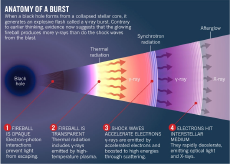
When the core of a massive star collapses,
it can eject a jet of gas into space at nearly
the speed of light. Collisions between the
fast-moving gas and its surroundings,
as well as within the jet itself, create
gamma rays
Source: NASA Goddard Space Flight Center
(Click to view full size.)
View 56-second YouTube video animation
showing the formation of GRB 130427A
This past April, an incredibly bright flash of light burst from near the constellation Leo. Originating billions of light years away, this explosion of light, called a gamma ray burst, has now been confirmed as the brightest gamma ray burst ever observed. Astronomers around the world were able to view the blast in unprecedented detail and observe several aspects of the event for the first time ever. The data could lead to a rewrite of standard theories of how gamma ray bursts work.
The blast, named GRB 130427A, was observed by several space- and ground-based telescopes, and the data was analyzed by dozens of astronomers around the world. The Fermi Gamma-ray Space Telescope was the first to detect the event, and it quickly began monitoring the flood of radiation using its Large Area Telescope (LAT), whose principal investigator is Peter Michelson, a physics professor at Stanford and the SLAC National Accelerator Laboratory. Michelson leads the international collaboration that built and operates the LAT.
Fermi's quick action, allowing the LAT to record nearly the entire event, yielded incredible data that revealed previously unknown aspects of the mechanisms involved in a gamma ray burst. The findings are reported in a series of papers published by the journal Science at the Science Express website on Nov. 21.
A special cosmic event
Several features of GRB 130427A combined to make it of particular interest to astronomers. First, its light traveled 3.6 billion years before arriving at Earth, about one-third the travel time for light from typical bursts. The record-setting 20 hours that the LAT observed gamma rays was longer than any other observed GRB. And, in addition to being the brightest GRB ever witnessed, it was also one of the most energetic. "When that happens, we start seeing features that we were not able to observe before," said Nicola Omodei, a research associate at Stanford's Hansen Experimental Physics Laboratory who led LAT data analysis for one of the Science papers. "Especially because it was very bright, you can uncover features that were not predicted by the standard models."
The leading theory explaining long gamma ray bursts such as GRB 130427A posits that they are created during the most energetic explosions in the cosmos, which occur when a very massive star collapses on itself. These explosions erupt a jet of elementary particles traveling at close to the speed of light. Within the jet, pressure, temperature and density are not uniform, creating internal shock waves that move inward and outward as faster regions within the jet collide with slower ones. As the jet travels outward, it collides with the interstellar medium to create additional shock waves, called "external shocks." Although details are not well understood, particles are accelerated at the shock front and, at the same time, interact with the surrounding electromagnetic fields. This causes particles to lose part of their energy emitting photons, through a process known as synchrotron radiation. The balance between the gain in energy from acceleration by the shock and the loss of energy due to synchrotron radiation dictates the maximum energy of the photons that can be emitted by such a system. The highest energy photons among these are classified as gamma rays and are detected by the LAT.
An unexpected observation
The observations of GRB 130427A, however, didn't quite match energy levels predicted by these models. For instance, the telescopes detected more photons, and more high-energy gamma rays, than theoretical models would predict for a burst of this magnitude. In particular, a few of these high-energy events are so energetic that they cannot be produced via existing models of synchrotron radiation from shock-accelerated particles. Additionally, the prevailing thought was that the brightest flashes were driven by the explosion's internal shock waves, but the evidence indicates that these photons were created externally. "It's like having a blanket that's too short. You pull it up to your chin and uncover your toes," Omodei said. "With our standard model, if you try to explain the pulse, you will fail to explain the energy."
The new observations don't rule out the existing model, but researchers will need to either amend portions of it or adopt a new theory altogether to account for these characteristics, said Giacomo Vianello, a postdoctoral scholar in Michelson's group and a co-author who performed LAT data analysis and interpretation on three of the Science papers. The microphysics of how particles are accelerated involves a certain amount of well-thought assumptions, and these assumptions therefore get built into the theoretical models used to predict the behavior of cosmic events. The assumptions are necessary in part because these events cannot be recreated in laboratory settings, he said, which highlights the critical role that observations play in the fine-tuning of fundamental physics theories.
"The really cool thing about this GRB is that because the exploding matter was traveling at the speed of light, we were able to observe relativistic shocks," Vianello said. "We cannot make a relativistic shock in the lab, so we really don't know what happens in it, and this is one of the main unknown assumptions in the model. These observations challenge the models and can lead us to a better understanding of physics."
For More Information:
2013 Stanford Annual Report, Physical Sciences Research Highlights
High-energy gamma ray burst could re-shape astrophysics theories, Stanford scientists say. Stanford Report, November 21, 2013:
Fermi-LAT Observations of the Gamma-Ray Burst GRB 130427A. AAAS Science Express, Science DOI: 10.1126/science.1242353, Published online November 21, 2013
NASA's Fermi & SWIFT Telescopes See "Shockingly Bright" Gamma-ray Burst. May 5, 2013
AAAS Science Magazine, 3 January 2014, vol 343, issue 6166, pp. 34-51
November 6, 2013 — A Particle Accelerator on a Silicon Chip
(Story by Mike Ross. Reprinted from Stanford Report, September 27, 2013)
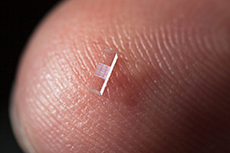
A nanofabricated chip of fused silica just
3
millimeters long was used to accelerate
electrons at a rate 10 times higher than
conventional particle accelerators.
Photo: Brad Plummer/SLAC
(Click to view full size.)
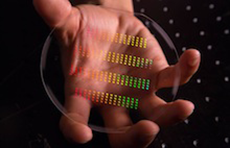
The nanoscale patterns of SLAC and
Stanford's accelerator on a chip gleam in
rainbow colors prior to being assembled
and cut into their final forms.
Photo: Matt Beardsley/SLAC
(Click to view full size.)
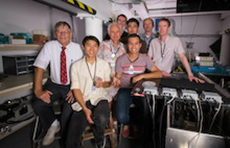
Members of the Accelerator on a Chip
project team.
Left to right: Robert Byer,
Ken Soong, Dieter Walz, Ken Leedle,
Ziran Wu, Edgar Peralta, Jim Spencer
and Joel England.
Photo: Matt Beardsley/SLAC
(Click to view full size.)
View 2 min YouTube video overview
of accelerator on a chip by project
manager, Joel England.
View 95-second YouTube video animation
of how accelerator on a chip works
In an advance that could dramatically shrink particle accelerators for science and medicine, researchers used a laser to accelerate electrons at a rate 10 times higher than conventional technology in a nanostructured glass chip smaller than a grain of rice. The achievement was reported today in the journal Nature by a team including scientists from the U.S. Department of Energy's SLAC National Accelerator Laboratory and Stanford University.
"We still have a number of challenges before this technology becomes practical for real-world use, but eventually it would substantially reduce the size and cost of future high-energy particle colliders for exploring the world of fundamental particles and forces," said Joel England, the SLAC physicist who led the experiments. "It could also help enable compact accelerators and X-ray devices for security scanning, medical therapy and imaging, and research in biology and materials science."
Because it employs commercial lasers and low-cost, mass-production techniques, the researchers believe it will set the stage for new generations of "tabletop" accelerators. At its full potential, the new "accelerator on a chip" could match the accelerating power of SLAC's 2-mile-long linear accelerator in just 100 feet, and deliver a million more electron pulses per second. This initial demonstration achieved an acceleration gradient, or amount of energy gained per length of the accelerator, of 300 million electronvolts per meter. That's roughly 10 times the acceleration provided by the current SLAC linear accelerator. "Our ultimate goal for this structure is one billion electronvolts per meter, and we're already one-third of the way in our first experiment," said Stanford applied physics Professor Robert Byer, the principal investigator for this research.
Today's accelerators use microwaves to boost the energy of electrons. Researchers have been looking for more economical alternatives, and this new technique, which uses ultrafast lasers to drive the accelerator, is a leading candidate. Particles are generally accelerated in two stages. First they are boosted to nearly the speed of light. Then any additional acceleration increases their energy, but not their speed; this is the challenging part.
In the accelerator-on-a-chip experiments, electrons are first accelerated to near light-speed in a conventional accelerator. Then they are focused into a tiny, half-micron-high channel within a glass chip just half a millimeter long. The channel had earlier been patterned with precisely spaced nanoscale ridges. Infrared laser light shining on the pattern generates electrical fields that interact with the electrons in the channel to boost their energy. (View animation for more detail.)
Turning the accelerator on a chip into a full-fledged tabletop accelerator will require a more compact way to get the electrons up to speed before they enter the device. A collaborating research group in Germany, led by Peter Hommelhoff at Friedrich Alexander University and the Max Planck Institute of Quantum Optics, has been looking for such a solution. It simultaneously reports in Physical Review Letters its success in using a laser to accelerate lower-energy electrons.
Applications for these new particle accelerators would go well beyond particle physics research. Byer said laser accelerators could drive compact X-ray free-electron lasers, comparable to SLAC's Linac Coherent Light Source, that are all-purpose tools for a wide range of research. Another possible application is small, portable X-ray sources to improve medical care for people injured in combat, as well as to provide more affordable medical imaging for hospitals and laboratories. That's one of the goals of the Defense Advanced Research Projects Agency's Advanced X-Ray Integrated Sources program, which partially funded this research. Primary funding for this research is from the U.S. Department of Energy Office of Science.
The study's lead authors were Stanford graduate students Edgar Peralta and Ken Soong. Peralta created the patterned fused silica chips in the Stanford Nanofabrication Facility. Soong implemented the high-precision laser optics for the experiment at SLAC's Next Linear Collider Test Accelerator. Additional contributors included researchers from the University of California-Los Angeles and Tech-X Corp. in Boulder, Colo.
For more information:
Demonstration of electron acceleration in a laser-driven dielectric microstructure by Peralta, Soong et. al. Nature Online: 503, 91–94 (November 7,2013)
Demonstration of electron acceleration in a laser-driven dielectric microstructure by Peralta, Soong et. al—Full Text PDF
Small is Reall Beautiful. The Economist, October 19, 2013
American Physical Society Focus: Accelerating Electrons with Light. Physics 6, 106 (September 27, 2013)
SLAC Press Release: September 27, 2013
September 1, 2013 — Sarah Church succeeds Peter Michelson as HEPL Director
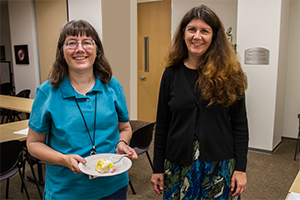
New HEPL Director, Sarah Church (left), with HEPL
Administrative Director, Nancy Christiansen, enjoying
refreshments following a HEPL Administrative
Committee meeting on September 9, 2013.
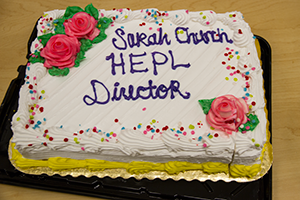
An official "Sarach Church HEPL Director" cake
welcoming Professor Church as the new HEPL
Director, was served as part of the refreshments
following the HEPL Administrative Committee meeting.
On September 1, 2013, physics professor Sarah Church became the new Director of HEPL. Professor Church is the eleventh person to oversee and direct the lab's activities during its 58-year history, beginning in 1951 when the lab was officially founded as the Stanford "High Energy Physics Lab" (also abbreviated HEPL). In 1990, the lab was renamed the" W.W. Hansen Experimental Physics Lab," honoring pioneering physicist and engineer, William W. Hansen.
The directorship of HEPL is a rotating position among the faculty members whose research programs are administered by HEPL. Having just completed his four-year term as HEPL Director, Professor Peter Michelson is keeping busy as Chairman of the Physics Department, as well as Principal Investigator of the NASA-funded Fermi Gamma-ray Large-Area Space Telescope program.
Professor Church, who heads the Church Group that builds instrumentation at centimeter and millimeter wavelengths to study the early universe, has kindly agreed to take the helm of HEPL for the next three-four years.
To commemorate this transition in HEPL leadership, an informal ceremony was held following the monthly HEPL Administrative Committee meeting on September 9, 2013, which was chaired by Professor Church. Refreshments were served, including a cake welcoming the new director, and all HEPL faculty and staff were invited to attend.
You can read more about the colorful history of HEPL and its previous directors on the About HEPL page of this web site.
January 29, 2013 — Fermi LAT Physicist, Roger Romani, wins 2013 Rossi Prize
(Reprinted from Stanford News: The Dish, January 29, 2013)
Fermi
LAT
Physicist,
Roger Romani
Stanford physics Professor, Roger W. Romani, will share the 2013 Rossi Prize with Alice Harding of NASA's Goddard Space Flight Center. The prize is being awarded to them by the American Astronomical Society for establishing a theoretical framework for understanding gamma-ray pulsars.
Gamma-ray pulsars are unusual cosmic objects: They are the remnants of massive stars that have exploded as supernovae and are now rapidly spinning neutron stars that emit gamma-ray photons and sometimes (but not always) radio photons. By elucidating the theoretical behavior of these irregular objects, Harding and Romani made possible many of the observations made with the Fermi Gamma-ray Space Telescope.
"While pulsars were discovered nearly 50 years ago via their radio emissions, it turns out that the radio pulses are just an energetically insignificant echo of the particle accelerators blasting away in these exotic stars' magnetospheres," said Romani. "Fermi, by detecting gamma rays from over 100 of these neutron stars, has revealed to us the heart of the pulsar machine."
"I am thrilled that Roger W. Romani's many contributions to our understanding of pulsars have been acknowledged in this way," said ROGER BLANDFORD, a physics professor at Stanford and the SLAC National Accelerator Laboratory and the 2013 winner of Britain's Royal Astronomical Society's highest honor, the Gold Medal.
"They have provided the essential connection between the basic theory of these fascinating objects and what we actually observe. This, in turn, has enabled the great discoveries made using Fermi," Blandford added.
The prize is awarded annually by the American Astronomical Society's High-Energy Astrophysics Division to recognize significant contributions in high-energy astrophysics. The award is named in honor of Bruno Rossi, an authority on cosmic ray physics and a pioneer in the field of X-ray astronomy.
For more information:
Stanford Fermi-GLAST Website
NASA Fermi-GLAST Public Website
NASA Website Story on 2013 Rossi Prize
January 14, 2013 —Roger Blandford Receives Royal Astronomical Society's Top Honor
(Story by Lori Ann White. Reprinted from SLAC News, January 24, 2013)
KIPAC Director Roger Blandford
(Credit: Brad Plummer)
Britain’s Royal Astronomical Society has named Stanford University Physics Professor Roger Blandford as the 2013 winner of the Society’s highest honor, the Gold Medal. Blandford directs the Kavli Institute for Particle Astrophysics and Cosmology, which is jointly run by Stanford and SLAC National Accelerator Laboratory, and is a professor of particle physics and astrophysics at SLAC.
Up to two Gold Medals are presented annually, one for extraordinary lifetime achievement in astronomy and another for the same in geophysics. Blandford was selected to receive the 2013 astronomy medal on the basis of “his varied and inspirational contributions to theoretical astrophysics, as well as his service to the astrophysics research community at an international level.”
The accompanying citation calls out Blandford’s many contributions to theoretical astrophysics, including work that helped decipher the high-energy processes powering supermassive black holes in the centers of galaxies and lay the groundwork for the current model of cosmic jets. He has also studied relativistic effects in neutron stars and binary systems, the extraction of energy from black holes and the analysis of gravitational lensing, “an important tool for probing the nature of the as yet unidentified dark matter found throughout the universe,” the citation stated.
Also cited are less tangible qualities that have earned Blandford the respect of his colleagues and a leadership role in the field, including fellowships in the Royal Society and the American Academy of Arts and Sciences and memberships in the National Academy of Sciences and the American Astronomical Society. Blandford served as chair of Astro2010: The Astronomy and Astrophysics Decadal Survey, which provided valuable guidance for the future path of astrophysics research in the United States and worldwide.
“I am overwhelmed but delighted by this quite unexpected recognition,” Blandford said. “It makes me realize just how fortunate I am to be working at a time of great discovery in astrophysics and cosmology and to be grateful to my wonderful teachers, collaborators and students."
David MacFarlane, director of SLAC’s Particle Physics and Astrophysics Directorate, added his congratulations. “This is a wonderful and very appropriate recognition of Roger's research contributions and leadership in the astrophysics community, including his establishment at Stanford and SLAC of KIPAC as a world-leading institution in particle astrophysics and cosmology.”
For more information:
Official announcement from the Royal Astronomical Society
KIPAC Website
SLAC Website
June 4, 2012 — Underground Search for Neutrino Properties Unveils First Results
Scientists studying neutrinos have found with the highest degree of sensitivity yet that these mysterious particles behave like other elementary particles at the quantum level. The results shed light on the mass and other properties of the neutrino and prove the effectiveness of a new instrument that will yield even greater discoveries in this area.
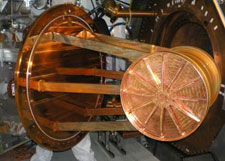
Photo of the Enriched Xenon Observatory
200's (EXO-200) time projection chamber,
the part of the detector that contains the
liquid xenon, isotopically enriched in
xenon-136. The photo shows the chamber
being inserted into the cryostat, which
keeps the experiment at extremely low
temperatures.
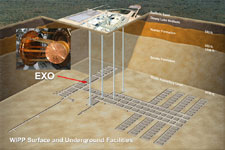
The Enriched Xenon Observatory 200
(EXO-200) is a neutrino experiment
housed 2,150 feet below ground in a salt
basin at the Waste Isolation Pilot Plant
(WIPP). The subterranean location
isolates it from cosmic rays and other
sources of natural radioactivity.
(Photo Credits: EXO/WIPP/SLAC)
The Enriched Xenon Observatory 200 (EXO-200), an international collaboration led by Stanford University and the U.S. Department of Energy's (DOE) SLAC National Accelerator Laboratory, has begun one of the most sensitive searches ever for a mysterious mechanism called "neutrinoless double-beta decay" in which two neutrinos, acting as particle and antiparticle, do not emerge from the nucleus.
If this decay were observed, it would signal that neutrinos have a different quantum structure than other elementary particles. EXO-200, which is capable of detecting decays that happen, on average, only once every 1025 years (1 quadrillion times the age of the universe), did not observe this decay, which constitutes the strongest evidence yet that neutrinos behave like other particles.
"The result could only have been more exciting if we'd been hit by a stroke of luck and detected neutrinoless double-beta decay," said Giorgio Gratta, a professor of physics at Stanford University and spokesperson for EXO-200. "In the region where double-beta decay was expected, the detector recorded only one event. That means the background activity is very low and the detector is very sensitive. It's great news to say that we see nothing!"
EXO-200 has been able to all but rule out a previous, highly controversial result claiming to have detected the decay, and they've also been able to narrow down the mass of the neutrino to less than 140- to 380-thousandths of an electronvolt (the unit of mass used in particle physics). For comparison, the minuscule electron has a mass of roughly 500,000 electronvolts.
At the heart of EXO-200 is a thin-walled cylinder made of extremely pure copper. It is full of about 200 kilograms (about 440 pounds) of liquid xenon and buried 2,150 feet deep at the DOE's Waste Isolation Pilot Plant (WIPP), a New Mexico salt bed where low-level radioactive waste is stored. The xenon—in particular the isotope xenon-136, which makes up the lion's share of the xenon in EXO-200—is one of the few substances that can theoretically undergo the decay. Constructing the experiment of exceedingly pure materials and locating it underground ensured that all other traces of radioactivity and cosmic radiation are eliminated or kept at a minimum.
EXO-200 will take data for a few more years and in the future, the team hopes to expand the technique to a several-ton version that would be even more sensitive at observing the nearly imperceptible physical processes that have been theorized.
EXO is a collaboration that involves scientists from SLAC, Stanford, the University of Alabama, Universität Bern, Caltech, Carleton University, Colorado State University, University of Illinois Urbana-Champaign, Indiana University, UC Irvine, ITEP (Moscow), Laurentian University, the University of Maryland, the University of Massachusetts – Amherst, the University of Seoul and the Technische Universität München. This research was supported by DOE and NSF in the United States, NSERC in Canada, SNF in Switzerland and RFBR in Russia. This research used resources of the National Energy Research Scientific Computing Center (NERSC).
For more information:
The SLAC EXO website
EXO story in SLAC News Center
Gratta Neutrino Physics Lab at Stanford/HEPL
May 13, 2012 — Restoring sight to the blind with a new photovoltaic retinal prosthesis
(Excerpted from a story by Jonathan Rabinovitz in the online newsletter, Inside Stanford Medicine.)
Palanker Group article in
June 2012
issue
of
Nature
Photonics
Schematic diagram of the photovoltaic
retinal prosthesis (Click to view full size.)
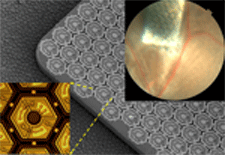
This pinpoint-sized photovoltaic chip
(upper right corner) is implanted under the
retina in a blind rat to restore sight.
(Click to view full size.)
View 92-second YouTube video describing
the
photovoltaic retinal prostheisis
Biophysicist Daniel Palanker and team members from his lab recently published an article entitled: Photovoltaic retinal prosthesis with high pixel density in the June 2012 issue of the journal Nature Photonics.
In this article, the Palanker Group demonstrates, in both normal and degenerate rat retinas, a photovoltaic subretinal prosthesis in which the silicon photodiodes in each pixel receive power and data through pulsed near-infrared illumination.
Using tiny solar-panel-like cells surgically placed underneath the retina, scientists in HEPL's Palanker Lab, in collaboration with researchers from the Stanford Schools of Engineering and Medicine, have devised a system that may someday restore sight to people who have lost vision because of certain types of degenerative eye diseases.
This device — a new type of retinal prosthesis — involves a specially designed pair of goggles, which are equipped with a miniature camera and a pocket PC that is designed to process the visual data stream.The resulting images would be displayed on a liquid crystal microdisplay embedded in the goggles, similar to what's used in video goggles for gaming. Unlike the regular video goggles, though, the images would be beamed from the LCD using laser pulses of near-infrared light to a photovoltaic silicon chip — one-third as thin as a strand of hair — implanted beneath the retina.
Electric currents from the photodiodes on the chip would then trigger signals in the retina, which then flow to the brain, enabling a patient to regain vision.
Having demonstrated the viability of this technique using rat retinas to assess the photodiode arrays in vitro, as reported in the June 2012 Nature Photonics article, the Palanker Group is now testing the system in live rats, taking both physiological and behavioral measurements, and are hoping to find a sponsor to support tests in humans.
“It works like the solar panels on your roof, converting light into electric current,” said Daniel Palanker, PhD, associate professor of ophthalmology and the paper’s senior author. “But instead of the current flowing to your refrigerator, it flows into your retina.”
In addition to be a member of the HEPL research faculty, Palanker is also a member of the interdisciplinary Stanford research program, Bio-X. The study’s co-first authors are Keith Mathieson, PhD, a visiting scholar in Palanker’s lab, and James Loudin, PhD, a postdoctoral scholar. Palanker and Loudin jointly conceived and designed the prosthesis system and the photovoltaic arrays.
There are several other retinal prostheses being developed, and at least two of them are in clinical trials. A device made by the Los Angeles-based company Second Sight was approved in April for use in Europe, and another prosthesis-maker, a German company called Retina Implant AG, announced earlier this month results from its clinical testing in Europe.
But, unlike these other devices — which require coils, cables or antennas inside the eye to deliver power and information to the retinal implant — the Stanford device uses near-infrared light to transmit images, thereby avoiding any need for wires and cables, and making the device thin and easily implantable.
For more information:
Complete Rabinovitz story in Inside Stanford Medicine, May 13, 2012
San Francisco ABC Channel 7 News Story, Restoring Sight with a Tiny Chip, June 26, 2012
The Palanker Group: Photovoltaic Retinal Prosthesis for Restoring Sight to the Blind
Nature Photonics Article: Photovoltaic retinal prosthesis with high pixel density, June 2012
August 19, 2011 — New method developed by HEPL's Solar Research Group detects emerging sunspots deep inside the sun
The first clear detection of emerging sunspot regions prior to any indication of the region in magnetograms was publishe today in the journal, Science.
Sunspots, dark features in the solar photosphere with strong magnetic field, have been observed for more than 400 years. They are the most visible components of regions where solar flares and coronal mass ejections (CMEs) occur, and these eruptive events may cause power outages and interruptions of telecommunication and navigation services on the Earth. Although it is widely believed that sunspot regions are generated in the deep solar interior, the detection of these regions before they emerge from the convection zone into the photosphere has remained undetected until now.
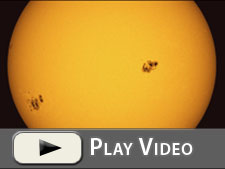
(Movie made by Thomas Hartlep)
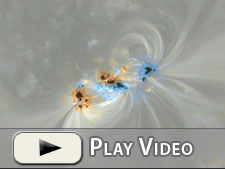
Movie showing the detected
travel-time
perturbations during
the emergence of
active region
11158. (Movie made by
Thomas
Hartlep & Scott Winegarden.)
KQED/QUEST Video:
Journey into the Sun
Scientists from HEPL's Solar Researc Group reported today the detection of several sunspot regions in the deep interior of the Sun, 1-2 days before they appear on the solar disc. Their results show that sunspots are generated at least 60,000 km below the surface and emerge from this depth up to the surface with an average speed of 0.3-0.6 km/s. The detection of sunspots in the solar interior may provide useful warnings about upcoming surface magnetic activity which can be used to improve and extend the predictions of space weather forecast. The technique that they used to detect the sunspots is called time-distance helioseismology , and it is similar to a technique used by seismologists to image the Earth's interior.
The results are reported by Stathis Ilonidis, Junwei Zhao, and Alexander Kosovichev in the paper "Detection of Emerging Sunspot Regions in the Solar Interior" published in Science Magazine (vol. 333, pp. 993-996, August 19, 2011).
About the Videos
The first video (link above right) shows the detected travel-time perturbations before the emergence of active region 10488 in the photosphere. The first 10 seconds of the movie show intensity observations of the Sun. The intensity later fades out and the photospheric magnetic field is shown. In the next 20 seconds, we zoom in to a region where a sunspot group would emerge. The upper layer shows magnetic field observations at the surface and the lower layer shows simultaneous travel-time perturbations, detected at a depth of about 60,000 km. After the emergence, intensity observations show the full development of this active region, until it rotates out of view on the west solar limb.
The second video (link at right) shows the detected travel-time perturbations during the emergence of active region 11158. The first 12 seconds of the movie show photospheric intensity observations (orange color) of the region, and travel-time perturbations detected at a depth of about 60,000 km (blue-red color). The movie then shows sunspots (blue and orange) on the solar surface and coronal loops (light green) observed by SDO/AIA.
The third video at right is a 13-minute overview of the NASA SOHO and SDO solar research satellites, and the ongoing work by the HEPL Solar Research Group, in collaboration with Lockheed Martin, to gain
invaluable scientific data and knowledge about the Sun.
For more information:
Stanford/HEPL HMI Web Page on this story
Stanford Report News Story, August 19, 2011
San Francisco Chronicle News Story, August 19, 2011
San Jose Mercury News Story, August 19, 2011
National Geographic Story, August 2011
May 4, 2011 — Gravity Probe B Announces Final Experimental Results in Press/Media Event at NASA HQ
After 31 years of research and development, 10 years of flight preparation, a 1.5 year flight mission and 5 years of data analysis,the GP-B team has arrived at the final experimental results for this landmark test of Einstein’s 1916 general theory of relativity.
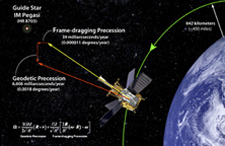
Einstein's predicted geodetic and frame-
dragging effects, with the Schiff
Equation for calculating them.
(Click to enlarge image.)
Graph of the results for each gyroscope
individually, and all four gyroscopes
combined.The area inside each colored
ellipse represents a 95% conficence
interval for a gyroscope's measurement
of both the N-S (geodetic) and the W-E
(frame-dragging) effects.
(Click to enlarge image.)
Click to view PRL paper (left) and
Physics Viewpoint article (right)
View 50-minute YouTube video of the
GP-B Results Announcement Press
Conference at NASA Headquarters
The results have been published in Physical Review Letters, Volume 106, Number 221101, 31 May 2011. Here is the abstract of the paper:
Gravity Probe B, launched 20 April 2004, is a space experiment testing two fundamental predictions of Einstein's theory of General Relativity (GR), the geodetic and frame-dragging effects, by means of cryogenic gyroscopes in Earth orbit. Data collection started 28 August 2004 and ended 14 August 2005. Analysis of the data from all four gyroscopes results in a geodetic drift rate of -6,601.8±18.3 mas/yr and a frame-dragging drift rate of -37:2±7.2 mas/yr, to be compared with the GR predictions of -6,606.1 mas/yr and -39.2 mas/yr, respectively ('mas' is milliarc-second; 1 mas= 4.848 X10⁻⁹ radians or 2.778 X10⁻⁷ degrees).
These experimental results are in agreement with Einstein's theoretical predictions of the geodetic effect with a 0.28% margin of error and the frame-dragging effect with a19% margin of error.
The PRL paper was accompanied by a Physics Viewpoint article written by Clifford Will, Professor of Physics at Washington University and Chairman of the GP-B Science Advisory Committee. The Viewpoint article is entitled Finally, Results from Graivty Probe B.
You can view/download thePhysics Viewpoint article, as well as the GP-B PRL paper from the American Physical Society website at: http://physics.aps.org/articles/v4/43
You can also download and view a PDF copy of th PRL paper in the GR-QC section of arXiv at: http://arxiv.org/abs/1105.3456
On May 4th, in a press and media event at NASA Headquarters, GP-B Principal Investigator, Francis Everitt announced the final results, and four other panelists discusssed various aspects of the program, its many accomplishments and the significance of the results to physicists and the scientific community at large.
This event, which was televised live on NASA TV and streamed live from the NASA TV website, featured a panel of five presenters:
- Francis Everitt, GP-B Princial Investigator
- Bill Danchi, Senior Astrophysicist and GP-B Program Scientist at NASA Headquarters
- Rex Geveden, President of Teledyne-Brown Engineering
- Colleen Hartman, Senior NASA Advisor and Research Professor at George Washington University
- Clifford Will, Professor of Physics, Washington University, and Chairman of the GP-B Science Advisory Committee
The panel presentations were followed by a Question and Answer session for members of the press and media and others present in the NASA auditorium, as well as press and media representatives linked-in from other NASA centers.
For more information:
Stanford's Gravity Probe B Website Status Page
Gravity Probe B Mission Page on the NASA Website
February, 2011 — HEPL's Igor Moskalenko and Stanford Professors Mark Brongersma and Juan Santiago Selected as 2010 APS Fellows
Story from Stanford Report, February 8, 2011
2010 Stanford APS Fellows.
From left: Igor Moskalenko,
Mark Brongersma and Juan
Santiago. (Photos courtesty
Stanford News Service)
Three Stanford scientists have been named fellows of the American Physical Society (APS), an honor bestowed upon members of the association by their peers. The APS was founded in 1889, and is dedicated to the advancement of physics.
The Stanford scholars join more than 200 other newly elected fellows chosen after extensive review. The total number of APS Fellows who may be elected in a given year is limited to one-half of 1 percent of the total APS membership.
The fellows are:
Igor Moskalenko, senior research scientist in the Hansen Experimental Physics Laboratory and the Kavli Institute for Particle Astrophysics and Cosmology. Moskalenko was nominated by the division of astrophysics and selected for his seminal contributions to gamma-ray astronomy, for making self-consistent computations of high-energy charged particle and gamma radiations from the galaxy and for making such calculations accessible to the astrophysics community world-wide. Moskalenko is part of the team working on the Large Area Telescope, which is the principal instrument on the Fermi Gamma Ray Space Telescope spacecraft launched in 2008. This project has increased knowledge of a number of cosmic phenomena, including pulsars, binary stars, galaxies, supernovas and cosmic rays.
Mark Brongersma, associate professor of materials science and engineering. Brongersma was nominated by the division of laser science and selected for pioneering contributions and seminal works on plasmonics and silicon nanophotonics. Brongersma’s research is focused on building and characterizing nanoscale electronic and optical devices. His work could lead to advances in semiconductors, telecommunications, chemistry and biology. Brongersma received a 2007 Walter J. Gores Award for Excellence in Teaching, the university’s highest teaching honor.
Juan Santiago, professor of mechanical engineering and director of the Stanford Microfluidics Laboratory. Santiago was nominated by the division of fluid dynamics and selected for insightful and manifold contributions to microfluidics, including novel measurement methods, characterization and explanation of electrically driven flow instabilities, and studies and engineering applications of electrically driven flows for pumps, separations and sample preparation. His work could be applied to genetic analysis, drug discovery, bioweapon detection, drug delivery and power generation. Santiago received one of the 2003 Presidential Early Career Awards for Scientists and Engineers, the nation’s highest honor for professionals at the outset of their independent research careers.
For more information:
Stanford Report, February 8, 2011
APS Fellows Webpage
January 12, 2011 — Fermi Large Area Telescope Team Awarded Rossi Prize
Story by Shawne Workman, SLAC Today
Group photo at the Fermi
LAT
Collaboration meeting
in September, 2009.
(Photo: Fermi LAT
Collaboration.)
On Wednesday, January 12, 2011, SLAC and Stanford astrophysicist and HEPL Director, Peter Michelson, and UC Santa Cruz particle astrophysicist Bill Atwood received word that they and the entire Fermi Gamma-ray Space Telescope, Large Area Telescope team have received the 2011 Bruno Rossi Prize.
Each year, the High Energy Astrophysics Division (HEAD) of the American Astronomical Society awards the Rossi Prize for recent original research in high-energy astrophysics. AAS HEAD leaders sent Atwood and Michelson word of the honor by e-mail:
The 2011 Rossi prize is awarded to Bill Atwood, Peter Michelson, and the Fermi Gamma-Ray Space Telescope/LAT team for enabling, through the development of the Large Area Telescope, new insights into neutron stars, supernova remnants, cosmic rays, binary systems, active galactic nuclei, and gamma-ray bursts.
"Both Bill and I are gratified that we were named in the citation for the award," Michelson wrote in e-mail. "However, as we said in an e-mail message to the Fermi LAT Collaboration: ... we are both keenly aware of the myriad contributions made by members of the collaboration that includes scientists, engineers and technicians, and by the community at large. It was the team work and effort that has made the Fermi Mission and the Large Area Telescope the success we are now enjoying."
The prize, named in honor of cosmic ray researcher Bruno Rossi, is awarded "for a significant contribution to High Energy Astrophysics, with particular emphasis on recent, original work," according to the HEAD website. It includes a cash award, citation and an invitation for the recipient to give a lecture, often a plenary talk at the January meeting of the American Astronomical Society. Potential awardees are nominated by HEAD members each fall; final selection is made by the HEAD executive committee.
For more information:
Lori Anne White's story on the March 2011 biannual collaboration meeting of the Fermi Gamma-ray Space Telescope–Large Area Telescope Collaboratio, SLAC Today, March 14, 2011
Shawne Workman's original story in SLAC Today, January 20, 2011.
American Astronomical Society—High Energy Astrophysics Division (HEAD Website
Bruno Rossi Prize—Wikipedia
Fermi Gamma Ray Space Telescope Stanford Web page
Fermi Gamma Ray Space Telescope NASA Web site
Palanker Group's Laser Cataract Surgery Technique is Cover Story in November 17, 2010 Issue of Science Translational Medicine
Excerpted from a story by Jonathan Rabinovitz, Inside Stanford Medicine, November 17, 2010
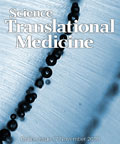
Science Translational
Medicine—11/17/2010
A colorized image of a
cut made in a porcine
lens with a femto-
second laser.

Daniel
Palanker
Imagine trying to cut by hand a perfect circle roughly one-third the size of a penny. Then consider that instead of a sheet of paper, you’re working with a scalpel and a thin, elastic, transparent layer of tissue, which both offers resistance and tears easily. And, by the way, you’re doing it inside someone’s eye, and a slip could result in a serious impairment to vision.
This standard step in cataract surgery — the removal of a disc from the capsule surrounding the eye’s lens, a procedure known as capsulorhexis — is one of the few aspects of the operation that has yet to be enhanced by technology, but new developments in guided lasers could soon eliminate the need for such manual dexterity. A paper from Stanford University School of Medicine, published as the Nov. 17, 2010 cover story in Science Translational Medicine, presents clinical findings about how one new system for femtosecond laser-assisted cataract surgery is not only safe but also cuts circles in lens capsules that are 12 times more precise than those achieved by the traditional method, as well as leaving edges that are twice as strong in the remaining capsule, which serves as a pocket in which the surgeon places the plastic replacement lens.
“The results were much better in a number of ways — increasing safety, improving precision and reproducibility, and standardizing the procedure,” said Daniel Palanker, PhD, associate professor of ophthalmology, who is the lead author of the paper. “Many medical residents are fearful of doing capsulorhexis, and it can be challenging to learn. This new approach could make this procedure less dependent on surgical skill and allow for greater consistency.” The senior author is William Culbertson, MD, professor of ophthalmology at the Bascom Palmer Eye Institute at the University of Miami.
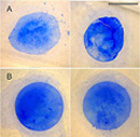
Representative examples
of lens capsule extraction
by manual capsulorhexis
(Row A) are not as close
to being perfect circles
and less uniform than
those from laser
capsulotomy (Row B)
Image courtesy of
Daniel Palanker
While the technology to perform this new approach — called a capsulotomy instead of capsulorhexis — is being developed by a number of private companies, this paper focuses on a specific system being produced by OpticaMedica Corp. of Santa Clara, Calif., which funded the study. Palanker, Culbertson and five other co-authors have equity stakes in the company; the remaining seven co-authors are company employees.
Cataract surgery is the most commonly performed surgery in the nation, with more than 1.5 million of these procedures done annually. The operation is necessary when a cloud forms in the eye’s lens, causing blurred and double vision and sensitivity to light and glare, among other symptoms.
. . .
“This will undoubtedly affect millions of people, as cataracts are so common,” said Palanker, though he expects that it will take time for the new procedure to be adopted. At present, the new procedure takes longer than the current standard, and it would cost more, with Medicare unlikely to cover it in the immediate future. “But there will be people who elect to have it done the new way if they can afford it. There are competitors coming out with related systems. This is what’s exciting. This technology is going to be picked up in the clinic.”
The other Stanford co- author is Mark Blumenkranz, MD, professor and chair of ophthalmology. Information about the Department of Ophthalmology, which also supported the work, is available at http://ophthalmology.stanford.edu/.
Read the full story:
Inside Stanford Medicine, November 17, 2010—Laser system developed at Stanford shows promise for cataract surgery by Jonathan Rabinovitz
For more information:
Professor Daniel Palanker's Website
Femtosecond Laser–Assisted Cataract Surgery with Integrated Optical Coherence Tomography. D. V. Palanker, M. S. Blumenkranz, D. Andersen, M. Wiltberger, G. Marcellino, P. Gooding, D. Angeley, G. Schuele, B. Woodley, M. Simoneau, N. J. Friedman, B. Seibel, J. Batlle, R. Feliz, J. Talamo, W. Culbertson,. Science Translational Medicine 2, 58ra85 (2010).
Science Translational Medicine, November 17, 2010 Web Issue
March 2010 — Francis Everitt and Sir Roger Penrose Awarded 2010 Trotter Prize; Delivered Trotter Lectures at Texas A&M University
Poster for the
2010 Trotter
Prize & Lecture.
(Click to view
larger image.)
On Thursday, March 11, 2010, two physicists—Francis Everitt, Principal Investigator for the HEPL Gravity Probe B Program and Sir Roger Penrose from Oxford—were jointly awarded the ninth annual Trotter Prize at Texas A&M University. The annual Trotter event includes both a cash prize to the recipient(s) and an endowed public lecture series.
The Trotter Prize in Information, Complexity and Inference is awarded annually for pioneering contributions to the understanding of the role of information, complexity and inference in illuminating the mechanisms and wonder of nature.
The Trotter Lecture seeks to reveal connections between science and religion, often viewed in academia as non-overlapping, if not rival, worldviews. For this year’s Trotter Lecture, both Everitt and Penrose spoke on this topic. Everitt’s talk, entitled “Mystery in Science, Reason in Religion,” explored how mystery and moral discipline permeate both science and religion and how reason affects each in the context of Christian faith. Penrose’s talk, entitled “ Did the Universe Have a Beginning?” explored the philosophical implications of conformal cyclic cosmology (CCC), which Penrose offers as an alternative scheme to the prevailing Big Bang theory.
For more information:
Stanford Report, March 9, 2010—The Dish: Stanford People on the Move and In the Spotlight
Gravity Probe B Website, Mission News Page
Texas A&M News Release
Texas A&M Trotter Prize & Endowed Lecture Web Page
EXO Takes Clean to an Extreme
Excerpted from a story by Lauren Knoche, Symmetry magazine
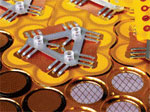
The triangular metal gadget
is an "APD Spider." It con-
nects
EXO's light sensors—
the golden circles with
electronics that allow
scientists to read out the
from the experiment's
detector. Photo courtesy of
the EXO Collaboration.
Some particle physics experiments require an extraordinary degree of cleanliness and quiet. How far will they go to achieve this? Try etching tools with acid, setting up shop in a deep salt bed, putting equipment on stilts, and choreographing a 2100-kilometer truck ride so not a moment would be lost.
Just before midnight on November 3, 2009, a large truck loaded with 40 tons of cargo pulled away from the Stanford University campus. It carried the last shipment of laboratory equipment from Stanford to New Mexico for a high-energy physics experiment that will begin taking data this year.
Moving complicated experimental equipment is always a delicate process, but in this case the task was more challenging than usual. The experiment, called the Enriched Xenon Observatory 200, or EXO-200, is designed to look for an ultra-rare phenomenon that could reveal key secrets about the nature of the neutrino. This process is so rare that detecting just a few signals over the course of a year would be a triumph. Scientists have no hope of seeing these faint signals unless they eliminate every possible source of background radiation that could get in the way. Yet sources of radiation are everywhere—from cosmic ray particles that rain down from space to materials as common as copper, everyday tools, ordinary rocks, even the human body.
It had taken the 70 scientists and engineers of the EXO collaboration six years to design and assemble their detector—a tank that would hold 200 kilograms of liquid xenon cooled to a very low temperature and heavily shielded by onion-like layers of components. A fanatic degree of cleanliness prevailed at every step. Most of the components were not only assembled in clean rooms, but also shipped in those same clean rooms, shielded and sealed against contamination. Even so, the team choreographed and practiced every move to make sure those containers spent as little time as possible in the open air.
For more information:
Full story: Symmetry Magazine, February 2010 Web Issue...
Stanford/SLAC Enriched Xenon Observatory (EXO) Program Website
February 11, 2010 — Stanford Helioseismic and Magnetic Imager (HMI) Launches on NASA SDO Satellite
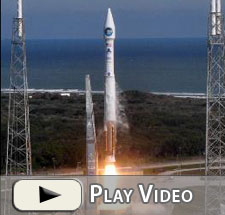
SDO Satellite launches on 11 Feb 2010
at
10:23AM EST. (42-second video;
Photo Credit: Pat Corkery, U.L.A.)
At 10:23 AM EST on Thursday, February 11, 2010,NASA's Solar Dynamic Observatory (SDO) lifted off from Cape Canaveral, FL aboard a United Launch Alliance Atlas V rocket in a picture-perfect launch. One of the three instruments on board the SDO is the Helioseismic and Magnetic Imager (HMI) developed collaboratively by the Stanford Solar Physics Group here in the HEPL lab and the Lockheed Martin Solar and
Astrophysics Laboratory (LMSAL) in Palo Alto, CA.
Click on the launch photo thumbnail to the right to view a short video of the launch.
SDO is the first mission to be launched under NASA's new Living with a Star Program. It is designed to help scientists study the solar atmosphere and better understand the causes of solar variability and its effects on space weather. Specifically, the observatory will perform various measurements to help characterize the interior of the Sun, the Sun's magnetic field, the hot plasma of the solar corona and the extreme ultraviolet radiation that creates the ionosphere surrounding Earth and other planets.
The SDO satellite houses three scientific instruments:
- The Atmospheric Imaging Assembly (AIA) is an array of four telescopes that will observe the surface and atmosphere of the Sun. The AIA was built by the Lockheed Martin Solar Astrophysics Laboratory (LMSAL), Palo Alto, California under the direction of Principal Investigator, AlanTitle.
- The Extreme Ultraviolet Variability Experiment (EVE) will measure fluctuations in the Sun’s
ultraviolet output. EVE was built by the Laboratory for
Atmospheric and Space Physics (LASP) at the University of Colorado under the direction of Principal Investigator, Tom Woods.
- The Helioseismic and Magnetic Imager (HMI) will map solar magnetic fields and peer beneath the Sun’s opaque surface using a technique called helioseismology. HMI was designed and built collaboratively by the Solar Observatories Group in the HEPL Labs here at Stanford under the direction of Principal Investigator, Phil Scherrer, and the Lockheed Martin Solar and
Astrophysics Laboratory (LMSAL), Palo Alto, California under the direction of Co-Investigator, Alan Title.
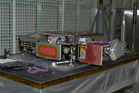
The HMI instrument on a
test bench at NASA's
Goddard Space Flight
Center. (Click to view
enlarged photo.)
HMI produces data to determine the interior sources and mechanisms of solar variability and how the physical processes inside the Sun are related to surface magnetic field and activity. It also produces data to enable estimates of the coronal magnetic field for studies of variability in the extended solar atmosphere which is where the Earth is. Solar variability that affects the Earth is called “space weather.”
The primary goal of the HMI investigation is to study the origin of solar variability and to characterize and understand the Sun’s interior and magnetic activity. Because of the turbulence in the convection zone near the surface, the Sun is figuratively ringing like a bell. By studying these oscillations of the visible surface of the Sun, considerable insight can be gained into the processes inside. In effect the solar turbulence is analogous to earthquakes. In a manner similar to the way seismologists can learn about the interior of the Earth by studying the waves generated in an earthquake, HMI’s helioseismologists will learn about the structure, temperature and flows in the solar interior.
HMI is a new and improved version of the Michelson Doppler Imager (MDI) instrument on the Solar and Heliospheric Observatory (SOHO). SOHO is a joint project of the European Space Agency and NASA. MDI was developed starting in 1988 by the same collaboration between Stanford and Lockheed Martin teams that developed HMI. SOHO/MDI was launched in December 1995. It is still operating well and has completed helioseismic and magnetic field observations of the Sun for all of solar cycle 23 and the beginning of cycle 24. HMI will continue these important measurements from space into the next solar cycle. It will observe the full solar disk in the Fe I absorption line at 6173Å with a resolution of 1 arc-second. Moreover, HMI will be able to measure the direction of the magnetic field, something MDI couldn't do!
The goal of SDO is to understand—striving towards a predictive capability—the solar variations that influence life on Earth and humanity’s technological systems. The mission seeks to determine how the Sun’s magnetic field is generated and structured, and how this stored magnetic energy is converted and released into the heliosphere and geospace in the form of solar wind, energetic particles, and variations in the solar irradiance. SDO is the most advanced spacecraft ever designed to study the Sun and its dynamic behavior. SDO will provide better quality, more comprehensive science data faster than any NASA spacecraft currently studying the Sun and its processes. SDO will unlock the secrets of how our nearest star sustains life on Earth and how it affects the planets of our solar system and beyond.
For more information:
NASA—SDO Mission Page
Goddard Spaceflight Center SDO Page
NASA—Living with a Star Program
HMI web page at Stanford
Stanford Solar Observatories Group Web Site
11 February 2010 Stanford Report HMI Story: "Here comes the sun: Camera developed by Stanford launches from Cape Canaveral"
NASA—SDO Press Kit (1MB PDF)
NASA—SDO Mission Guide (14MB PDF)
December 17, 2009 — Dark Matter Search: Latest CDMS-II Results
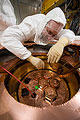
CDMS project
manager Dan
Bauer adjusts
the CDMS
detector.
Scientists believe that most of the matter in the universe neither emits nor absorbs light, but rather is "dark matter" which provides the gravitational scaffolding that caused normal matter to coalesce into the galaxies we see today. Particle physics theories suggest that dark matter may be composed of Weakly Interacting Massive Particles (WIMPs), with masses comparable to, or perhaps heavier than, the masses of atomic nuclei. Although such WIMPs would rarely interact with normal matter, they could occasionally scatter from an atomic nucleus like billiard balls, leaving a small amount of energy that might be detectable under the right conditions.
The Cryogenic Dark Matter Search (CDMS) experiment, located a half-mile underground at the Soudan mine in northern Minnesota, uses 30 detectors made of germanium and silicon in an attempt to detect such WIMP scatters.CDMS has been searching for dark matter at Soudan since 2003, and until now, the data have not yielded evidence for WIMPs, but there is good cause for optimism....
At 2:00 Pm on Thursday, December 17, 2009, scientists from the CDMS program announced the latest research findings in two simultaneous presentations—one in California and one in Illinois. The California presentation was given at Stanford's SLAC National Accelerator Laboratory by Southern Methodist University physicist and CDMS analysis coordinator, Jodi Cooley. The Illinois presentation was given by Lauren Hsu at the Fermi National Accelerator Laboratory in Batavia, Ill.
The essence of these presentations is that the recently completed analysis of the latest CDMS-II data set, collected in 2007-08, shows two events that have characteristics consistent with those expected from WIMPs. However, with only two such events detected, there is a ~25% chance that they could be due to background particles, rather than WIMPs, so this result cannot be deemed statistically significant. With the current detector setup, at least five events would have to have been detected in order to allay any seeds of doubt. But, rather than running the current dectector system for many more years, the CDMS team is taking advantage of new detector developments and, most important, trippling the number of detectors used in hopes of significantly increasing the number of events detected from these elusive particles.
Both the Cooley and Hsu presentations were videotaped and now can be viewed in various web video formats via links on the U.C. Berkeley CDMS web site (http://cdms.berkeley.edu). Likewise, PDF copies of the presentation slides and a summary of the latest results are available for downloading from this site.
For more information:
Symmetry Breaking, a joint publication of SLAC and Fermilab: December 2009 Web edition
November 2, 2009 — Fermi Telescope Celebrates First Year's Results with Cosmic Reflection Concert
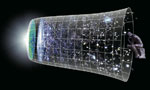
Reflecting on cosmology
and the story of the universe
Image by Pierre Schwob
(Click thumbnail to enlarge)
The 2009 Fermi International Science Symposium will be held in Washington, D.C. , Nov. 2-5, 2009, looking back on the first year of spectacular results from the Fermi Gamma-ray Space Telescope (formerly known as GLAST).
An extraordinary highlight of this symposium will be a live public concert on Nov. 2nd at the John F. Kennedy Center for the Performing Arts in Washington, D.C. This concert, produced and sponsored by Pierre Schwob, founder and CEO of Classical Archives in Palo Alto, Ca., will feature two works by composer Nolan Gasser (Stanford Ph.D. in Musicology, 2001)—GLAST Prelude, Op.12, for brass quintet and the World Premiere of Cosmic Reflection: A Narrated Symphony, Op.15.
For more information:
Read the full story
September, 2009 — Peter Michelson succeeds Blas Cabrera as HEPL Director
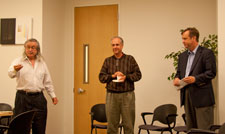
HEPL Director Transition Ceremony.
Following a luncheon featuring Chinese
cuisine, GP-B Principal Investigator,
Francis Everitt (left), reads the
fortune
cookie messages for outgoing HEPL
Director, Blas Cabrera (center), and for
incoming director, Peter
Michelson (right).
(Click on the thumbnail above to view
full-sized photo.)
On September 1, 2009, physics professor Peter Michelson became the new Director of HEPL. Professor Michelson is the tenth person to oversee and direct the lab's activities during its 58-year history, beginning in 1951 when the lab was officially founded as the Stanford "High Energy Physics Lab" (also abbreviated HEPL). In 1990, the lab was renamed the" W.W. Hansen Experimental Physics Lab," honoring pioneering physicist and engineer, William W. Hansen.
Over the years, the directorship of HEPL has evolved into a three-year, rotating position among the faculty members whose research programs are administered by HEPL. Having just completed his term as HEPL Director, Professor Blas Cabrera is now looking forward to devoting more time to his research on the search for cryogenic dark matter and weakly interactive massive particles (WIMPs). Professor Michelson, who is Principal Investigator of the NASA-funded Fermi Gamma-ray Large-Area Space Telescope program, has kindly agreed to take the helm of HEPL for the next three years.
To commemorate this transition in HEPL leadership, a brief ceremony was held on August 24, 2009 in the Physics/Astrophysics main conference room. The highlight of the ceremony came when Professor Francis Everitt, Principal Investigator of the Gravity Probe B program, picked out two fortune cookies—one for the outgoing HEPL director and one for the incoming HEPL director—and read them aloud. Both fortunes were uncannily apt for their respective recipients.
You can read more about the colorful history of HEPL and its previous directors on the About HEPL page of this web site.
August 2009 —Fermi Gamma-ray Space Telescope results prominently featured in 8/14 issue of AAAS Science
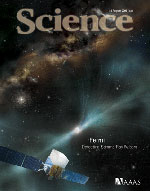
Pulsars in our Galaxy newly
discovered by the Fermi LAT
Telescop. Image: NASA/U.S.
DOE/Fermi LAT Collaboration
/Sonoma State University/
Aurore Simonnet. (Click to
view larger cover image.)
The extraordinary results of the Fermi Gamma-ray Large Area Telescope in detecting and thereby confirming the predicted presence of gamma-ray pulsars in our galaxy was the cover story in the August 14, 2009 issue of Science, the journal of the American Association for the Advancement of Science (AAAS). In addition to the cover story article about the detection of 16 " gamma-ray-only" pulsars, the issue contains two related research reports, as well as an Astronomy Perspectives overview article by astronomer, Jules Halpern of Columbia University.
Following are abbreviated abstracts of the cover story article and the two related research reports, which follow each other sequentially beginning on page 840 of the issue.
Cover article (p. 840): Detection of 16 Gamma-Ray Pulsars Through Blind Frequency Searches Using the Fermi LAT.
Pulsars are rapidly rotating, highly magnetized neutron stars emitting radiation across the electromagnetic spectrum. We report the detection of 16 gamma-ray pulsars in blind frequency searches using the LAT. Most of these pulsars are coincident with previously unidentified gamma-ray sources, and many are associated with supernova remnants.
Research Report (p. 845 ): Detection of High-Energy Gamma-Ray Emission from the Globular Cluster 47 Tucanae with Fermi.
We report the detection of gamma-ray emissions above 200 megaelectron volts at a significance level of 17{sigma} from the globular cluster 47 Tucanae, using data obtained with the Large Area Telescope onboard the Fermi Gamma-ray Space Telescope. Globular clusters are expected to emit gamma rays because of the large populations of millisecond pulsars that they contain. The spectral shape of 47 Tucanae is consistent with gamma-ray emission from a population of millisecond pulsars. The observed gamma-ray luminosity implies an upper limit of 60 millisecond pulsars present in 47 Tucanae.
Research Report (p.848): A Population of Gamma-Ray Millisecond Pulsars Seen with the Fermi Large Area Telescope.
Pulsars are born with subsecond spin periods and slow by electromagnetic braking for several tens of millions of years, when detectable radiation ceases. We searched Fermi Large Area Telescope data for pulsations from all known millisecond pulsars (MSPs) outside of globular clusters, using rotation parameters from radio telescopes. Strong gamma-ray pulsations were detected for eight MSPs. The gamma-ray pulse profiles and spectral properties resemble those of young gamma-ray pulsars.
For more information:
Fermi Gamma Ray Space Telescope Stanford Web page
Fermi Gamma Ray Space Telescope NASA Web site
June/July, 2009 — Gravity Probe B Data Analysis Update
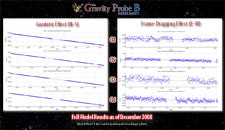
Significantly improved GP-B results from
December 2008. Both the geodetic and
frame-dragging effects are clearly visible
in the data for all 4 gyros. (Click on the
thumbnail above to view full-sized image.)
In a series of five HEPL Seminars, members of the Gravity Probe B (GP-B) science team have been detailing the progress they have made over the past three and a half years in analyzing the data from this landmark physics experiment. Four ultra-precise gyroscopes and a telescope in an earth-orbiting satellite are used to measure two effects predicted by Einstein's 1916 general theory of relativity—1) the geodetic effect (the warping of earth's local spacetime due to earth's mass) and 2) the frame-dragging effect (the twisting of earth's local spacetime due to earth's rotation).
The latest progress shows a tenfold improvement over the preliminary experimental results announced at the American Physical Society annual meeting in April 2007. At that time, only the larger, geodetic effect was clearly visible in the data. Over the past two years, the GP-B data analysis team has made significant progress in understanding and modeling three Newtonian effects, all due to patch potentials on the gyroscope rotor and housing surfaces. The latest results, based upon treatment of 1) damped polhode motion, 2) misalignment torques and 3) roll-polhode resonance torques, clearly show both frame-dragging and geodetic precession in all four gyroscopes (see figure above left).
The GP-B data analysis history reads like a detective story, with the last chapter still in-work. The data analysis described above was performed using orbit-by-orbit modeling of gyroscope orientation (97-minute intervals). The team is now developing 2-second processing of the science data, resulting in about a 3,000-fold increase in the number of data points that have to be processed.This increased computational load will be handled with parallel processing, using a computer cluster in Stanford's Aeronautics and Astronautics Department. The GP-B data analysis will conclude next spring, with final results to be announced next summer or early fall.
For more information:
HEPL Seminar Information Page
Presentation slides from HEPL Seminars on GP-B
GP-B website
May 2009 — NASA's Fermi Telescope Measures Spectrum of Electrons and Positrons; Celebratory 'Cosmic Reflection' Concert
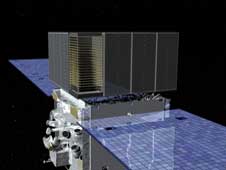
The Large Area Telescope (LAT) onFermi
detects gamma-rays by tracking the
electrons positrons they produce after
striking layers of tungsten. This ability also
makes the LAT an excellent tool for
exploring high-energy cosmic rays.
Credit: NASA/Goddard Space Flight Center
Conceptual Image Lab. (Click to enlarge.)
There was much excitement at the recent American Physical Society meeting in Denver, May 2-5, 2009 about recent results from the Fermi Gamma-ray Space telescope A number of talks were given by collaboration members on many topics, including gamma-ray bursts, active galaxies, pulsars, and diffuse radiation. However, the result that received the most attention was the Fermi LAT measurement of the spectrum of electrons and positrons from 20 GeV to 1 TeV, reported on in talks by Alex Moiseev and Luca Latronico. This result received much attention, not only from the meeting attendees, but also from the science news media. An APS online Viewpoint article highlighted this important result, and Science, Nature, New Scientist, Discover Magazine, Sky and Telescope and Science News have all published stories as well.
Within hours of the cosmic-ray electron/positron result being published by Physical Review Letters, there were several new appears appearing in the online astrophysics archives offering various interpretations of these results in the context of the earlier Pamela results. These interpretations generally fell into two camps: either nearby pulsar(s) injecting primary positrons (and electrons) or dark matter decays or annihilations. The Fermi team is just beginning to understand the results, and there is much work ahead. The possibility of finding new physics cannot be ignored, and thus the theoretical physics community is eagerly anticipating more results and information from the Fermi group in the future.
The Fermi international science team, including members from Stanford and NASA, will be holding a symposium in Washington DC the first week in November 2009. On November 2, 2009, Stanford alumnus and composer, Nolan Gasser's newest composition, 'Cosmic Reflection,' will debut at the Kennedy Center for the Performing Arts as part of a free public event, celebrating the success of missions like Fermi, which explore the nature of the universe and provide possible answers to fundamental questions of physics and basic science. Gasser's composition will be performed by the Boston University Symphony. The American Brass Quintet will also be performing at the event, and there will be a short lecture about the early Fermi science results.
For more information:
Fermi Gamma Ray Space Telescope Stanford Web page
Fermi Gamma Ray Space Telescope NASA Web site
April 28, 2009 — Bob Byer Awarded the Frederic Ives Medal/Jarus W. Quinn Endowment by the OSA
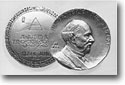
The Frederick Ives
Medal is the highest
award bestowed by
the Optical Society
of America (OSA).
On April 28, 2009, the Optical Society of America (OSA) announced the 2009 recipients of 17 prestigious awards and medals for outstanding achievements in the field of optics. Among the recipients of this year's awards was Robert Byer, Stanford's William R. Kenan Jr. Professor of Applied Physics.
Byer was awarded the Frederic Ives Medal/Quinn Prize, the highest award bestowed by the Optical Society of America, for his pioneering contributions to optical science and the commercial development of optical technologies, and for wide-ranging leadership activities within the optics community.
"OSA is honored to recognize these leaders in the field of optics," said Elizabeth Rogan, OSA executive director. "These recipients have demonstrated tremendous ingenuity and have proved themselves to be invaluable to the understanding of optics and photonics. OSA congratulates them on their outstanding achievements."
Byer has conducted research and taught classes in lasers and nonlinear optics at Stanford since 1969. Byer will receive his award at the society's annual meeting in October in San Jose.
Fore more information:
Bob Byer's Stanford Web Page
OSA 2009 Awards Press Release
OSA Frederick Ives Award/ Quinn Endowment Information & Past Recipients
February 19, 2009 - NASA's Fermi Telescope
Sees Most Extreme Gamma-ray Blast Yet
On Sept. 17, 31.7 hours after GRB 080916C
exploded, the Gamma-Ray
Burst Optical/Near-
Infrared Detector (GROND) on the 2.2m
Max Planck
Telescope at the European
Southern Observatory, La Silla, Chile,
began
acquiring images of the blasts fading
afterglow (circled).
Credit: MPE/GROND
(Click to view enlarged photo.)
The first gamma-ray burst to be seen in high-resolution from NASA's Fermi Gamma-ray Space Telescope is one for the record books. The blast had the greatest total energy, the fastest motions and the highest-energy initial emissions ever seen.
"We were waiting for this one," said Peter Michelson, the principal investigator on Fermi's Large Area Telescope at Stanford University. "Burst emissions at these energies are still poorly understood, and Fermi is giving us the tools to understand them."
Gamma-ray bursts are the universe's most luminous explosions. Astronomers believe most occur when exotic massive stars run out of nuclear fuel. As a star's core collapses into a black hole, jets of material -- powered by processes not yet fully understood -- blast outward at nearly the speed of light. The jets bore all the way through the collapsing star and continue into space, where they interact with gas previously shed by the star and generate bright afterglows that fade with time.
This explosion, designated GRB 080916C, occurred at 7:13 p.m. EDT on Sept. 15, in the constellation Carina. Fermi's other instrument, the Gamma-ray Burst Monitor, simultaneously recorded the event. Together, the two instruments provide a view of the blast's initial, or prompt, gamma-ray emission from energies between 3,000 to more than 5 billion times that of visible light.
NASA provides a movie that compresses about 8 minutes of Fermi LAT observations of GRB 080916C into 6 seconds. Colored dots represent gamma rays of different energies. Visible light has energy between about 2 and 3 electron volts (eV). The blue dots represent lower-energy gamma rays (less than 100 million eV); green, moderate energies (100 million to 1 billion eV); and red, the highest energies (more than 1 billion eV). Credit: NASA/DOE/Fermi LAT Collaboration.
For more information:
NASA Vvideo: http://www.nasa.gov/mov/314162main_GRB080916C_LAT_600.mov
Fermi Gamma Ray Space Telescope Stanford Web page
Fermi Gamma Ray Space Telescope NASA Web site
January 5, 2009 - CDMS Leading the Search for Dark Matter in the Form of WIMPs
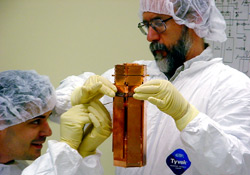
Project manager Dan Bauer from Fermilab
holds one tower of detectors as Vuk Mandic,
now at the University of Minnesota, examines
them. (Photo courtesy of Fermilab. Click to
view enlorged photo.
)
In the January 13, 2009 issue of Physical Review Letters, the CDMS (Cryogenic Dark Matter Search) Collaboration has published the latest results from its search for WIMPs (weakly interactive massive particles). These elusive particles are curently favored as the essence of dark matter, which scientists believe accounts for 83% of all matter in the universe. Data for this experiment was collected at the Soudan Underground Laboratory (CDMS II), located 2,400 ft undergournd in the Soudan Mine in Minnesota, using an arragy of five detector towers, each containing a vertical stack of six solid-state detector discs, cooled with liquid helium to a cryogenic temperature of ~40 mK. The results from this experiment have achieved the best sensitivity to date for dark matter WIMPs with masses above 4 GeV/c2 and have set new upper limits on the spin-independent interaction of WIMPs and nucleons. Full Story...
January 7, 2009 - Fermi Gamma Ray Space Telescope Discovers Slew of New Pulsars
by Kelen Tuttle, SLAC Today
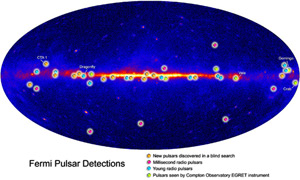
The Fermi Telescope has found 12 previously unknown
pulsars (orange). It also detected gamma-ray emissions
from known radio pulsars (magenta, cyan) and from known
or suspected gamma-ray pulsars (green). (Image courtesy
of NASA/Fermi/LAT Collaboration. Click to enlarge.)
Four months into its mission, the Fermi Gamma-ray Space Telescope has discovered 12 never-before-seen pulsars and observed gamma-ray pulses from 18 others, shedding new insight on the high-energy universe.
"I am very happy to welcome you all to a new era in pulsar physics," Roger Romani said at a press conference held yesterday at the American Astronomical Society meeting in Long Beach, California. Romani is a researcher in the Kavli Institute for Particle Astrophysics and Cosmology at SLAC National Accelerator Laboratory and Stanford University. "We know of 1800 pulsars, but until Fermi we saw only little wisps of energy from all but a handful of them. Now, for dozens of pulsars, we're seeing the actual power of these machines."
In the past, most pulsars–rapidly spinning neutron stars that emit energy in narrow beams–were observed only in radio waves. Yet, as the FGST data reveals, this radio-wave emission is extremely weak compared to the pulsars' flashes of gamma-rays.
The 12 newly discovered pulsars offer insight into the mechanism behind the gamma-ray emissions. The data show that the classic understanding of emission, whereby gamma rays are created in the same location as radio waves, is mistaken. Researchers now theorize that the radio beams form near the neutron star's surface, while the gamma rays form far above.
FGST is also shedding light on pulsars as they near the end of their lifecycles. Over the past few months, the telescope found seven very old and relatively rare pulsars that are thought to have gravitationally attracted additional stellar matter from companion stars, causing them to increase in mass and spin much faster. These "millisecond" pulsars spin hundreds of times faster than their younger siblings, with their surfaces moving at up to a tenth of the speed of light. They also have magnetic fields 10,000 times lower and are thought to be 10,000 times older than previously discovered pulsars.
With the observation of these millisecond pulsars, Romani said, "we're really seeing the history of pulsars." Alice Harding of the NASA-Goddard Space Flight Center added: "This is the tip-of-the-iceberg. We'll probably be discovering a lot more."
Researchers announced these findings at the American Astronomical Society meeting this week in Long Beach, California, and at the Texas Symposium on Relativistic Astrophysics last December in Vancouver, Canada. More information can be found in a NASA press release issued yesterday and in a recent Science News article by Ron Cowen.
For more information:
Fermi Gamma Ray Space Telescope Stanford Web page
Fermi Gamma Ray Space Telescope NASA Web site
August 26, 2008 - GLAST Observatory Renamed for Fermi, Reveals Entire Gamma-Ray Sky
The U.S. Department of Energy (DOE) and NASA announced today that the Gamma-Ray Large Area Space Telescope (GLAST) has revealed its first all-sky map in gamma rays. The onboard Large Area Telescope's (LAT) all-sky image—which shows the glowing gas of the Milky Way, blinking pulsars and a flaring galaxy billions of light-years away—was created using only 95 hours of "first light" observations, compared with past missions which took years to produce a similar image. Scientists expect the telescope will discover many new pulsars in our own galaxy, reveal powerful processes near super-massive black holes at the cores of thousands of active galaxies and enable a search for signs of new physical laws.
The NASA mission was made possible by collaboration with many U.S. and international partners. As part of its support for particle physics research, DOE contributed funding to the LAT—the primary instrument on GLAST—and DOE's Stanford Linear Accelerator Center (SLAC) managed the LAT construction. SLAC also played a key role in assembling the instrument and now plays the central role in LAT science operations, data processing and making scientific data available to collaborators for analysis.
"The DOE-NASA collaboration on this new observatory has been very successful and shows what can be accomplished when we work together," said Dennis Kovar, DOE Associate Director of Science for High Energy Physics. "We look forward to the scientific discoveries it will enable in both particle physics and astrophysics."
NASA also announced today that GLAST has been renamed the Fermi Gamma-ray Space Telescope. The new name honors Prof. Enrico Fermi (1901-1954), a pioneer in high-energy physics. "Enrico Fermi was the first person to suggest how cosmic particles could be accelerated to high speeds," said Paul Hertz, chief scientist for the Science Mission Directorate at NASA Headquarters in Washington, D.C. "His theory provides the foundation for understanding the powerful phenomena his namesake telescope will discover."
For two months following the mission's June 11, 2008 launch, scientists tested and calibrated its two instruments, the LAT and the GLAST Burst Monitor (GBM). "What impressed me the most is that everything went by the book," said Peter Michelson, LAT principal investigator at Stanford University, Calif. "We're elated." The LAT has already verified sources found by other gamma-ray detectors—and discovered more.
The all-sky image shows gas and dust in the plane of the Milky Way glowing in gamma rays due to collisions with accelerated nuclei called cosmic rays. The famous Crab Nebula and Vela pulsars also shine brightly at these wavelengths. These fast-spinning neutron stars, which form when massive stars die, were originally discovered by their radio emissions. The image's third pulsar, named Geminga and located in Gemini, is not a radio source. It was discovered by an earlier gamma-ray satellite. The Fermi Gamma-ray Space Telescope is expected to discover many more radio-quiet pulsars, providing key information about how these exotic objects work.
A fourth bright spot in the LAT image lies some 7.1 billion light-years away, far beyond our galaxy. This is 3C 454.3 in Pegasus, a type of active galaxy called a blazar. It's now undergoing a flaring episode that makes it especially bright.
The LAT scans the entire sky every three hours when operating in survey mode, which will occupy most of the telescope's observing time during the first year of operations. These fast snapshots will let scientists monitor rapidly changing sources.
The LAT instrument detects photons with energies ranging from 20 million electronvolts to over 300 billion electronvolts. The high end of this range, which corresponds to energies more than 5 million times greater than dental X-rays, is little explored.
The spacecraft's secondary instrument, the GBM, spotted 31 gamma-ray bursts in its first month of operation. These high-energy blasts occur when massive stars die and when orbiting neutron stars spiral together and merge.
The GBM is sensitive to lower energy range gamma rays (8000 to 30 million electronvolts) than LAT. Bursts seen by both instruments will provide an unprecedented look across a broad gamma-ray spectrum, enabling scientists to peer into the processes powering these events.
NASA's Fermi Gamma-ray Space Telescope is an astrophysics and particle physics partnership, developed in collaboration with the U.S. Department of Energy, along with important contributions from academic institutions and partners in France, Germany, Italy, Japan, Sweden and the United States.
Date Issued: August 26, 2008 (SLAC Today)
Fore more informaiton:
Contact:
Web URLs:
August 2008 - Palanker Research Group Develops Pulsed Electron Avalanche Knife (PEAK)
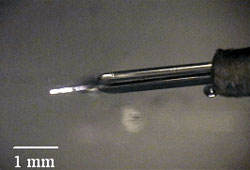
Discharge on cylindrical microelectrode in
saline driven by microsecond burst of pulses.
Daniel Palanker's research group at HEPL and the Stanford Medical School have developed electrosurgical technology called Pulsed Electron Avalanche Knife (PEAK). Stanford's Office of Technology Licensing licensed it to a local startup company called PEAK Surgical Inc. They recently received FDA approval for this device, and performed their first 30-40 human cases during the last couple weeks. Feedback from surgeons is exceptionally good, so this device has a potential to become a new standard of care in surgery. In contrast to conventional electrosurgery, based on continuous radiofrequency waveforms applied via large electrodes, PEAK uses microsecond pulses and micrometers-thin blade electrodes to excise tissue with cellular precision. Not only the cuts are more precise and narrow, but also, due to the very low collateral thermal damage produced by PEAK technology, the tissue heals faster, and with much less scarring and other defects, than after traditional electrosurgery.
For more information:
Palanker Lab Web site
Stanford School of Medicine—Opthamology Research Web site
August 2008 —Professor Robert Byer Wins 2009 IEEE Photonics Award
ROBERT L. BYER, HEPL faculty member, professor of applied physics and director of the Ginzton Laboratory, has won the 2009 IEEE Photonics Award. Byer, the William R. Kenan Jr. Professor, was cited for "seminal contributions to nonlinear optics and solid-state lasers for commercial applications
from precision measurement to manufacturing." The products of non-linear optics, which often involve changing the color of lasers, have wide use. For example, the yellow laser that creates an artificial star 90 kilometers above Earth is used by astronomers to calibrate their telescopes, to eliminate blurring from the atmosphere. Laser televisions, another product of multi-colored lasers, are expected to hit the market soon. Solid-state lasers have a wide range of uses, including trimming and processing the circuit boards in cell phones.
June 11, 2008 — NASA's GLAST Launch Successful
 image courtesy of
NASA CAPE CANAVERAL AIR FORCE STATION, Fla. -- NASA's Gamma-ray Large Area Space Telescope, or GLAST, successfully launched aboard a Delta II rocket from Cape Canaveral Air Force Station in Florida at 12:05 p.m. EDT Wednesday, 6/11/08..
The GLAST observatory separated from the second stage of the Delta II at 1:20 p.m. and the flight computer immediately began powering up the components necessary to control the satellite. Twelve minutes after separating from the launch vehicle, both GLAST solar arrays were deployed. The arrays immediately began producing the power necessary to maintain the satellite and instruments. The operations team continues to check out the spacecraft subsystems.
"The entire GLAST Team is elated the observatory is now on-orbit and all systems continue to operate as planned," said GLAST program manager Kevin Grady of NASA's Goddard Space Flight Center in Greenbelt, Md.
After a 75-minute flight, the GLAST spacecraft was deployed into low Earth orbit. It will begin to transmit initial instrument data after about three weeks. The telescope will explore the most extreme environments in the universe, searching for signs of new laws of physics and investigating what composes mysterious dark matter. It will seek explanations for how black holes accelerate immense jets of material to nearly light speed, and look for clues to crack the mysteries behind powerful explosions known as gamma-ray bursts.
"After a 60-day checkout and initial calibration period, we'll begin science operations," said Steve Ritz, GLAST project scientist at Goddard. "GLAST soon will be telling scientists about many new objects to study, and this information will be available on the internet for the world to see."
NASA's GLAST mission is an astrophysics and particle physics partnership, developed in collaboration with the U.S. Department of Energy, along with important contributions from academic institutions and partners in France, Germany, Italy, Japan, Sweden and the U.S.
—NASA Press Release 6/11/08
For more information:
http://www.nasa.gov/glast
http://www-glast.stanford.edu/
March 2008 — Crystal bells stay silent as physicists look for dark matter
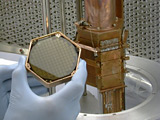
Closeup of a CDMS detector,
made of crystal germanium.
Credit: Fermilab. (Click to
view enlarged photo.)
U.S. experiment retakes the lead in competitive race
Batavia, Ill.--Scientists of the Cryogenic Dark Matter Search experiment today announced that they have regained the lead in the worldwide race to find the particles that make up dark matter. The CDMS experiment, conducted a half-mile underground in a mine in Soudan, Minn., again sets the world’s best constraints on the properties of dark matter candidates.
“With our new result we are leapfrogging the competition,” said Blas Cabrera of Stanford University, co-spokesperson of the CDMS experiment, for which the Department of Energy’s Fermi National Accelerator Laboratory hosts the project management. “We have achieved the world’s most stringent limits on how often dark matter particles interact with ordinary matter and how heavy they are, in particular in the theoretically favored mass range of more than 40 times the proton mass. Our experiment is now sensitive enough to hear WIMPs even if they ring the ‘bells’ of our crystal germanium detector only twice a year. So far, we have heard nothing.”
January 30, 2008 — On the frontiers of science for decades, a storied building is soon to be razed
BY DAN STOBER, Stanford Report
Panoramic photo of the HEPL Lab building
taken in November 2007, prior to demolition.
Photo by Bob Kahn
(Click to enlarge.)
From the obituary desk: The HEPL building, 58 years old, a Stanford baby boomer born in 1949 in the aftermath of World War II, a child prodigy that produced the world's first full-scale linear accelerator when only a year old and won the Nobel Prize for physics at age 12, has passed on. Despite a certain gangly appearance, it was loved by its extended family of researchers for its utilitarian qualities. There were several causes for its passing (old and in the way, in essence), but the final blow was delivered by heavy-duty construction equipment.
HEPL Directors: Sandy
Fetter, Blas Cabrera,
Mason Yearian & Bob Byer.
Photo by Linda Cicero
(Click to enlarge.)
On November 7, 2007, a gala party was held in honor of sixty years of research in this historic building 04-250, aka "HEPL North." The event was part celebration, part wake to say "goodbye" to the building that had been home to numerous collaborative research projects for over 60 years. Alan J. Keith played the bagpipes and marched through the gutted laboratories during this pre-demolition party, which brought together many former and current researchers for an afternoon of reminiscing.
It was built nearly six decades ago with science in mind. Long and skinny with a wide-open interior, the no-fuss structure was an experimenter's delight, a sort of high-end tinkerer's garage stretched out over several blocks—a perfect space for a linear accelerator pushing a beam of electrons at extremely high speeds. It was made of cinder block and concrete, in some places several feet thick. Sunlight came into the building from rows of identical windows high up on the walls. One employee described the architectural style as "old."
"I'll miss it," said Bob Byer, a professor of applied physics who was director of HEPL from 1997 to 2006. "It has character, it has a rhythm, it has a design that is pleasing. We've replaced it with buildings that have a scale larger than humans."
" Working in an old building had its advantages," said Blas Cabrera, who followed Byer as HEPL director: "We always found it very useful because nobody cared if you punched a hole in the wall."
Now, the bulldozers are circling, and if all goes as planned, an elder statesman of Stanford research structures will be torn down and hauled away this week. The HEPL building (originally the High-Energy Physics Laboratory, now the Hansen Experimental Physics Laboratory) will be put to rest with as much recycling as possible.
Fore more information:
Read full story in the Stanford Report Online
Read about the History of Hansen Experimental Physics Laboratory (pdf)
October 31, 2007 — Physicists chase Einstein’s equivalence principle down a hole
Physicist Mark Kasevich works in a 25-foot pit beneath the Varian Building in search of Albert Einstein. Or more specifically, Kasevich is searching for proof that Einstein got it right in 1907 when he formulated his equivalence principle, declaring in effect that the tug of gravity is indistinguishable from the force that pushes you back into your seat in a rapidly accelerating Porsche.
If Einstein was right, the equivalence principle also requires that "objects should fall at the same rate under gravity, regardless of their composition, regardless of their mass," said Jason Hogan, one of Kasevich's graduate students. Their team is now installing the esoteric equipment designed to test that prediction by tossing up a handful of rubidium atoms—some slightly heavier than others—and watching them fall to the bottom of the pit.
Fore more information:
Read full story in the Stanford Report Online