
SEQUENCE INFO
Note: Due to ease of recombination, AAV and lentivirus vectors should be amplified in a recombination deficient bacteria strain such as Invitrogen's OneShot Stbl3 cells.
Aliquots of live virus may be directly ordered from the vector cores after MTA completion.
Quick Menu- KALI »
- ChRmine 2.0 »
- ChRmine »
- FLASH »
- cFos »
- eNPAC 2.0 »
- iC++ and SwiChR++ »
- BreaChes »
- INTRSECT & Triplesect »
- Inhibitory light-activated channel »
- Cell Filling variants »
- Red-Shifted Optical Excitation: C1V1 variants [C1V1] »
- Stabilized Step Function Opsins [SSFO] »
- Second-generation Ultrafast Optogenetic Control »
- Transsynaptic Tracers »
- Third-generation Optogenetic Inhibition
- eNpHR3.0 »
- Champ »
- Arch 3.0, ArchT 3.0, and Mac 3.0 »
- Ultrafast Optogenetic Control [ChETA] »
- Optical Control of Intracellular Signaling [Opto-XRs] »
- Bi-stable excitation: Step Function Opsins [SFO] »
- Cre-inducible Adeno-associated Virus [DIO-AAV] »
- Optical Excitation: Channelrhodopsin-2 [ChR2] »
- Optical Inhibition: Halorhodopsin [NpHR] »
- Optical Excitation: Volvox Channelrhodopsin-1 [VChR1] »
- Control Fluorophores »
KALI
K+-selective channelrhodopsins (KCR) variants with increased K+ selectivity, suitable for inhibition/neuronal silencing.

| pAAV-Ef1a-DIO KALI1-eYFP-WPRE | [ Vector Map ] |
| pAAV-Ef1a-DIO KALI2-eYFP-WPRE | [ Vector Map ] |
| pAAV-CaMKIIa-KALI1-eYFP-WPRE | [ Vector Map ] |
| pAAV-CaMKIIa-KALI2-eYFP-WPRE | [ Vector Map ] |
ChRmine 2.0
Faster and more red-light-specific variants of ChRmine, designed based on the high-resolution structure.

| pAAV-CaMKIIa-ChRmine-oScarlet-WPRE | [ Vector Map ] |
| pAAV-CaMKIIa-ChRmine-oScarlet-Kv2.1-WPRE | [ Vector Map ] |
| pAAV-Ef1a-DIO ChRmine-oScarlet-WPRE | [ Vector Map ] |
| pAAV-Ef1a-DIO ChRmine-oScarlet-Kv2.1-WPRE | [ Vector Map ] |
| pAAV-CaMKIIa-hsChRmine-eYFP-WPRE | [ Vector Map ] |
| pAAV-CaMKIIa-rsChRmine-eYFP-WPRE | [ Vector Map ] |
| pAAV-CaMKIIa-rsChRmine-oScarlet-WPRE | [ Vector Map ] |
| pAAV-CaMKIIa-rsChRmine-oScarlet--Kv2.1WPRE | [ Vector Map ] |
| pAAV-Ef1a-DIO rsChRmine-oScarlet-WPRE | [ Vector Map ] |
| pAAV-Ef1a-DIO rsChRmine-oScarlet-Kv2.1-WPRE | [ Vector Map ] |
| pAAV-CaMKIIa-hsChRmine-oScarlet-WPRE | [ Vector Map ] |
| pAAV-CaMKIIa-hsChRmine-oScarlet--Kv2.1WPRE | [ Vector Map ] |
| pAAV-Ef1a-DIO hsChRmine-oScarlet-WPRE | [ Vector Map ] |
| pAAV-Ef1a-DIO hsChRmine-oScarlet-Kv2.1-WPRE | [ Vector Map ] |
| pAAV-CaMKIIa-frChRmine-eYFP-WPRE | [ Vector Map ] |
| pAAV-CaMKIIa-frChRmine-oScarlet-WPRE | [ Vector Map ] |
| pAAV-CaMKIIa-frChRmine-oScarlet--Kv2.1WPRE | [ Vector Map ] |
| pAAV-Ef1a-DIO frChRmine-oScarlet-WPRE | [ Vector Map ] |
| pAAV-Ef1a-DIO frChRmine-oScarlet-Kv2.1-WPRE | [ Vector Map ] |
ChRmine
ChRmine (pronounced Carmine) is the high-photocurrent red-shifted excitatory channelrhodopsin developed by structure-based genome mining.

| pAAV-CaMKIIa-ChRmine-eYFP-WPRE | [ Vector Map ] |
| pAAV-CaMKIIa-ChRmine-eYFP-Kv2.1-WPRE | [ Vector Map ] |
| pAAV-CaMKIIa-ChRmine-mScarlet-WPRE | [ Vector Map ] |
| pAAV-CaMKIIa-ChRmine-mScarlet-Kv2.1-WPRE | [ Vector Map ] |
| pAAV-hSyn-ChRmine-eYFP-WPRE | [ Vector Map ] |
| pAAV-hSyn-ChRmine-eYFP-Kv2.1-WPRE | [ Vector Map ] |
| pAAV-hSyn-ChRmine-mScarlet-WPRE | [ Vector Map ] |
| pAAV-hSyn-ChRmine-mScarlet-Kv2.1-WPRE | [ Vector Map ] |
| pAAV-Ef1a-DIO-ChRmine-eYFP-WPRE | [ Vector Map ] |
| pAAV-Ef1a-DIO-ChRmine-eYFP-Kv2.1-WPRE | [ Vector Map ] |
| pAAV-Ef1a-DIO-ChRmine-mScarlet-WPRE | [ Vector Map ] |
| pAAV-Ef1a-DIO-ChRmine-mScarlet-Kv2.1-WPRE | [ Vector Map ] |
| pAAV-CaMKIIa-GCaMP6m-p2A-ChRmine-Kv2.1-WPRE | [ Vector Map ] |
| pAAV-hSyn-GCaMP6m-p2A-ChRmine-Kv2.1-WPRE | [ Vector Map ] |
FLASH
Fast Light-Activated anion Selective rHodopsin engineered by structure-guided approach

| pAAV-CaMKIIa-FLASH-eYFP-WPRE | [ Vector Map ] |
| pAAV-Ef1a-DIO FLASH-eYFP-WPRE | [ Vector Map ] |
| pAAV-hSyn-FLASH-eYFP-WPRE | [ Vector Map ] |
cFos
An engineered c-Fos promoter combining minimal promoter and regulatory elements in intron-1 driving either ChR2 or Cre useful to capture neuronal activity of neuronal cells.
cFos FAQ
Q: I tried to make 4TM into the aqueous solution but it precipitated immediately. How do you prepare the solution exactly?
A: Here is how we normally prepare the solution:
- Dissolve 4TM powder by adding 250ul DMSO into the 10mg bottle (Sigma H6278). You may freeze small vials in DMSO in -20c at this point.
- Add 400ul 25% Tween80 to 4.35ml of saline, mix well (total volume=4.75ml)
- Add the 250ul 4TM stock to (2) to make 5ml, mix well by vortexing vigorously. You should get a clear solution after vortexing. Only dilute the 4TM stock into aqueous solutions right before the injection. Do not let the diluted solution sit for more than 1 hour.
- This is now 2mg/ml 4TM solution in saline w/2% tween-80. Injecting 250ul of this solution to a 25g mouse will deliver 20mg/kg 4TM. You can inject up to 500ul to a 25g mice (ie, 40mg/kg). You may also dilute it with regular saline for the volume/dose you need.
Q: How do I use the fos-ER-Cre-ER virus for my labeling experiments?
A: The key is to be very specific on the viral titer, as it is critical for balancing specificity vs. efficiency and it varies significantly from lot to lot. It is best to run a lot-specific pilot in your region of interest with your particular stimulus to determine the optimal dilution factor and use this dilution for all the subsequent aliquots from the same lot. For the pilot experiments, the goal is to find the dilution that gives you the largest difference between "no tamoxifen" and "stimulated+ tamoxifen" groups. For example, it can be done by injecting this virus to Ai14 mice and exposing injected animals to your stimulus without 4TM and with up to 30mg/kg 4TM (it is also important to use our new formulation and "2-3 hours after behavior" protocol described in the paper). The high TM dose will make it easier for you to find the optimal viral titer. Once you lock the titer, you can reduce 4TM down to 5-10mg/kg if specificity is a concern in actual experiments (in which your home-cage control will determine the best dose of 4TM).
Also, our current protocol was specifically designed for using this fos-ER-Cre-ER virus in transgenic Cre reporter mice (such as Ai14, Ai3, etc). In theory, one can also combine this Cre virus with another Cre-dependent virus (such as AAV-DIO-XXXX) in wild type animals. But optimizing parameters for the viral mixture is quite different (as you have to consider the transduction and expression dynamic of two AAVs) from using a single virus in a reporter line. You may have to configure your own protocol for this purpose.
| pAAV-cfos-hChR2H134R-eYFP-PEST-no WPRE | [ Vector Map ] |
| pAAV-cFos-ERT2-Cre-ERT2-PEST-no WPRE | [ Vector Map ] |
eNPAC 2.0

eNPAC 2.0 is a bicistronic vector containing both NpHR and ChR2 that is useful for excitation or inhibition of the same cell using yellow/red (590 to 620 nm) or blue (448 nm) light respectively. This vector has been reduced in size to comply with the accepted AAV payload and results in increased photocurrents of both opsins.

| pAAV-hSyn-eNPAC 2.0-WPRE | [ Vector Map ] |
| pAAV-nEF-DIO-eNPAC 2.0-WPRE | [ Vector Map ] |
iC++ and SwiChR++
Next-generation engineered chloride-conducting channelrhodopsins
| pAAV-CaMKIIa-iC++-eYFP | [ Vector Map ] |
| pAAV-CaMKIIa-SwiChR++-eYFP | [ Vector Map ] |
| pAAV-Ef1a-DIO-iC++-eYFP | [ Vector Map ] |
| pAAVEf1a-DIO-SwiChR++-eYFP | [ Vector Map ] |
| pAAV-hSyn-iC++-eYFP | [ Vector Map ] |
| pAAV-hSyn-SwiChR++-eYFP | [ Vector Map ] |
BreaChes
Red-shifted optical excitation with chimeric channelrhodopsins
| pAAV-CaMKIIa-bReaChes-TS-eYFP | [ Vector Map ] |
| pAAV-Ef1a-DIO -bReaChes-TS-eYFP | [ Vector Map ] |
| pAAV-hSyn-bReaChes-TS-eYFP | [ Vector Map ] |
INTRSECT (INTronic Recombinase Sites Enabling Combinatorial Targeting)-related constructs

A versatile single-AAV system for selective expression that is conditional upon multiple cell-type features (such as wiring or genetic type) related by Boolean logic operations (AND, AND NOT) using multiple recombinases including Cre and Flp. May be used in combination with multiple viruses, transgenic animals, or combinations thereof. The engineered INTRSECT introns that enable this targeting can also be applied to other genes in a variety of settings, and the introns themselves enhance expression of the host gene.
INTRSECT SOP
View the SOP (PDF)
We have prepared a document to facilitate the use of our intersectional expression toolset. For more information on the development and function of these molecular tools, please read the original publication in Nature Methods and the guide to producing new INTRSECT vectors in Current Protocols in Neuroscience.
Flp line database
You can view or add new Flp lines to our database.
Triplesect
For more information, questions, or to request a Material Transfer Agreement for these, or any other vectors available from the Deisseroth lab, please write to charur@stanford.edu.
Recombinases| pAAV-Ef1a-Cre-WPRE | [ Vector Map ] |
| pAAV-Ef1a-Flpo-WPRE | [ Vector Map ] |
| pAAV-Ef1a-vCre-WPRE | [ Vector Map ] |
| pAAV-Ef1a-Dre-WPRE | [ Vector Map ] |
| pAAV-Ef1a-sCre-WPRE | [ Vector Map ] |
| pAAV-EF1a-mCherry-IRES-Cre-WPRE | [ Vector Map ] |
| pAAV-EF1a-mCherry-IRES-vCre-WPRE | [ Vector Map ] |
| pAAV-EF1a-mCherry-IRES-Dre-WPRE | [ Vector Map ] |
| pAAV-EF1a-mCherry-IRES-sCre-WPRE | [ Vector Map ] |
Single recombinase-dependent (DIO)
| pAAV-Ef1a-fDIO-EYFP-WPRE | [ Vector Map ] |
| pAAV-EF1a-fDIO-hChR2(H134R)-EYFP-WPRE | [ Vector Map ] |
| pAAV-EF1a-vCreDIO hChR2(H134R)-EYFP-WPRE | [ Vector Map ] |
| pAAV-EF1a-sCreDIO hChR2(H134R)-EYFP-WPRE | [ Vector Map ] |
| pAAV-Ef1a-dDIO hChR2(H134R)-EYFP-WPRE | [ Vector Map ] |
INTRSECT Fluorophores
| pAAV-Ef1a-Con/Fon mTagBFP-WPRE | [ Vector Map ] |
| pAAV-Ef1a-Con/Foff mTagBFP-WPRE | [ Vector Map ] |
| pAAV-Ef1a-Coff/Fon mTagBFP-WPRE | [ Vector Map ] |
| pAAV-hSyn-Con/Fon EYFP-WPRE | [ Vector Map ] |
| pAAV-hSyn-Con/Foff EYFP-WPRE | [ Vector Map ] |
| pAAV-EF1a-Con/Foff EYFP-WPRE | [ Vector Map ] |
| pAAV-hSyn-Coff/Fon EYFP-WPRE | [ Vector Map ] |
| pAAV-Ef1a-Con/Fon mCherry-WPRE | [ Vector Map ] |
| pAAV-Ef1a-Con/Foff mCherry-WPRE | [ Vector Map ] |
| pAAV-Ef1a-Coff/Fon mCherry-WPRE | [ Vector Map ] |
| pAAV-Ef1a-oScarlet-WPRE | [ Vector Map ] |
| pAAV-Ef1a-Con/Fon oScarlet-WPRE | [ Vector Map ] |
| pAAV-Ef1a-Con/Foff oScarlet-WPRE | [ Vector Map ] |
| pAAV-Ef1a-Coff/Fon oScarlet-WPRE | [ Vector Map ] |
INTRSECT Excitatory Opsins
| pAAV-nEF-Con/Fon hChR2(H134R)-EYFP-WPRE | [ Vector Map ] |
| pAAV-hSyn-Con/Fon hChR2(H134R)-EYFP-WPRE | [ Vector Map ] |
| pAAV-nEF-Con/Foff hChR2(H134R)-EYFP-WPRE | [ Vector Map ] |
| pAAV-hSyn-Con/Foff hChR2(H134R)-EYFP-WPRE | [ Vector Map ] |
| pAAV-nEF-Coff/Fon hChR2(H134R)-EYFP-WPRE | [ Vector Map ] |
| pAAV-hSyn-Coff/Fon hChR2(H134R)-EYFP-WPRE | [ Vector Map ] |
| pAAV-nEF-Con/Fon ChR2(H134R)-mCherry-WPRE | [ Vector Map ] |
| pAAV-nEF-Con/Foff ChR2(H134R)-mCherry-WPRE | [ Vector Map ] |
| pAAV-nEF-Coff/Fon ChR2(H134R)-mCherry-WPRE | [ Vector Map ] |
| pAAV-nEF-Con/Fon ChR2(E123T/T159C)-EYFP-WPRE | [ Vector Map ] |
| pAAV-nEF-Con/Foff ChR2(E123T/T159C)-EYFP-WPRE | [ Vector Map ] |
| pAAV-nEF-Coff/Fon ChR2(E123T/T159C)-EYFP-WPRE | [ Vector Map ] |
| pAAV-nEF-Con/Fon bReaChES-EYFP-WPRE | [ Vector Map ] |
| pAAV-nEF-Con/Foff bReaChES-EYFP-WPRE | [ Vector Map ] |
| pAAV-nEF-Coff/Fon bReaChES-EYFP-WPRE | [ Vector Map ] |
| pAAV-nEF-ChRmine-p2a-oScarlet-WPRE | [ Vector Map ] |
| pAAV-nEF-Con/Fon ChRmine-p2a-oScarlet-WPRE | [ Vector Map ] |
| pAAV-nEF-Con/Foff ChRmine-p2a-oScarlet-WPRE | [ Vector Map ] |
| pAAV-nEF-Coff/Fon ChRmine-p2a-oScarlet-WPRE | [ Vector Map ] |
INTRSECT Inhibitory Opsins
| pAAV-nEF-NpHR(W179F)-p2a-EYFP-WPRE | [ Vector Map ] |
| pAAV-nEF-Con/Fon NpHR(W179F)-p2a-EYFP-WPRE | [ Vector Map ] |
| pAAV-nEF-Con/Foff NpHR(W179F)-p2a-EYFP-WPRE | [ Vector Map ] |
| pAAV-nEF-Coff/Fon NpHR(W179F)-p2a-EYFP-WPRE | [ Vector Map ] |
| pAAV-nEF-Con/Fon iC++-EYFP-WPRE | [ Vector Map ] |
| pAAV-nEF-Con/Foff iC++-EYFP-WPRE | [ Vector Map ] |
| pAAV-nEF-Coff/Fon iC++-EYFP-WPRE | [ Vector Map ] |
| pAAV-nEF-Con/Fon Arch-p2a-EYFP-WPRE | [ Vector Map ] |
| pAAV-nEF-Con/Foff Arch-p2a-EYFP-WPRE | [ Vector Map ] |
| pAAV-nEF-Coff/Fon Arch-p2a-EYFP-WPRE | [ Vector Map ] |
INTRSECT GECIs
| pAAV-EF1a-ConFon GCaMP6m-WPRE | [ Vector Map ] |
| pAAV-EF1a-ConFoff GCaMP6m-WPRE | [ Vector Map ] |
| pAAV-EF1a-CoffFon GCaMP6m-WPRE | [ Vector Map ] |
| pAAV-EF1a-ConFon GCaMP6f-WPRE | [ Vector Map ] |
| pAAV-EF1a-ConFoff GCaMP6f-WPRE | [ Vector Map ] |
| pAAV-EF1a-CoffFon GCaMP6f-WPRE | [ Vector Map ] |
| pAAV-EF1a-sRGECO-WPRE | [ Vector Map ] |
| pAAV-EF1a-ConFon sRGECO-WPRE | [ Vector Map ] |
| pAAV-EF1a-ConFoff sRGECO-WPRE | [ Vector Map ] |
| pAAV-EF1a-CoffFon sRGECO-WPRE | [ Vector Map ] |
Triplesect three recombinase-dependent
| pAAV-EF1a-3x-EYFP-WPRE | [ Vector Map ] |
| pAAV-EF1a-3x-GCaMP6m-WPRE | [ Vector Map ] |
SwiChR and iC1C2: Action potential inhibition with chloride-conducting channelrhodopsins

The engineered iC1C2 was designed based on the 2012 crystal structure of C1C2 to conduct chloride ions instead of cations, utilizing physiological chloride gradients to precisely inhibit action potentials in response to blue light. The resulting inhibition is much more light-sensitive than with prior optogenetic inhibitory tools and involves reversible input resistance changes [ Berndt et al. 2014 ]. Neuronal inhibition can also be controlled by a switchable variant: Step-Waveform Inhibitory ChannelRhodopsin (SwiChR), which is activated by brief blue light stimulation at low intensities, remains open in the dark for an extended period of time and gets deactivated by red light. Light sensitivity of expressing cells is further improved. The channel pore is open and flow of chloride ions across the cell membrane is elevated between the blue and red light pulses, thereby greatly reducing spike probability in expressing neurons without the need for continuous light delivery.


| pAAV-CaMKIIa-iC1C2 2.0-TS-EYFP | [ Vector Map ] |
| pAAV-CaMKIIa-SwiChRCA-TS-EYFP | [ Vector Map ] |
| pAAV-Ef1a-DIO-iC1C2 2.0-TS-EYFP | [ Vector Map ] |
| pAAV- Ef1a-DIO -SwiChRCA-TS-EYFP | [ Vector Map ] |
Cell-filling variants

Cell filling variants of optogenetic tools use p2A sequences for bicistronic expression of opsin and fluorophore from a single virus to allow for enhanced identification of opsin-expressing cells without a loss in functional opsin expression. All of the constructs have been deposited at the UNC and Stanford Vector Cores. Please check their websites for availability of prepackaged AAV-2, AAV-5 or AAV-DJ
| pAAV-CamKIIa-hChR2 (T159C)-p2A-EYFP-WPRE | [ Vector Map ] |
| pAAV-CamKIIa-hChR2 (T159C)-p2A-mCherry-WPRE | [ Vector Map ] |
| pAAV-CamKIIa-hChR2 (E123T/T159C)-p2A-EYFP-WPRE | [ Vector Map ] |
| pAAV-CamKIIa-hChR2 (E123T/T159C)-p2A-mCherry-WPRE | [ Vector Map ] |
| pAAV-CamKIIa-C1V1 (E162T)-TS-p2A-EYFP-WPRE | [ Vector Map ] |
| pAAV-CamKIIa-C1V1 (E162T)-TS-p2A-mCherry-WPRE | [ Vector Map ] |
| pAAV-CamKIIa-C1V1 (t/t)-TS-p2A-EYFP-WPRE | [ Vector Map ] |
| pAAV-CamKIIa-C1V1 (t/t)-TS-p2A-mCherry-WPRE | [ Vector Map ] |
| pAAV-Ef1a-DIO hChR2 (E123T/T159C)-p2A-EYFP-WPRE | [ Vector Map ] |
| pAAV-Ef1a-DIO hChR2 (E123T/T159C)-p2A-mCherry-WPRE | [ Vector Map ] |
| pAAV-Ef1a-DIO C1V1 (E162T)-TS-p2A-EYFP-WPRE | [ Vector Map ] |
| pAAV-Ef1a-DIO C1V1 (E162T)-TS-p2A-mCherry-WPRE | [ Vector Map ] |
| pAAV-Ef1a-DIO C1V1 (t/t)-TS-p2A-EYFP-WPRE | [ Vector Map ] |
| pAAV-Ef1a-DIO C1V1 (t/t)-TS-p2A-mCherry-WPRE | [ Vector Map ] |
| pAAV-CamKIIa-hChR2(H134R)-p2A-EYFP | [ Vector Map ] |
| pAAV-Ef1a-DIO hChR2(C128A/H134R)-p2A-EYFP | [ Vector Map ] |
| pAAV-Ef1a-DIO hChR2(C128A/H134R)-p2A-mCherry | [ Vector Map ] |
Red-Shifted Optical Excitation: C1V1 variants C1V1
Combinatorial optogenetic excitation within intact mammalian tissues: a new family of engineered chimeric opsin variants (C1V1) composed of ChR1 and VChR1 fragments, that implements fast and potent optical excitation at red-shifted wavelengths.

| pLenti-CaMKIIa-C1V1-EYFP | [ Vector Map ] |
| pLenti-CaMKIIa-C1V1-TS-EYFP | [ Vector Map ] |
| pLenti-CaMKIIa-C1V1 (E122T)-TS-EYFP | [ Vector Map ] |
| pLenti-CaMKIIa-C1V1 (E162T)-TS-EYFP | [ Vector Map ] |
| pLenti-CaMKIIa-C1V1 (E122T/E162T)-TS-EYFP | [ Vector Map ] |
| pAAV-CaMKIIa-C1V1 (E122T/E162T)-TS-EYFP | [ Vector Map ] |
| pAAV-CaMKIIa-C1V1 (E122T/E162T)-TS-mCherry | [ Vector Map ] |
| pAAV-Ef1a-DIO C1V1 (E122T/E162T)-TS-EYFP | [ Vector Map ] |
| pAAV-Ef1a-DIO C1V1 (E122T/E162T)-TS-mCherry | [ Vector Map ] |
Stabilized Step Function Opsins SSFO
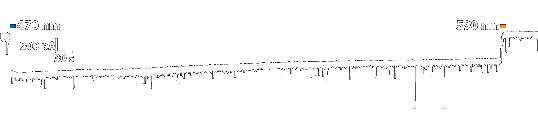
ChR2 variant harboring two amino acid substitutions which act to stabilize the conducting state of the channel to deactivate with a time constant of nearly 30 minutes following a brief pulse of activating blue light. Like previously published step function opsins, this stabilized step function opsin (SSFO) may be deactivated using yellow light (590nm). The stabilized open state of the channel allows for both lower power activation, meaning in some circumstances the light delivery system need not penetrate the brain, as well as for behavior in the absence of a tethered laser or other light delivery system.
| pAAV-CaMKIIa-hChR2 (C128S/D156A)-EYFP | [ Vector Map ] |
| pAAV-CaMKIIa-hChR2 (C128S/D156A)-mCherry | [ Vector Map ] |
| pAAV-hSyn-hChR2 (C128S/D156A)-EYFP | [ Vector Map ] |
| pAAV-hSyn-hChR2 (C128S/D156A)-mCherry | [ Vector Map ] |
| pAAV-Ef1a-DIO hChR2 (C128S/D156A)-EYFP | [ Vector Map ] |
| pAAV-Ef1a-DIO hChR2 (C128S/D156A)-mCherry | [ Vector Map ] |
Second-generation Ultrafast Optogenetic Control
| pAAV-CaMKIIa-hChR2(E123A)-eYFP | [ Vector Map ] |
| pAAV-CaMKIIa-hChR2(E123A)-mCherry | [ Vector Map ] |
| pAAV-CaMKIIa-hChR2 (E123T/T159C)-EYFP | [ Vector Map ] |
| pAAV-CaMKIIa-hChR2 (E123T/T159C)-mCherry | [ Vector Map ] |
| pAAV-CaMKIIa-hChR2 (T159C)-EYFP | [ Vector Map ] |
| pAAV-CaMKIIa-hChR2 (T159C)-mCherry | [ Vector Map ] |
| pAAV-Ef1a-DIO hChR2(E123A)-eYFP | [ Vector Map ] |
| pAAV- Ef1a-DIO hChR2(E123A)-mCherry | [ Vector Map ] |
| pAAV- Ef1a-DIO hChR2 (E123T/T159C)-EYFP | [ Vector Map ] |
| pAAV- Ef1a-DIO hChR2 (E123T/T159C)-mCherry | [ Vector Map ] |
| pAAV- Ef1a-DIO hChR2 (T159C)-EYFP | [ Vector Map ] |
| pAAV- Ef1a-DIO hChR2 (T159C)-mCherry | [ Vector Map ] |
| pAAV-hSyn-hChR2(E123A)-eYFP | [ Vector Map ] |
Transsynaptic Tracers: WGA-recombinases
Transsynaptic tracing viruses are available to assist in targeting neuronal subpopulations based on their syanptic connectivity to a downstream region. These may be used in conjunction with any of the recombinase-dependent class of targeting virus. Researchers need to determine the directionality and extent of spread of the WGA translocation in each experimental system.
| pAAV-EF1a-mCherry-IRES-WGA-Cre | [ Vector Map ] |
| pAAV-EF1a-DIO mCherry-IRES-WGA-Flpo | [ Vector Map ] |
| pAAV-EF1a-mCherry-IRES-WGA-Flpo | [ Vector Map ] |
Third-generation Optogenetic Inhibition: eNpHR 3.0
Engineered halorhodopsin construct for nanoamp-scale optical inhibition with chloride currents at low light powers (<5 mW/mm2) suitable for in vivo use. Reversible, step-like kinetic stability over many minutes suitable for physiology or behavior, responsive to far-red light, and well-tolerated due to enhanced membrane trafficking modifications.

| pAAV-Ef1a-DIO-eNpHR 3.0-EYFP | [ Vector Map ] |
| pAAV-Ef1a-DIO-eNpHR 3.0-mCherry | [ Vector Map ] |
| pAAV-CaMKIIa-eNpHR3.0-EYFP | [ Vector Map ] |
| pAAV-CaMKIIa-eNpHR3.0-mCherry | [ Vector Map ] |
| pAAV-hSyn-eNpHR3.0-EYFP | [ Vector Map ] |
| pAAV-hSyn-eNpHR3.0-mCherry | [ Vector Map ] |
| pAAV-hThy1-eNpHR 3.0-EYFP | [ Vector Map ] |
| pLenti-CaMKIIa-eNpHR 3.0-EYFP | [ Vector Map ] |
| pLenti-hSyn-eNpHR 3.0-EYFP | [ Vector Map ] |
Third-generation Optogenetic Inhibition: Arch 3.0 ArchT 3.0, and Mac 3.0
Optical inhibition with enhanced proton pumps, Arch from H. sodomense, ArchT from Halorubrum sp. TP009 and Mac from L. maculans modified for mammalian expression with ER export and Trafficking Signals resulting in 3-5 fold increase in originally reported currents and stable in vivo expression. [Technical Paper]
| pAAV-Ef1a-DIO eArch 3.0-EYFP | [ Vector Map ] |
| pAAV-CaMKIIa-eArch 3.0-EYFP | [ Vector Map ] |
| pAAV-CaMKIIa-eArchT 3.0-EYFP | [ Vector Map ] |
| pAAV-hSyn-eArch 3.0-EYFP | [ Vector Map ] |
| pAAV-hThy1-eArch 3.0-EYFP | [ Vector Map ] |
| pLenti-CaMKIIa-eArch 3.0-EYFP | [ Vector Map ] |
| pLenti-CaMKIIa-eArchT 3.0-EYFP | [ Vector Map ] |
| pLenti-CaMKIIa-eMac 3.0-EYFP | [ Vector Map ] |
Ultrafast Optogenetic Control: ChETA
Engineered channelrhodopsin-2 variant with faster deactivation kinetics, resulting in 1) high-fidelity light-driven spiking over sustained trains at least up to 200 Hz, 2) reduced multiplets and plateau potentials, 3) faster recovery from inactivation, and 4) improved temporal stationarity of performance in sustained trains.

| pLenti-CaMKIIa-hChR2(E123T-H134R)-EYFP | [ Vector Map ] |
| pAAV-Ef1a-DIO-ChETA-EYFP | [ Vector Map ] |
Optical Control of Intracellular Signaling: Opto-XRs
Chimeric fusions of bovine Rhodopsin and adrenergic G-Protein Coupled Receptors allowing optical control of GPCR signaling cascades. Proteins are activated by 500nm light.

| pcDNA3.1v5his-opto-a1AR-EYFP | [ Vector Map ] |
| pcDNA3.1v5his-opto-b2AR-EYFP | [ Vector Map ] |
| pAAV-CaMKIIa-Opto A1-EYFP | [ Vector Map ] |
| pAAV-CaMKIIa-Opto B2-EYFP | [ Vector Map ] |
| pAAV-CaMKIIa-Opto D1-EYFP | [ Vector Map ] |
| pAAV-EF1a-DIO Opto A1-EYFP | [ Vector Map ] |
| pAAV-EF1a-DIO Opto A1-mCherry | [ Vector Map ] |
| pAAV-EF1a-DIO Opto B2-EYFP | [ Vector Map ] |
| pAAV-EF1a-DIO Opto B2-mCherry | [ Vector Map ] |
| pAAV-EF1a-DIO Opto D1-EYFP | [ Vector Map ] |
| pAAV-EF1a-DIO Opto D1-mCherry | [ Vector Map ] |
| pAAV-hSyn Opto A1-EYFP | [ Vector Map ] |
| pAAV-hSyn Opto B2-EYFP | [ Vector Map ] |
| pAAV-hSyn Opto D1-EYFP | [ Vector Map ] |
Bi-stable excitation: Step Function Opsins (SFOs)
Three point-mutants of humanized ChR2 convert a brief pulse of light into a stable step in membrane potential. The lentiviral vectors were created by site-directed mutagenesis of the C128 position in ChR2. All three mutants are activated by blue (470nm) light. Photocurrents generated by ChR2(C128A) and ChR2(C128S) can be effectively terminated by a pulse of green (542nm) light.

| pLenti-CaMKIIa-hChR2 (C128A)-EYFP-WPRE | [ Vector Map ] |
| pLenti-CaMKIIa-hChR2 (C128S)-EYFP-WPRE | [ Vector Map ] |
| pLenti-CaMKIIa-hChR2 (C128T)-EYFP-WPRE | [ Vector Map ] |
Cre-inducible Adeno-associated Virus: DIO-AAV
For cell type-specific targeting and to capitalize on the large number of Cre driver lines with the flexible virus injection/fiberoptic approach, we have developed a tool we call DIO-AAV (doublefloxed inverse orf) AAV.

| pAAV-Ef1a-DIO hChR2(H134R)-eYFP-WPRE | [ Vector Map ] |
| pAAV-Ef1a-DIO hChR2(H134R)-mCherry-WPRE | [ Vector Map ] |
| pAAV-Ef1a-DIO eNpHR 2.0-eYFP-WPRE | [ Vector Map ] |
Optical Excitation: Channelrhodopsin-2 (ChR2)
There are two versions of the ChR2 sequence, one containing the wildtype sequence and another containing condons optimized for mammalian expression (hChR2). In-frame fusions to mCherry or EYFP are available to make visualization of ChR2-expressing cells easier. ChR2 and XFP are fused via a NotI site. The linker is GCGGCCGCC.
ChR2-XFPs are available either in a standard mammalian expression vector containing the CMV promoter or in lentiviral expression vectors under the control of the ubiquitous EF-1a or the neuron-specific CaMKIIa or human Synapsin I promoters. The structure of the lentivirus is shown below.

| pcDNA3.1/hChR2-mCherry | [ Vector Map ] |
| pcDNA3.1/hChR2-EYFP | [ Vector Map ] |
| pcDNA3.1/hChR2(H134R)-EYFP | [ Vector Map ] |
| pAAV-CaMKIIa-hChR2(H134R)-EYFP | [ Vector Map ] |
| pAAV-CaMKIIa-hChR2(H134R)-mCherry | [ Vector Map ] |
| pAAV-hSyn-hChR2(H134R)-EYFP | [ Vector Map ] |
| pAAV-hSyn-hChR2(H134R)-mCherry | [ Vector Map ] |
| pAAV-mThy1-hChR2(H134R)-eYFP-WPRE | [ Vector Map ] |
| pAAV-hThy1-hChR2(H134R)-eYFP-WPRE | [ Vector Map ] |
| pAAV-GFAP-hChR2(H134R)-EYFP | [ Vector Map ] |
| pAAV-GFAP-hChR2(H134R)-mCherry | [ Vector Map ] |
| pAAV-EF1a-hChR2(H134R)-EYFP | [ Vector Map ] |
| pLenti-EF1a-hChR2-EYFP-WPRE (a.k.a. pLECYT) | [ Vector Map ] |
| pLenti-EF1a-hChR2(H134R)-EYFP-WPRE (a.k.a. pLECYT) | [ Vector Map ] |
| pLenti-CaMKIIa-hChR2-mCherry-WPRE | [ Vector Map ] |
| pLenti-CaMKIIa-hChR2-EYFP-WPRE | [ Vector Map ] |
| pLenti-Hcrt-hChR2(H134R)-EYFP | [ Vector Map ] |
| pLenti-Synapsin-hChR2(H134R)-EYFP-WPRE | [ Vector Map ] |
| pLenti-Synapsin-hChR2(H134R)-mCherry-WPRE | [ Vector Map ] |
| pLenti-mThy1-hChR2(H134R)-eYFP | [ Vector Map ] |
| pLenti-hThy1-hChR2(H134R)-eYFP | [ Vector Map ] |
Optical Inhibition: Halorhodopsin (NpHR)
The NpHR sequence here has been optimized for mammalian expression. The NpHR-EYFP inframe fusion genes are made via a NotI site with the linker GCGGCCGCC. The start codon on EYFP has been deliberately removed. To reduce membrane blebbing or other toxicity at high levels of expression, we have generated a modified eNpHR by adding signaling peptides to enhance membrane translocation and ER export.
Currently, the only versions of halorhodopsin that are available for shipping are eNpHR3.0 (above) and eNpHR2.0 (pLenti-CaMKII-eNpHR-EYFP). eNpHR2.0 may be superior in some cell types, including photoreceptors (Busskamp et al., Science 2010).

| pLenti-CaMKIIa-eNpHR2.0-EYFP-WPRE | [ Vector Map ] |
| pAAV-mThy1-eNpHR 2.0-eYFP-WPRE | [ Vector Map ] |
| pAAV-hThy1-eNpHR 2.0-eYFP-WPRE | [ Vector Map ] |
| pLenti-hSyn-eNpHR 2.0-WPRE | [ Vector Map ] |
| pLenti-hThy1-eNpHR 2.0-eYFP | [ Vector Map ] |
Optical Excitation: Volvox Channelrhodopsin-1 (VChR1)
The VChR1 sequence here has been optimized for mammalian expression. The VChR1-EYFP inframe fusion genes are made via a NotI site with the linker GCGGCCGCC. The start codon on EYFP has been deliberately removed. VChR1-EYFP are also available in a standard mammalian expression vector and lentivirus vectors.

| pcDNA3.1/VChR1-EYFP | [ Vector Map ] |
| pcDNA3.1/VChR1-mCherry | [ Vector Map ] |
| pLenti-CaMKIIa-VChR1-EYFP-WPRE | [ Vector Map ] |
| pLenti-CaMKIIa-VChR1-mCherry-WPRE | [ Vector Map ] |
Control Fluorophores
| pAAV-CaMKIIa-mScarlet-WPRE | [ Vector Map ] |
| pAAV-Ef1a-DIO mScarlet | [ Vector Map ] |
| pAAV-hSyn-mScarlet | [ Vector Map ] |
| pAAV-CamKII-EYFP-WPRE | [ Vector Map ] |
| pAAV-CamKII-mcherry-WPRE | [ Vector Map ] |
| pAAV-EF1a-DIO EYFP-WPRE | [ Vector Map ] |
| pAAV-EF1a-double floxed mCherry-WPRE | [ Vector Map ] |
| pAAV-hSyn-EYFP-WPRE | [ Vector Map ] |
| pAAV-hSyn-mCherry-WPRE | [ Vector Map ] |