Mechanics of groove formation in the Drosophila dorsal embryonic ectoderm
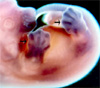
During embryogenesis, the Drosophila embryonic ectoderm folds to form segmental grooves, each of which extends from near the dorsal limit of the ectoderm to the ventrolateral side of the embryo. Grooves are one cell wide, except at their most lateral portion (the “pit”), where they are several cells wide. The grooves form at the segmental boundaries, where specific cells are specified to have the groove cell fate. We have described specification of the groove cell identity (Vincent et al., 2008), and it will not be discussed in detail here. The grooves are transient structures that form concomitantly with other morphogenetic processes. We would like to understand the forces that contribute to the stereotypical process of groove formation.

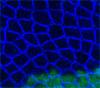
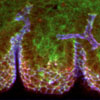
Segmental grooves begin to form during embryonic stage 12, first deepening at their dorsal and ventral extremities, and then extending toward the lateral domain where the deepening portions merge. Initiation of groove formation begins with the anterior grooves and proceeds posteriorly, with grooves forming in a temporally sequential and overlapping manner. Grooves are at their maximum depth at stage 13, after which they begin to flatten and disappear. Groove formation is accompanied by a stereotypical cell shape change as monitored by labeling of the adherens junctions.

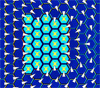
We are working with an international multidisciplinary team to investigate the mechanical forces and genetic contributions to groove formation. We using genetic analyses to assess intrinsic and extrinsic forces to groove formation. We are using microscopy and computer vision technology to extract quantitative descriptions of the morphogenetic process, and we are using mechanical modeling and rendering to derive mechanical descriptions of the forces. By joining these methods, we expect to produce a detailed understanding of the morphogenetic forces that contribute to groove formation.

People:
This work is a collaboration with groups at Berkeley, Lyon, Delft, Padova

 research